


Precision machining plays an important role in modern manufacturing, where components often need to meet exact dimensional requirements while maintaining consistency from one part to the next. From custom tooling and production fixtures to brackets, plates, mounts, and fabricated assemblies, CNC milling provides manufacturers with the ability to create accurate components for a wide range of industrial applications.
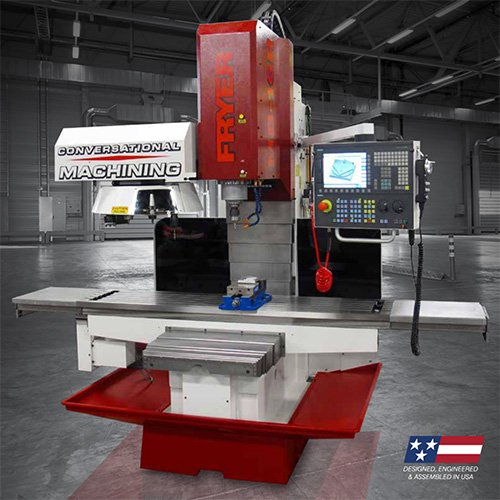
At Salco Engineering & Manufacturing, the Fryer MB-16R milling machine expands the company’s ability to perform precision machining in-house. Combining CNC control with the flexibility required for custom manufacturing, the MB-16R can support prototype work, custom components, tooling, fixtures, replacement parts, and repeat production requirements.
By combining machining capabilities with Salco’s broader manufacturing experience, customers can work with a supplier capable of taking a component from concept and fabrication through precision machining and final production.
What Is the Fryer MB-16R Milling Machine?
The Fryer MB-16R is a CNC toolroom mill designed to combine precision machining capabilities with the flexibility needed for a variety of manufacturing applications. Rather than limiting the machine to one narrow type of production work, it can be used for individual components, prototypes, tooling, fixtures, repairs, and repeatable production parts.
For a custom manufacturer, this versatility is particularly valuable. Customer projects can vary considerably in material, dimensions, geometry, quantity, and required machining operations.
A versatile CNC milling machine allows Salco to adapt to these different requirements while maintaining control over the machining process in-house.
Precision CNC Milling for Custom Components
One of the most important advantages of CNC milling is dimensional control. Industrial components frequently need machined surfaces, holes, slots, pockets, and other features to align correctly with surrounding parts or equipment.
Even relatively simple components can require precise machining. A mounting plate, for example, may need accurately positioned holes so it aligns with an existing machine. A fixture may require pockets and locating features that consistently position a part during production. A fabricated assembly may require machined surfaces to achieve proper alignment during final installation.
The Fryer MB-16R helps Salco provide precision CNC milling services for projects where dimensional accuracy, repeatability, and dependable machining are important.
Repeatability for Production Milling
Accuracy is important for an individual component, but repeatability becomes equally important when multiple parts must be produced to the same specifications.
CNC machining uses programmed tool paths to control the movement of the cutting tool and workpiece. Once the machining process has been developed, the same programmed operations can be repeated across additional parts.
This provides important advantages for manufacturers that require multiple components for assemblies, replacement parts, production equipment, or recurring orders.
Consistent CNC machining can help:
- Maintain dimensional consistency between parts
- Reduce variation across production quantities
- Improve fit during assembly
- Reduce the need for manual adjustments
- Support repeat orders for previously manufactured components
- Improve overall manufacturing consistency
Repeatability is particularly valuable when a machined component must interface with other parts, tooling, equipment, or automated systems.
Versatility for Different CNC Milling Operations
Custom components often require more than one machining operation. A single workpiece might need a combination of holes, slots, pockets, profiles, and finished surfaces before it is complete.
The Fryer MB-16R gives Salco the flexibility to perform a variety of machining operations depending on the geometry and requirements of the part.
Potential operations include:
- Face milling
- Contour milling
- Pocket milling
- Slotting
- Drilling
- Boring
- Counterboring
- Tapping
- Machining mounting holes
- Creating locating features
- Machining flat and finished surfaces
Combining multiple operations within an efficient machining process can reduce unnecessary handling and help maintain dimensional relationships between different features on the component.
CNC Milling for Steel Components
Steel is widely used throughout industrial manufacturing because of its strength, durability, and availability in many different forms and grades. However, machining steel requires appropriate equipment, tooling, programming, and process control.
CNC milling can be used to create precision features in steel plates, blocks, fabricated components, brackets, mounting structures, and other industrial parts.
Typical steel milling applications can include:
- Mounting plates
- Machine components
- Brackets and supports
- Tooling components
- Production fixtures
- Equipment bases
- Custom replacement parts
- Structural components requiring machined features
- Components for material handling equipment
Machining can also be incorporated into a larger fabrication process when a steel component requires both fabricated and precision-machined features.
Milling Stainless Steel, Aluminum, and Other Materials
Not every CNC milling project involves carbon steel. Different applications may require stainless steel, aluminum, or other machinable materials depending on the environment and performance requirements.
Stainless steel may be selected when corrosion resistance, durability, or cleanability is important. Aluminum can provide advantages when reduced weight and machinability are priorities.
Material selection affects tooling, cutting parameters, machining strategy, and other aspects of the process. Having in-house milling capabilities gives Salco greater flexibility to develop an appropriate manufacturing approach around the component and material being used.
Machining Larger Industrial Components
One advantage of the Fryer MB-16R is its ability to accommodate a range of workpiece sizes, making it useful for more than small precision components.
Industrial manufacturing frequently involves plates, brackets, fixtures, bases, supports, and other components that require machining but may not fit comfortably within smaller machining equipment.
This capability can be valuable for projects involving:
- Manufacturing equipment
- Automotive components
- Industrial material handling equipment
- Production fixtures
- Machine bases and mounting plates
- Custom fabricated assemblies
- Warehouse and production equipment
- Replacement machine components
The ability to machine larger components gives Salco greater flexibility when a project combines substantial fabricated structures with accurately located machined features.
CNC Milling for Tooling and Fixtures
Manufacturing tooling and fixtures are important applications for precision milling.
Fixtures may be used to locate parts during welding, assembly, inspection, machining, or other production processes. To function correctly, locating surfaces, mounting points, holes, and other features often need to be positioned accurately.
CNC milling can be used to create:
- Welding fixtures
- Assembly fixtures
- Inspection fixtures
- Machine fixtures
- Locating plates
- Mounting plates
- Jigs
- Tooling components
- Production aids
Because Salco works with custom industrial equipment and fabricated products, in-house machining capabilities can also support the creation of tooling required for other manufacturing processes.
Supporting Prototype and Product Development
Before a component enters production, manufacturers may need prototypes to evaluate dimensions, fit, function, manufacturability, or interaction with other parts.
CNC milling can be useful during this process because design changes can be incorporated into machining programs as the component evolves.
A prototype might reveal that a hole needs to move, a mounting surface requires additional clearance, or a pocket should be modified. Making these adjustments before larger production quantities are manufactured can help prevent costly changes later.
This makes milling an important capability not only for production manufacturing but also for engineering and product development.
Custom Replacement Parts and One-Off Components
Industrial facilities occasionally need replacement components that are difficult or impossible to purchase as standard parts. Equipment may be older, the original manufacturer may no longer support the machine, or the required component may have always been custom.
CNC milling can provide a practical method for producing certain replacement components when sufficient dimensional and material information is available.
Examples might include custom brackets, mounting plates, spacers, supports, tooling components, fixture parts, and machine components.
The ability to handle one-off and lower-volume work can be particularly valuable to industrial customers that need a specialized component without committing to a large production quantity.
Combining CNC Milling with Custom Fabrication
Many industrial components cannot be produced entirely through milling. A project might involve cutting, forming, welding, machining, and finishing before the final component is ready for use.
Having CNC milling available within a broader custom manufacturing operation creates opportunities to coordinate these processes.
For example, a steel assembly could be fabricated and welded before specific surfaces or mounting locations are machined. In another application, individual machined components could be produced before they are incorporated into a larger assembly.
Coordinating fabrication and machining can be especially useful for:
- Custom industrial equipment
- Material handling components
- Machine frames
- Production fixtures
- Equipment bases
- Custom brackets and mounts
- Welded assemblies requiring machined features
The manufacturing sequence can be developed according to the requirements of the finished component rather than treating machining and fabrication as completely separate processes.
Advanced CNC Control and Complex Tool Paths
CNC control is one of the features that separates modern milling from conventional manual machining.
A programmed machining process allows tool movements to be controlled according to the geometry of the component. This makes it possible to produce complex combinations of holes, pockets, slots, contours, and surfaces while maintaining consistent positioning.
CNC programming also allows machining parameters to be developed around the material, cutting tool, and operation being performed.
For repeat production, established programs can help provide consistent machining from one component to the next while reducing reliance on manually reproducing every operation.
From CAD Design to CNC Machining
Modern manufacturing increasingly relies on digital design and manufacturing workflows.
Three-dimensional CAD models and engineering drawings can define the dimensions, geometry, hole locations, tolerances, and other requirements of a component. This information can then be used when planning the machining process and developing CNC tool paths.
Connecting design and machining helps manufacturers evaluate how a part will be produced before material is cut.
Potential manufacturing issues can sometimes be identified during this stage, including difficult tool access, unnecessary complexity, or features that could be modified to simplify production.
For custom manufacturing projects, this connection between engineering and production can help turn a design concept into a practical finished component.
Improving Manufacturing Efficiency with In-House Milling
When a fabricated product requires machining, outsourcing that portion of the project introduces another supplier, transportation step, schedule, and quality-control process.
In-house CNC milling allows more of the manufacturing process to remain under Salco’s control.
Depending on the project, this can help:
- Reduce transportation between suppliers
- Simplify production scheduling
- Improve coordination between fabrication and machining
- Allow faster response to design changes
- Reduce delays between manufacturing operations
- Improve communication between engineering and production
- Maintain greater control over finished components
These benefits can be especially important for custom projects where machining is only one stage of a larger manufacturing process.
CNC Milling for Low-Volume and Repeat Production
Custom manufacturing does not always involve thousands of identical parts. Industrial customers may need a single component, several prototypes, a limited production run, or recurring quantities manufactured as needed.
The flexibility of CNC milling makes it suitable for these different production requirements.
For low-volume work, CNC machining can provide the accuracy required for custom parts without requiring tooling dedicated to extremely high-volume production. For repeat orders, established programs and manufacturing processes can support consistency when additional components are needed.
This flexibility makes CNC milling useful for manufacturers with changing production requirements and specialized applications.
Industries That Benefit from Precision CNC Milling
Precision milling is used across a broad range of industries because so many manufactured products depend on accurate metal components.
Potential applications include:
- Automotive and EV manufacturing
- Aerospace manufacturing
- Medical equipment manufacturing
- Industrial equipment
- Material handling systems
- Metal fabrication
- Automation equipment
- Food processing equipment
- Warehousing equipment
- Tooling and fixture manufacturing
- General industrial manufacturing
Although the components can differ significantly between industries, the fundamental requirements are often similar: accurate dimensions, consistent quality, dependable materials, and a manufacturing process capable of producing the required geometry.
The Value of Precision and Repeatability in Custom Manufacturing
A machined component is often only one part of a larger assembly. Dimensional errors can therefore create problems beyond the individual part.
Incorrect hole positions can prevent assembly. Improper surface dimensions can affect alignment. Inconsistent parts can require additional fitting or modification during production.
Precision CNC milling helps reduce these issues by producing features according to defined dimensions and programmed machining operations.
Repeatability is equally important when several components must function interchangeably. Consistent machining helps ensure replacement or repeat-production parts continue to fit within the intended assembly.
Fryer MB-16R Milling Capabilities at Salco Engineering & Manufacturing
The Fryer MB-16R strengthens Salco Engineering & Manufacturing’s ability to provide precision machining as part of its broader custom manufacturing capabilities.
Whether a customer needs a custom bracket, machined steel plate, tooling fixture, prototype component, replacement part, or a larger fabricated assembly requiring precision-machined features, in-house milling gives Salco additional control over how the project moves from design to finished product.
Combining CNC milling with engineering and fabrication experience also allows projects to be evaluated from a broader manufacturing perspective. Instead of considering only how a component will be machined, Salco can consider how it will be fabricated, assembled, used, and integrated into the customer’s application.
Request a Quote for Precision CNC Milling Services
If your project requires precision milling, custom machined components, steel milling, tooling, fixtures, prototypes, or fabricated assemblies with machined features, Salco Engineering & Manufacturing can help develop a manufacturing solution around your specifications.
Contact Salco Engineering & Manufacturing to discuss your project and request a quote for custom CNC milling services.