


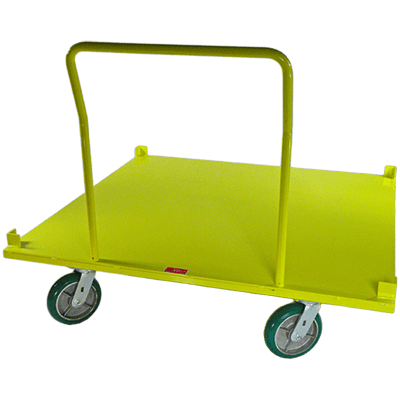
Efficient material movement is essential to productivity in manufacturing plants, warehouses, distribution centers, shipping departments, and other industrial facilities. Pallets, containers, heavy components, tooling, raw materials, and work-in-process inventory may need to move between multiple areas of a facility throughout every shift. Heavy duty pallet carts and pallet trolleys provide a durable and flexible way to keep these materials moving.
Unlike general-purpose warehouse carts, industrial pallet carts can be designed for substantial loads, frequent movement, and demanding operating conditions. Heavy-duty steel frames, properly selected casters, reinforced load-bearing areas, ergonomic handles, tow bars, brakes, and load-retention features can all be incorporated according to the application.
For facilities with specialized requirements, custom pallet carts offer another important advantage: the equipment can be designed around the load and workflow rather than requiring employees to adapt their processes to a standard cart.
What Are Heavy Duty Pallet Carts?
Heavy duty pallet carts are mobile material handling platforms designed to transport pallets, containers, industrial components, tooling, bulk materials, and other substantial loads within a facility. They can provide a practical solution for movements that do not necessarily require a forklift or other powered lifting equipment.
Depending on the application, a pallet cart may consist of a relatively simple welded frame and platform or a more specialized structure designed around a particular pallet, container, component, or production process.
Pallet carts can be manually pushed or pulled for shorter distances. Larger or heavier carts may also be designed for towing as part of a tugger or cart-train system.
The terms pallet cart, pallet trolley, pallet dolly, pallet transport cart, and industrial pallet cart can describe several variations of this basic concept. What matters most is that the equipment is appropriately designed for the load, facility, and material handling process.
Why Pallet Carts Are Important for Industrial Material Handling
Material handling connects nearly every stage of an industrial operation. A manufacturing process may be highly efficient at individual workstations but still experience delays if materials cannot move efficiently between those stations.
Warehouses face similar challenges. Products must travel between receiving docks, storage locations, picking areas, packing stations, staging zones, and shipping docks. Inefficient movement between these areas can create congestion, increase forklift traffic, and require employees to handle the same materials multiple times.
Heavy duty pallet carts can provide a consistent method for moving materials between these locations.
Common uses include:
- Transporting palletized products between departments
- Moving heavy components and industrial parts
- Delivering raw materials to production areas
- Staging inventory near manufacturing lines
- Transporting work-in-process materials between operations
- Moving tooling, fixtures, dies, and maintenance equipment
- Supporting warehouse replenishment
- Moving containers, totes, bins, and bulk materials
- Staging incoming or outgoing shipments
- Reducing short-distance forklift movements
By designing the cart around these tasks, manufacturers and warehouse operators can create a material handling solution that fits more naturally into existing workflows.
Heavy Duty Pallet Carts vs. Standard Warehouse Carts
General-purpose warehouse carts can work well for boxes, tools, supplies, and lighter materials. However, equipment designed for occasional light-duty use may not be appropriate for large pallets, dense metal components, tooling, or other heavy industrial loads.
Heavy duty pallet carts are designed with structural strength and repeated industrial use in mind.
This may include heavier steel tubing, reinforced frames, additional cross members, welded construction, larger caster mounting areas, and high-capacity wheels. The complete structure should be evaluated as a system so the frame, platform, casters, axles, handles, and other components are suitable for the anticipated load.
Important considerations include:
- Maximum load weight
- Dimensions of the pallet or product
- Distribution of weight across the platform
- Frequency of loading and unloading
- Distance traveled during each movement
- Condition of warehouse or factory floors
- Aisle width and turning requirements
- Manual or powered movement
- Braking requirements
- Potential impacts and other demanding operating conditions
A custom design can address these factors before the equipment enters service.
Custom Pallet Carts Designed Around the Application
One of the primary advantages of custom industrial equipment is the ability to design around actual operating requirements.
A warehouse handling standard palletized inventory may need a relatively straightforward platform cart. A manufacturing plant moving large metal components may require a reinforced frame with dedicated supports. Another operation may need a cart that interfaces with production equipment or carries a proprietary container.
Salco’s custom pallet trolleys can be developed around factors such as load size, capacity, facility layout, travel requirements, caster configuration, and how materials are loaded and unloaded.
Rather than accepting compromises associated with a standard design, the dimensions and features of the cart can be selected to support the actual material handling process.
Heavy Duty Pallet Carts for Manufacturing
Manufacturing facilities can use pallet carts throughout the production process. Raw materials arrive at receiving, parts move through fabrication or machining, components travel to assembly and inspection, and finished products eventually move toward packaging and shipping.
Providing a consistent way to transport materials between these processes can help maintain production flow.
Line-Side Material Delivery
Production lines depend on having the correct materials available when they are needed. Pallet carts can be loaded with parts or components and positioned near workstations, assembly lines, or manufacturing cells.
A cart can also be designed around the appropriate quantity of material for a particular process. This can help facilities avoid placing unnecessarily large quantities of inventory around production areas while keeping operators supplied with the components they need.
Work-in-Process Material Movement
Many products pass through several departments before they are complete. Parts might travel from machining to washing, fabrication to welding, welding to finishing, or assembly to inspection.
Keeping these components on a dedicated pallet trolley can reduce unnecessary transfers between containers or temporary storage locations.
The same cart may be able to accompany a batch of components through multiple production stages, depending on the process. This can simplify handling and help keep related parts organized.
Heavy Component Transport
Industrial components can be difficult to handle because of their weight, dimensions, or shape. Custom pallet carts can incorporate support structures that correspond to the geometry of the parts.
Rails, stops, cradles, dividers, locating features, or other structures can help prevent movement and maintain organization during transport.
These designs can be particularly useful in automotive, aerospace, metal fabrication, machinery, and industrial component manufacturing.
Tooling and Fixture Movement
Tooling, dies, fixtures, jigs, and maintenance equipment can represent substantial investments and may also be extremely heavy.
A heavy duty pallet trolley can provide a dedicated method for transporting these items between storage locations and production equipment. The cart can be designed around the dimensions of the tooling and include retaining or locating features where necessary.
Pallet Carts for Warehousing and Distribution
Warehouses and distribution centers have different material handling requirements than manufacturing plants, but they face many of the same challenges. Materials must move quickly without creating excessive congestion or unnecessary handling.
Heavy duty pallet carts can support receiving, inventory movement, replenishment, staging, fulfillment, and shipping.
Receiving and Inbound Material Movement
Receiving docks can become bottlenecks when incoming products accumulate faster than employees can move them into storage or processing areas.
Pallet carts can help move loads away from receiving areas and toward inspection, staging, storage, or production. Dedicated carts can also be assigned to specific departments or material routes to create a more predictable inbound workflow.
Warehouse Staging
Not every pallet moves directly from storage to a truck. Materials frequently need to be staged for inspection, order consolidation, production, packaging, or shipment.
Placing materials on mobile pallet carts can make staging areas more flexible. Loads can be repositioned as priorities change without repeatedly moving pallets from the floor with a pallet jack or forklift.
Inventory Replenishment
Picking and packing areas need regular replenishment from bulk storage locations. Pallet carts can transport inventory from reserve storage to forward picking areas while allowing the cart dimensions to be matched to the available aisle space.
For repeatable replenishment routes, facilities may also consider towable carts that allow multiple loads to move together.
Order Fulfillment and Shipping
Larger orders and bulk products may be consolidated on pallet carts before packaging or shipment. The carts can then move completed orders toward staging or shipping areas.
Mobile staging can be particularly useful when shipping priorities change throughout the day because employees can reposition complete loads without breaking them down.
Reducing Forklift Dependence for Short-Distance Transport
Forklifts remain essential in manufacturing and warehousing. They are particularly valuable for lifting pallets, accessing storage racks, loading trucks, and transporting very heavy loads.
However, not every movement requires a forklift.
Using pallet carts for appropriate short-distance movements can help reserve forklifts for applications where their lifting capabilities are necessary. This may also reduce vehicle traffic around workstations, production lines, and other areas where employees regularly work on foot.
The appropriate solution depends on load weight and travel distance. Some carts can be moved manually, while heavier loads may require towable designs or other powered assistance.
Key Design Features of Heavy Duty Pallet Carts
A pallet cart should be designed as a complete material handling system rather than simply a steel platform with wheels. Several design elements can significantly affect performance.
Heavy-Duty Steel Construction
Steel provides the strength, durability, and fabrication flexibility needed for demanding industrial applications.
Frames can be fabricated from tubing, structural shapes, plate, or combinations of materials depending on the application. Cross members and reinforcement can be added in high-load areas to help distribute weight throughout the structure.
Welded construction can also create a rigid frame capable of withstanding repeated loading, movement, and industrial use.
Load Capacity and Weight Distribution
Maximum load capacity is an important starting point, but total weight alone does not determine cart design.
A 2,000-pound load distributed evenly across a platform creates different structural demands than the same amount of weight concentrated in a small area. The location of the center of gravity can also affect cart stability and maneuverability.
Understanding what the cart will carry allows structural support to be positioned where it is actually needed.
Platform Dimensions and Configuration
Pallet carts can be designed for standard pallets or completely custom loads.
Depending on the application, the platform might be:
- A flat steel deck
- An open welded frame
- A recessed pallet platform
- A frame with raised perimeter edges
- A platform with rails or guides
- A part-specific support structure
The correct configuration depends on how the material will be loaded, transported, and unloaded.
Industrial Casters and Wheels
Caster selection has a major impact on how a pallet cart performs.
Wheel diameter, wheel material, caster capacity, bearing type, floor conditions, debris, thresholds, travel distance, and load weight should all be considered. Larger-diameter wheels can make certain heavy loads easier to move, while different wheel materials may be appropriate for particular floor surfaces or environmental conditions.
Caster arrangement is equally important. Four swivel casters can provide excellent maneuverability in confined areas, while combinations of rigid and swivel casters may provide more predictable tracking over longer distances.
Brakes and directional locks can also be incorporated when needed.
Push Handles and Pull Handles
Handle placement should provide adequate control without interfering with the load. Height, width, orientation, and available clearance should all be considered.
For manually moved equipment, ergonomics become particularly important because even relatively small improvements in pushing position or maneuverability are repeated every time the cart is used.
Tow Bars and Hitch Systems
Towable pallet carts can be useful for moving heavier loads or multiple carts along established routes.
Manufacturing plants and larger warehouses may use tugger systems to deliver materials on predictable schedules. Custom tow bars and hitch configurations can be incorporated when carts need to operate as part of these systems.
Brakes and Locking Systems
Carts frequently need to remain stationary while employees load, unload, inspect, assemble, or otherwise work with materials.
Caster brakes, floor locks, or other locking mechanisms can provide additional stability. The appropriate solution depends on the cart design, load, floor conditions, and operating process.
Load Retention and Product Protection
Moving a pallet or container safely involves more than simply supporting its weight. Loads may shift as carts accelerate, stop, turn, or travel over uneven surfaces.
Custom pallet carts can incorporate features that help control the load, including:
- Raised edges
- Side rails
- Corner posts
- Stops and guides
- Removable retaining bars
- Part-specific fixtures
- Cradles and supports
- Protective contact surfaces
These features can be especially important when handling precision components, finished products, expensive tooling, or loads with unusual shapes.
Ergonomics and Operator Safety
A cart can have adequate structural capacity while still being difficult to operate. Total loaded weight, wheel resistance, handle placement, turning radius, floor condition, and travel distance all affect the force required to move a cart.
Ergonomic considerations should therefore be incorporated into the initial design.
For loads that can reasonably be moved manually, appropriate handle placement and caster selection can help improve control. Extremely heavy loads or carts traveling longer distances may be better suited to towing or powered movement.
The objective is not simply to build a cart capable of supporting the load, but to create equipment appropriate for how employees will actually use it.
Heavy Duty Pallet Carts and Lean Material Flow
Lean manufacturing and warehouse improvement initiatives often focus on eliminating unnecessary transportation, waiting, handling, and excess inventory.
Custom pallet carts can support these goals by establishing predictable methods for moving materials between locations.
A cart can be sized around an appropriate production quantity rather than whatever happens to fit on a generic platform. Dedicated carts can travel between specific departments, and standardized cart designs can help employees immediately understand where materials belong.
This can contribute to:
- More consistent material routes
- Reduced unnecessary handling
- Better organization of work-in-process inventory
- Less material stored directly on floors
- Faster movement between operations
- More predictable line-side replenishment
- Improved use of production and warehouse space
In high-volume facilities, relatively small improvements in each material movement can add up to meaningful operational gains.
Steel vs. Stainless Steel Pallet Carts
Carbon steel is a practical choice for many general manufacturing, warehouse, automotive, logistics, and fabrication applications. It provides strength and can be finished according to the operating environment.
Stainless steel may be preferable when corrosion resistance, frequent cleaning, moisture exposure, sanitation, or other environmental conditions are important.
Applications in food processing, medical manufacturing, pharmaceutical production, washdown areas, and certain industrial environments may benefit from stainless steel construction.
The correct material should be selected according to the actual operating conditions rather than applying the same construction to every application.
Industries That Use Heavy Duty Pallet Carts and Trolleys
Heavy duty pallet carts are used throughout industrial operations where substantial materials must move safely and efficiently.
Common applications can be found in:
- Automotive and EV manufacturing
- Aerospace manufacturing
- Warehousing and distribution
- Metal fabrication
- Machining operations
- Food processing
- Industrial equipment manufacturing
- Logistics and transportation
- Packaging operations
- Maintenance departments
- Assembly operations
- Shipping and receiving facilities
Each environment presents different challenges, which is one reason custom cart design can provide advantages over standardized material handling equipment.
Choosing the Right Pallet Cart or Pallet Trolley
Before specifying a pallet cart, it is important to understand exactly how it will be used.
Facilities should consider questions such as:
- What products, components, pallets, or containers will the cart carry?
- What is the maximum anticipated load?
- Is the load evenly distributed or concentrated in particular areas?
- What dimensions must the cart accommodate?
- How will materials be loaded and unloaded?
- Will employees push or pull the cart manually?
- Will the cart need to be towed?
- How far will it typically travel?
- What aisle widths and turning restrictions exist?
- What floor surfaces will the cart encounter?
- Does the load require rails, guides, stops, or custom supports?
- Does the cart need brakes or locking features?
- Are corrosion resistance or cleaning requirements important?
- Does the cart need to interface with existing equipment?
Answering these questions early in the design process helps determine the appropriate frame, dimensions, material, caster configuration, load-retention features, and overall cart design.
Custom Heavy Duty Pallet Carts from Salco Engineering & Manufacturing
The right pallet cart can do more than move a heavy load. It can help improve material flow, reduce unnecessary handling, organize work-in-process inventory, support warehouse staging, and provide a consistent method for transporting materials throughout a facility.
Salco Engineering & Manufacturing designs and fabricates custom pallet carts and pallet trolleys for manufacturing plants, warehouses, distribution centers, automotive facilities, logistics operations, food production environments, and other industrial applications.
From straightforward pallet transport platforms to specialized trolleys designed around unique components, containers, tooling, or production processes, carts can be developed according to the customer’s load and workflow requirements.
Request a Quote for Heavy Duty Pallet Carts and Trolleys
If standard material handling equipment does not provide the capacity, dimensions, durability, or functionality your operation requires, a custom pallet cart may provide a better long-term solution.
Salco can work with your team to develop heavy duty pallet carts and pallet trolleys around your load requirements, facility layout, material movement process, and operating environment.
Contact Salco Engineering & Manufacturing to discuss your application and request a quote for custom pallet carts and trolleys designed for demanding industrial use.