


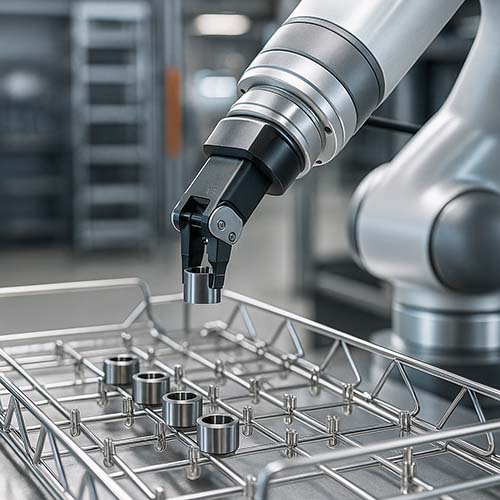
As manufacturers continue to adopt smarter, faster, and more automated production systems, robotics integration has become an important part of modern material handling. Robotic arms, CNC machines, automated wash lines, conveyors, inspection systems, and production cells can all help improve speed, consistency, and throughput. However, automation is only as effective as the equipment used to hold, position, and present parts during each step of the process.
Custom wire fixtures play a critical role in automated manufacturing environments. These fixtures help keep parts properly oriented, separated, supported, and accessible so robotic systems can perform repeatable tasks with accuracy. Whether a robot is loading a CNC machine, transferring components into a wash line, moving parts through an inspection system, or staging products for assembly, the fixture must support consistent part placement from cycle to cycle.
In manual operations, employees can adjust parts as needed. They can rotate a component, separate tangled items, or reposition a part before the next step. Automated systems require more predictable handling. If parts are misaligned, unstable, or difficult to access, a robot may miss a pick, damage a part, interrupt a cycle, or require operator intervention. Custom wire fixtures help eliminate these problems by creating a controlled, repeatable material handling solution designed around the part and process.
The Role of Custom Wire Fixtures in Modern Manufacturing
Custom wire fixtures are used to hold, organize, position, support, and transport components during manufacturing. In automated environments, they act as the connection point between the part, the robot, and the production equipment. A fixture may be used to present parts to a robotic gripper, hold components during washing, separate parts for inspection, or keep materials secure as they move through a production cell.
Wire fixtures are especially useful because they can be designed with open construction, precise spacing, formed supports, and lightweight strength. Compared to solid containers or generic bins, wire fixtures can provide better visibility, improved airflow, drainage, cleaning access, and easier part identification.
Custom wire fixtures may be used for:
- Robotic part loading and unloading
- CNC machine tending
- Automated wash lines
- Parts cleaning and drying systems
- Robotic pick-and-place applications
- Automated inspection and vision systems
- Assembly line staging
- Conveyor-based production cells
- Work-in-process handling
- Part separation and organization
When these fixtures are designed correctly, they help automated systems operate more smoothly and reduce the need for manual correction.
Why Robotics Integration Requires Customization
No two automation systems are exactly the same. Each facility has different parts, grippers, robots, cycle times, load requirements, cleaning processes, conveyor layouts, and production goals. Because of this, standard baskets, bins, or trays may not provide the precision needed for reliable robotic handling.
Custom wire fixtures are designed around the specific application. The fixture can be built to match the part geometry, robot reach, pick points, equipment clearance, load capacity, and movement pattern. This makes it easier for the robot to access each part in the same way every time.
Important design factors may include:
- Part size, shape, and weight
- Part orientation requirements
- Robot gripper access
- Vision system visibility
- Fixture loading and unloading method
- Cycle time requirements
- Spacing between parts
- Drainage and airflow needs
- Cleaning or washdown exposure
- Compatibility with carts, conveyors, racks, or machines
By accounting for these details early in the design process, manufacturers can reduce automation problems and improve overall system reliability.
Custom Wire Fixtures for Robotic CNC Loading
CNC machine tending is one of the most common uses for industrial robotics. Robots may load raw parts into a CNC machine, unload finished parts, transfer components to inspection, or move parts into washing or deburring operations. For this process to work efficiently, parts must be presented in a repeatable position.
Custom wire fixtures can be designed to hold components in specific locations so robotic arms can pick them accurately. Formed wire supports, dividers, pockets, and part stops can help prevent parts from rolling, shifting, nesting, or rotating out of position.
For finished machined parts, custom fixtures can also help protect important surfaces. Machined components may have critical tolerances, threaded features, smooth finishes, or sharp edges that must be protected during handling. A custom wire fixture can keep parts separated and stable as they move from CNC machining to cleaning, inspection, or assembly.
Wire Fixtures for Automated Wash Lines
Automated wash lines require fixtures that support both cleaning performance and material handling efficiency. Parts must be held securely while still allowing cleaning solution, spray, water, air, or ultrasonic energy to reach the surfaces that need to be cleaned.
Wire construction is often a good choice for wash line fixtures because the open design allows fluids to flow through the basket or rack. This can help improve drainage, reduce trapped debris, and support more consistent drying after the cleaning cycle.
Custom wire fixtures for wash lines may include:
- Open wire spacing for fluid access
- Dividers to separate parts during washing
- Handles or lift points for easier loading
- Stacking features for storage or staging
- Reinforced frames for repeated wash cycles
- Stainless steel construction for corrosion resistance
- Part-specific supports for improved cleaning exposure
In automated wash environments, the fixture must also fit the washer, conveyor, or robotic transfer system. Proper sizing and clearance are essential for preventing jams, inefficient cleaning, or handling delays.
Supporting Automated Production Cells
Automated production cells often combine several processes into one connected workflow. A production cell may include robotic loading, machining, washing, drying, inspection, assembly, and packaging. In these environments, custom wire fixtures help standardize how parts move from one stage to the next.
A well-designed fixture allows parts to stay organized throughout the cell, reducing unnecessary transfers and operator handling. This can improve uptime, reduce variation, and help keep the production process more predictable.
For automated production cells, custom wire fixtures may need to work with:
- Robotic arms
- Grippers and end-of-arm tooling
- Conveyors
- Turntables
- Lift systems
- CNC machines
- Washers and dryers
- Vision inspection systems
- Storage racks or staging carts
When all of these systems rely on consistent part presentation, the fixture becomes a key part of the automation strategy.
Improving Repeatability and Pick Accuracy
Repeatability is one of the main reasons manufacturers invest in automation. Robots are designed to perform the same motion repeatedly, but they depend on parts being in the correct position. If a part moves or rotates inside a container, the robot may not be able to pick it properly.
Custom wire fixtures can improve pick accuracy by holding each component in a defined location. The fixture can be designed with specific contact points, formed supports, or spacing that keeps each part accessible to the robotic gripper. This reduces the chance of mis-picks, dropped parts, cycle interruptions, and manual intervention.
Repeatable positioning can also support quality control. When parts are presented consistently, cameras, sensors, and inspection systems can evaluate them more reliably. This can be especially valuable in high-volume production environments where small errors can create significant downtime.
Reducing Part Damage in Automated Handling
Automation can improve speed and consistency, but parts still need to be protected during movement. If components collide, shift, or rub against each other, they can become scratched, dented, bent, or contaminated. This is especially important for machined parts, finished surfaces, coated components, precision assemblies, and high-value products.
Custom wire fixtures can reduce part damage by separating components and controlling how they are supported. Instead of loosely stacking items in a bin, the fixture can hold each part in a stable position. This improves organization and reduces unnecessary contact during transport, washing, loading, or unloading.
Part protection features may include:
- Individual compartments
- Wire dividers
- Formed part nests
- Retaining features
- Rounded contact points
- Custom spacing
- Protective coating or finish options when needed
These design details can help reduce scrap, rework, and product handling issues.
Material Selection for Custom Wire Fixtures
The right material depends on the application and environment. Stainless steel is often selected for wash lines, clean manufacturing, food processing, medical applications, and environments where corrosion resistance is important. Carbon steel may be suitable for general industrial use, especially when paired with a powder-coated or plated finish.
Material and finish decisions should consider:
- Moisture exposure
- Cleaning chemicals
- Temperature conditions
- Load requirements
- Part sensitivity
- Wear and abrasion
- Sanitation needs
- Expected service life
Choosing the right material helps ensure the fixture can handle daily production demands while supporting the requirements of the automated system.
Industries That Use Custom Wire Fixtures for Robotics
Custom wire fixtures are used across many industries where automation, precision, and repeatability matter. They are especially valuable in environments that handle large volumes of parts or require controlled movement between production stages.
Common industries include:
- Automotive manufacturing
- EV component manufacturing
- Aerospace production
- Medical device manufacturing
- Food processing equipment production
- Electronics manufacturing
- Precision machining
- Industrial parts washing
- Metal fabrication
- Automated assembly operations
Each industry has different requirements for part protection, cleanliness, strength, corrosion resistance, and handling precision. Custom design allows the fixture to fit those requirements more closely than a standard basket or tray.
Custom Wire Fixtures and Robotic Material Handling Baskets
Many robotic fixture applications overlap with automated basket design. Fixtures, baskets, trays, and racks can all be used to present parts to robotic systems, support wash lines, and keep production cells organized. For a deeper look at how these products support CNC loading, wash lines, and automated production environments, Salco’s article on robotic material handling baskets explains how custom basket designs can improve part flow in automated systems.
Whether the application requires a fixture, basket, rack, or hybrid design, the goal is the same: keep parts secure, visible, accessible, and consistently positioned throughout the manufacturing process.
Partner with Salco for Custom Wire Fixtures
As manufacturers continue to invest in robotics and automation, custom wire fixtures will remain an important part of efficient material handling. The right fixture can improve robotic pick accuracy, reduce part damage, support cleaner wash processes, and help automated production cells run more consistently.
Salco Engineering & Manufacturing designs and manufactures custom wire fixtures, baskets, racks, carts, and material handling solutions for demanding industrial applications. From CNC loading and robotic pick-and-place to wash line baskets and automated production cell fixtures, our team can develop solutions around your parts, equipment, workflow, and performance requirements.
To discuss custom wire fixtures for robotics integration or automated material handling, contact Salco Engineering today.