

Efficient material movement is an important part of nearly every manufacturing, warehousing, and distribution operation. Parts, components, tooling, raw materials, work-in-process inventory, and finished products often need to move between storage areas, production cells, assembly stations, inspection areas, and shipping departments throughout the day. When standard material handling equipment does not fit the application, custom steel pallet trolleys can provide a durable and efficient solution.
Unlike generic platform carts or standard pallet-moving equipment, custom pallet trolleys can be engineered around the size, weight, shape, and handling requirements of a specific load. They can also be designed around the facility itself, taking aisle widths, floor conditions, workstations, production processes, and existing material handling systems into consideration.
For industrial facilities looking to improve workflow, reduce unnecessary handling, and create a more organized material movement process, custom steel pallet trolleys can become an integral part of daily operations.
What Are Industrial Pallet Trolleys?
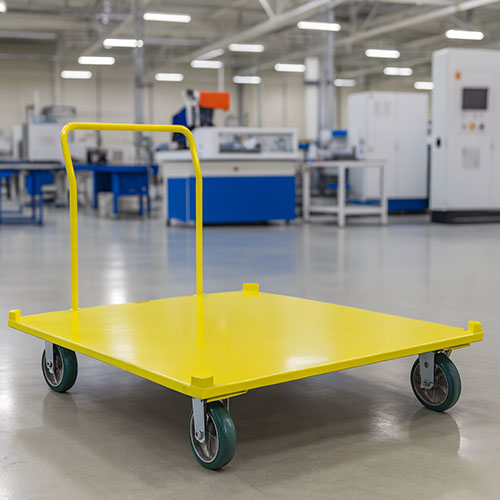
Industrial pallet trolleys are mobile platforms or frames designed to support and transport palletized materials, containers, components, baskets, or other industrial loads. Depending on the application, a trolley may use a solid platform, open steel frame, perimeter supports, guide rails, or a custom structure specifically designed to hold a particular pallet or container.
Unlike forklifts and powered material handling equipment, pallet trolleys can provide a relatively simple way to move materials short distances within a facility. They may be moved manually, incorporated into a tugger system, or designed to work as part of a larger material handling process.
This makes pallet trolleys particularly useful for moving work-in-process inventory between operations, delivering parts to production areas, staging components for assembly, or transporting finished products to inspection and shipping areas.
Why Use Custom Steel Pallet Trolleys?
Standard carts work well for many applications, but industrial facilities frequently have material handling requirements that cannot be addressed effectively with an off-the-shelf product. Loads may be unusually heavy, oversized, difficult to secure, or sensitive to movement. A standard cart may also have the wrong dimensions, deck height, caster configuration, or handle placement for the facility.
Custom fabrication allows the trolley to be designed around the actual application rather than requiring employees to adapt their workflow around a generic cart.
Built Around the Load
One of the primary advantages of a custom pallet trolley is the ability to design the structure around the material being transported.
A trolley may need to accommodate a standard pallet footprint, custom container, large fabricated component, stack of baskets, tooling fixture, automotive component, or other specialized load. The frame dimensions and support structure can be designed to provide proper weight distribution while keeping the load stable during movement.
Stops, guides, rails, retaining features, or other components can also be incorporated when additional load control is necessary.
Designed for Heavy Industrial Use
Manufacturing equipment is often subjected to considerably more demanding conditions than general-purpose commercial carts. High load weights, frequent movement, uneven floors, impacts, vibration, and repeated loading and unloading can quickly expose weaknesses in equipment that was not designed for industrial use.
Steel construction provides the strength and rigidity needed for demanding applications. Welded frames can be reinforced in high-stress areas, while material thickness and structural design can be selected according to the anticipated load.
Salco’s heavy duty pallet carts can be designed for specific industrial applications rather than relying on a one-size-fits-all configuration.
Improved Material Handling Efficiency
The right trolley can eliminate unnecessary steps in the material handling process. Instead of transferring materials between several different carts, pallets, or containers, a custom trolley may allow the same load to move through multiple stages of production.
For example, components could be loaded onto a trolley near receiving or storage, moved to a production cell, transferred to inspection, and then staged for another operation without repeatedly unloading the entire load.
Reducing these handling steps can help shorten travel time, decrease congestion, and simplify the movement of work-in-process materials.
Reducing Forklift Dependency for Short-Distance Material Movement
Forklifts remain essential equipment in many industrial facilities, particularly for heavy loads, pallet racking, truck loading, and longer-distance transportation. However, not every material movement requires a forklift.
Using forklifts for frequent short-distance moves can create additional traffic around production areas and may require operators to wait for equipment to become available. Properly designed pallet trolleys can provide an alternative for certain repetitive movements between nearby work areas.
Facilities may use pallet trolleys for line-side delivery, work-in-process movement, component staging, or transportation between adjacent production departments. This allows forklifts and other powered equipment to remain available for applications where their lifting capacity and capabilities are actually required.
Supporting Lean Manufacturing and Material Flow
Efficient material flow is an important component of lean manufacturing. Parts should ideally arrive where they are needed, in the quantities required, without excessive handling, transportation, or inventory accumulation.
Custom pallet trolleys can be designed around these goals.
Rather than moving large quantities of components simply because a standard pallet or cart dictates the load size, facilities can design trolleys around appropriate batch quantities. Dedicated carts can also help establish predictable routes between production processes.
This approach can support:
- More organized work-in-process inventory
- Consistent material delivery between workstations
- Reduced unnecessary material handling
- Better use of production floor space
- Faster movement between manufacturing processes
- Improved visibility of parts and inventory
- More standardized material handling procedures
The result is a material handling system that is better aligned with the actual production process.
Custom Pallet Trolley Design Considerations
There is no single ideal pallet trolley configuration for every facility. Several factors should be evaluated before designing equipment for an industrial application.
Load Capacity
The expected weight of the load is one of the first considerations. The frame, welds, deck, axles, casters, and other components must work together to safely support the intended capacity.
Designing for the actual application also helps avoid unnecessarily heavy equipment. A trolley should provide appropriate strength and durability without adding weight that makes the unit more difficult to maneuver than necessary.
Overall Dimensions
Length and width should reflect both the load and the available space within the facility. Oversized carts can become difficult to maneuver through narrow aisles or crowded production areas, while undersized carts may not properly support the load.
Door openings, aisle widths, machinery placement, workstation layouts, and storage areas should all be considered during design.
Deck and Frame Configuration
Depending on the application, a trolley may use a solid deck, open frame, perimeter frame, recessed pallet area, support rails, or another custom configuration.
Open-frame designs may reduce overall weight and provide access from underneath, while solid decks can provide continuous support for smaller items or loads without a rigid base.
Caster Selection
Casters have a major influence on how an industrial trolley performs.
Wheel diameter, wheel material, load rating, floor conditions, operating temperature, and exposure to oils, chemicals, moisture, or debris can all influence caster selection. The arrangement of rigid and swivel casters also affects how the trolley tracks and turns.
Braking casters or other locking mechanisms can be added when the trolley needs to remain stationary during loading, unloading, or production processes.
Handles and Ergonomics
For manually moved trolleys, handle position and overall trolley height can affect usability. Handles should be positioned to provide adequate control while allowing operators to maintain a comfortable pushing or pulling position.
The total loaded weight must also be considered. A trolley may be structurally capable of carrying a very heavy load while still requiring powered assistance for safe and practical movement.
Load Retention and Protection
Not every load can simply rest on a flat platform. Components may need to remain separated, oriented in a specific direction, or protected from shifting during transportation.
Custom stops, rails, dividers, fixtures, or retaining structures can be incorporated directly into the trolley. This is particularly valuable when transporting precision components, finished surfaces, assemblies, or other parts where contact and movement could cause damage.
Applications for Custom Steel Pallet Trolleys
Custom pallet trolleys can be used across a broad range of manufacturing and material handling environments.
Automotive and EV Manufacturing
Automotive production requires continuous movement of components between manufacturing, assembly, inspection, and storage areas. Pallet trolleys can transport castings, machined components, assemblies, battery-related components, tooling, and other work-in-process materials.
Custom dimensions and load-retention features can be especially useful when components have unusual shapes or need to remain organized throughout production.
Warehousing and Distribution
Warehouses can use pallet trolleys for order staging, replenishment, picking operations, and movement between storage and shipping areas.
Trolleys can also help create repeatable material routes within larger facilities, particularly where inventory frequently moves between the same locations.
Aerospace Manufacturing
Aerospace components often require careful handling due to their value, size, geometry, or finished surfaces. A custom trolley can provide support at appropriate points while incorporating features that limit unwanted movement during transportation.
Metalworking and Fabrication
Fabrication facilities frequently move raw materials, welded assemblies, machined parts, fixtures, and partially completed products between departments. Heavy-duty steel construction makes pallet trolleys well suited for these demanding environments.
Food Processing and Commercial Production
Applications requiring frequent cleaning or exposure to moisture may benefit from stainless steel construction. Material selection, frame design, and surface finishing can be adapted to suit the operating environment and cleaning requirements of the facility.
Custom Steel vs. Stainless Steel Pallet Trolleys
The appropriate material depends largely on where and how the trolley will be used.
Carbon steel can provide a strong and economical solution for many general manufacturing, warehousing, automotive, and fabrication applications. Protective coatings or finishes can be applied depending on environmental requirements.
Stainless steel may be preferable when corrosion resistance, frequent cleaning, moisture exposure, or sanitation requirements are important. This can include food processing, medical, pharmaceutical, washdown, and certain chemical or manufacturing environments.
Choosing the correct material at the design stage can improve service life while avoiding unnecessary costs.
Designing Pallet Trolleys Around Existing Production Equipment
One of the greatest benefits of custom manufacturing is the ability to design material handling equipment as part of a larger production system.
A trolley’s dimensions can be coordinated with workstations, storage racks, manufacturing equipment, conveyors, assembly cells, or other handling systems. Deck heights may be selected to simplify loading and unloading, while frames can be designed to fit specific containers or production fixtures.
When equipment is designed around the complete workflow, the trolley becomes more than a mobile platform. It becomes part of the process itself.
Durable Pallet Trolleys for Long-Term Industrial Use
Industrial material handling equipment is often used every shift for years. Small design weaknesses can become significant problems when equipment is loaded, moved, stopped, and repositioned hundreds or thousands of times.
Investing in a trolley designed specifically for the application can provide better long-term value than repeatedly replacing general-purpose equipment that was never intended for the operating conditions.
Proper frame construction, quality welding, appropriate caster selection, and application-specific design all contribute to equipment that can withstand demanding daily use.
Custom Pallet Trolleys from Salco Engineering & Manufacturing
Salco Engineering & Manufacturing designs and manufactures custom steel material handling equipment for industrial applications. Rather than limiting customers to standard sizes and configurations, Salco can develop pallet trolley solutions around specific loads, facility requirements, manufacturing processes, and material handling goals.
Custom options can include different frame dimensions, load capacities, deck configurations, caster arrangements, handles, guides, stops, retaining features, and materials. From a relatively simple heavy-duty pallet trolley to specialized equipment integrated into a production process, each design can be developed around how it will actually be used.
Request a Quote for Custom Steel Pallet Trolleys
The right pallet trolley can make material movement safer, more organized, and more efficient while providing the durability required for demanding industrial environments. Whether you need to transport pallets, containers, components, tooling, work-in-process inventory, or specialized loads, Salco can help develop a solution around your operation.
Contact Salco Engineering & Manufacturing to discuss your application and request a quote for custom steel pallet trolleys designed for your facility.