


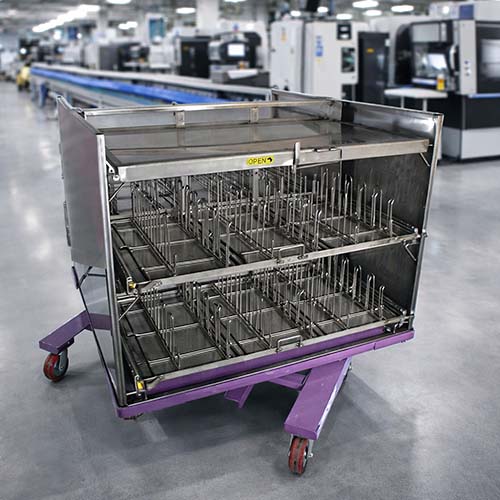
In demanding industrial environments, material handling equipment needs to do more than move items from one area to another. Heavy duty industrial carts must support substantial weight, withstand daily use, protect valuable components, and fit smoothly into existing production workflows. Whether they are used in automotive plants, warehouses, metal fabrication shops, assembly areas, or general manufacturing facilities, the right cart design can have a direct impact on safety, efficiency, organization, and throughput.
Standard carts are often not built for the realities of industrial work. They may lack the frame strength, caster capacity, shelf support, or custom features needed to handle heavy components, bulk containers, tooling, fixtures, or work-in-process materials. When carts bend, wobble, tip, or become difficult to move under load, they slow down production and create unnecessary safety risks.
Custom heavy duty industrial carts solve these problems by matching the cart design to the application. Instead of forcing employees to adapt to equipment that does not fit the job, a custom cart can be engineered around load capacity, part size, handling requirements, aisle space, workstation layout, and daily use conditions.
Why Heavy Duty Industrial Carts Matter in Manufacturing and Warehousing
Manufacturing and warehouse environments depend on reliable product movement. Parts need to move from storage to production, from one workstation to another, from washing to inspection, or from assembly to shipping. When this movement is inefficient, the entire operation can be affected.
Heavy duty industrial carts help facilities reduce unnecessary manual handling, limit forklift dependency, organize materials, and keep components moving safely between departments. In high-volume environments, these carts often become part of the daily workflow. They are not occasional-use equipment. They are relied on shift after shift to carry heavy loads and support consistent movement.
For operations that handle large components, dense parts, bulk materials, or specialized assemblies, cart design must account for both strength and usability. A cart may need to hold hundreds or thousands of pounds while still being easy to maneuver, access, load, and unload.
Designed for Maximum Load Capacity
Load capacity is one of the most important factors in heavy duty cart design. A cart must be strong enough to support the intended load without frame deflection, shelf sagging, caster failure, or instability. This requires more than simply using heavier steel. The entire cart must be engineered as a system.
Important load capacity considerations include:
- Frame material and tube size
- Weld quality and joint placement
- Cross-bracing and structural reinforcement
- Shelf thickness and support spacing
- Caster load rating
- Wheel material and floor compatibility
- Center of gravity
- Expected load distribution
- Push, pull, or tow requirements
A properly designed cart should support the maximum expected load while remaining stable and controllable. This is especially important when loads are unevenly distributed, stacked vertically, or moved across long distances.
Built for Daily Industrial Use
Heavy duty industrial carts are often exposed to demanding conditions. They may be pushed across rough floors, moved around machinery, loaded with sharp or abrasive parts, exposed to oils or coolants, or used in areas with constant forklift and equipment traffic. Because of this, durability must be built into the design from the beginning.
Daily-use carts should be designed to resist premature wear and failure. Reinforced frames, properly sized casters, durable finishes, and application-specific shelf designs can help extend service life. When carts are built for the actual environment, they can reduce downtime, maintenance issues, and replacement costs.
Salco Engineering designs custom carts and trolleys for industrial applications where standard equipment may not provide the strength, fit, or functionality required for daily production use.
Custom Cart Features That Improve Workflow
Heavy duty industrial carts can be customized with features that improve access, organization, ergonomics, and product protection. The best features depend on how the cart will be used and what problems it needs to solve.
Carts with Heavy Duty Shelves
Carts with shelves are commonly used to separate parts by job, process stage, assembly sequence, or part number. In industrial settings, shelf strength matters. Shelves must be able to support the load without sagging, shifting, or creating awkward access points.
Custom shelf spacing allows the cart to match the height and size of the parts being handled. Shelves may be designed as solid platforms, wire surfaces, formed trays, or reinforced levels depending on the application. For facilities handling multiple part types, shelf layouts can be built around the most common product sizes to reduce wasted space and improve accessibility.
Gas-Assisted Shelves for Better Access
Some heavy duty carts can include shelves or lids assisted by gas shocks. These features allow operators to lift or open a shelf more easily, reducing strain during access to lower levels or enclosed areas. Gas-assisted movement can be especially helpful when working with heavy shelf sections, protective covers, or multi-level cart designs.
By improving access, these features can help employees work faster and more comfortably while reducing awkward lifting or reaching.
Pull-Out Shelves with Drawer Slides
Pull-out shelves can make a major difference in carts used for assembly, kitting, inspection, maintenance, or parts staging. When shelves are mounted on heavy duty drawer slides, operators can pull parts toward them instead of reaching deep into the cart.
This improves visibility and access while reducing unnecessary bending and stretching. Pull-out shelf carts are especially useful when parts are stored in layers, when employees need to select specific components quickly, or when the cart is used at a workstation where space is limited.
Rotating Bases and Turntable Cart Designs
Rotating cart bases allow operators to access parts from multiple sides without moving the entire cart. This can improve workflow in tight production cells, assembly areas, inspection stations, and robotic work zones.
A rotating base or turntable design can reduce repositioning, improve reach, and help employees maintain better control of the work area. For heavy components, the ability to rotate the load instead of manually lifting or shifting parts can also improve safety and ergonomics.
Custom Compartments, Dividers, and Part Supports
Heavy duty industrial carts can be built with compartments, dividers, dunnage, or custom supports that keep parts separated and protected. This is important when components have machined surfaces, painted finishes, delicate features, or specific orientation requirements.
Instead of allowing parts to slide, stack, or contact each other during movement, custom supports can hold each item in a defined position. This helps reduce damage, improve organization, and make it easier for employees to identify the correct part at the point of use.
Improving Safety and Ergonomics
Heavy loads create safety challenges when they are not handled properly. Employees may be required to lift awkward parts, push overloaded carts, reach into deep shelves, or maneuver equipment that is not designed for the load. Over time, these issues can contribute to fatigue, strain, and injury risk.
Custom heavy duty carts can improve ergonomics by positioning parts at better working heights, reducing manual carrying, and making loads easier to move. Proper handle placement, caster selection, braking systems, shelf height, and cart footprint all affect how the cart performs for the operator.
Safety-focused cart features may include:
- Ergonomic push handles
- Heavy duty brakes or floor locks
- Directional locking casters
- Stable wide-base designs
- Rounded or protected contact points
- Controlled-access shelves or pull-out trays
- Part containment features
- Load-specific frame reinforcement
When carts are easier to control and safer to load, employees can work more efficiently with less physical strain.
Applications for Heavy Duty Industrial Carts
Heavy duty industrial carts are used across many types of facilities. Their flexibility makes them valuable for both production and warehouse environments.
Common applications include:
- Automotive component transport
- Metal fabrication and welding support
- Machined part handling
- Assembly line staging
- Work-in-process movement
- Tooling and fixture transport
- Bulk material handling
- Warehouse picking and staging
- Maintenance department carts
- Heavy parts storage
- Inspection and quality control support
- Shipping and receiving movement
Each application may require a different cart configuration. A cart used for dense metal parts may need a reinforced low-profile frame. A cart used for kitting may need labeled compartments and pull-out shelves. A cart used near an assembly line may need precise height, access, and footprint requirements. Custom design makes it possible to build the cart around the actual work being performed.
Material and Finish Options
The right material and finish depend on the operating environment. Steel is commonly used for heavy duty industrial carts because it provides the strength needed for demanding loads. Stainless steel may be selected for clean environments, washdown areas, food-related applications, or locations where corrosion resistance is important.
Finish options may include powder coating, plating, paint, or other protective finishes depending on the facility conditions. Powder coating can provide a durable surface and may also support color-coded organization. Plating may be useful for corrosion resistance in certain environments. The best option depends on moisture exposure, cleaning requirements, abrasion, temperature, chemical contact, and appearance preferences.
Why Custom Design Is Often the Better Choice
Off-the-shelf carts may be acceptable for light-duty tasks, but they often fall short in demanding industrial environments. Standard carts may not match the required footprint, shelf spacing, load capacity, caster configuration, or part protection needs.
A custom cart can be designed around:
- The exact size and weight of the load
- The way parts are loaded and unloaded
- The distance the cart travels
- The aisle width and floor conditions
- The desired working height
- The need for shelves, drawers, dividers, or rotating features
- The required finish or material
- The operator’s workflow
This makes custom carts a better long-term solution for facilities that rely on material handling equipment every day.
A Smarter Approach to Heavy Duty Material Handling
Heavy duty industrial carts are more than rolling platforms. When designed correctly, they become essential tools for improving workflow, safety, organization, and productivity. They help reduce manual handling, protect valuable parts, support ergonomic movement, and keep materials flowing between production steps.
For operations that handle heavy components, custom assemblies, tooling, bulk materials, or work-in-process inventory, investing in the right cart design can improve daily performance and reduce long-term equipment issues.
Request a Custom Heavy Duty Industrial Cart Quote
Salco Engineering can design and manufacture heavy duty industrial carts built around your load requirements, facility layout, product handling needs, and daily workflow. Whether your operation needs reinforced shelves, pull-out trays, rotating bases, ergonomic handling features, or a fully custom cart configuration, Salco can help develop a solution for your application.
To discuss a custom heavy duty industrial cart for your facility, request a quote from Salco Engineering today.