

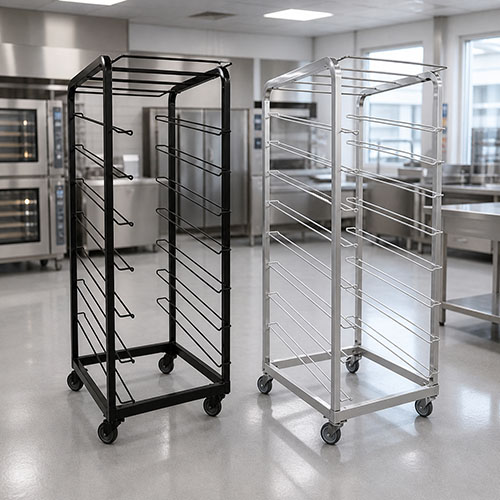
Bakery racks play an important role in commercial kitchens, wholesale bakeries, food production facilities, and other high-volume environments where trays, pans, ingredients, and finished products need to move efficiently. From cooling baked goods to transporting sheet pans, staging ingredients, or organizing production areas, the right rack can improve workflow, sanitation, safety, and long-term durability.
Two common options for bakery rack construction are stainless steel and coated steel. Both materials can be effective depending on the application, environment, budget, and cleaning requirements. Rather than viewing one as universally better than the other, it is more useful to compare how each option performs in different bakery settings.
For bakeries with unique layouts, product sizes, sanitation needs, or handling requirements, custom stainless steel bakery racks and coated rack designs can be engineered around the specific demands of the facility.
Understanding Stainless Steel Bakery Racks
Stainless steel bakery racks are commonly used in commercial food production because of their clean appearance, corrosion resistance, and long service life. Stainless steel is especially valuable in environments where sanitation, frequent cleaning, moisture exposure, and durability are top priorities.
In a bakery setting, stainless steel racks may be used for sheet pan storage, cooling, ingredient staging, transport, washdown areas, freezer or cooler environments, and production line support. Because stainless steel resists rust and corrosion better than many other materials, it is often selected for applications where racks are exposed to water, cleaning chemicals, humidity, or temperature changes.
Stainless steel also has a smooth, professional appearance that works well in front-of-house commercial kitchens, commissaries, food production rooms, and facilities where equipment cleanliness is highly visible.
Benefits of Stainless Steel Bakery Racks
One of the biggest advantages of stainless steel is its corrosion resistance. Commercial bakeries often require regular cleaning, and some areas may experience moisture from washing, cooling, refrigeration, steam, or ingredient handling. Stainless steel helps protect against rust and surface deterioration in these conditions.
Another major benefit is sanitation. Stainless steel is easy to clean and can be designed with smooth surfaces, open wire construction, and accessible corners that reduce places for debris to collect. This is especially important in facilities that must maintain strict food safety procedures.
Stainless steel racks are also known for strength and durability. When properly designed, they can handle repeated movement, heavy pan loads, and daily use in demanding production environments. Reinforced frames, high-quality welds, and heavy-duty casters can make stainless steel racks a strong long-term investment.
For bakeries that want equipment with a long service life, stainless steel is often a practical choice. While the upfront cost may be higher than some coated options, the durability and cleanability can make it cost-effective over time, especially in wet, high-use, or washdown environments.
Understanding Coated Bakery Racks
Coated bakery racks are typically made from steel and finished with a protective coating. Depending on the application, coatings may help improve corrosion resistance, provide a smoother handling surface, reduce metal-to-metal contact, improve product protection, or create a specific appearance.
Coated racks can be a strong choice for many bakery environments, especially in dry storage, staging, transport, packaging, and general production areas. They can provide strength and durability while offering flexibility in finish type, color, and application-specific performance.
Because Salco can provide custom rack solutions, coated bakery racks can be designed for the same general categories as stainless steel racks, including pan handling, tray storage, mobile transport, cooling, and material staging. The best choice depends on how the rack will be used and what environmental factors it will face.
Benefits of Coated Bakery Racks
Coated bakery racks offer several practical advantages. One of the most important is versatility. Different coatings can be selected based on the needs of the application, including durability, surface protection, visibility, or facility preferences.
For bakeries that want color-coded organization, coated racks can be useful. Different rack colors can help identify production zones, allergen-specific areas, product types, departments, or workflow stages. This can support better organization and reduce confusion in busy facilities.
Coated racks may also be beneficial when product protection is a priority. In some applications, a coated surface can help reduce scratching, scuffing, or direct contact between metal components and pans, trays, or handled items. This can be helpful in areas where equipment is frequently moved or where contact surfaces need an added layer of protection.
Cost can also be a factor. Depending on the design, finish, and use environment, coated steel racks may provide a more budget-conscious option while still offering the strength needed for commercial bakery operations. For dry environments or applications that do not require frequent washdown, a coated rack may be a practical and efficient solution.
Key Differences: Stainless Steel vs Coated Bakery Racks
The biggest difference between stainless steel and coated bakery racks is how they respond to moisture, cleaning, and long-term wear.
Stainless steel is often preferred for wet, humid, high-sanitation, or washdown environments because the material itself provides corrosion resistance. Even if the surface is exposed to frequent cleaning, stainless steel remains a dependable choice when properly maintained.
Coated racks rely on the protective coating to help shield the underlying steel. This can work very well in the right environment, but if the coating becomes damaged over time, the exposed area may require attention. For that reason, coated racks are often best suited for applications where the coating will not be exposed to harsh scraping, repeated impact, or aggressive washdown unless the coating is specifically selected for that type of use.
Another difference is appearance and customization. Stainless steel offers a clean, uniform, industrial food-grade look. Coated racks offer more flexibility in color and finish, which can support organization, branding, or departmental separation.
There may also be differences in weight, cost, maintenance, and expected service life depending on the specific rack design. A heavy-duty coated rack may be ideal for one application, while a stainless steel rack may be better suited for another. The right answer depends on the bakery’s workflow and operating environment.
When Stainless Steel May Be the Right Choice
Stainless steel bakery racks are often a strong fit for:
- Washdown areas
- Wet or humid production environments
- Freezer, cooler, or temperature-variable spaces
- High-sanitation food production areas
- Long-term heavy-duty use
- Facilities focused on corrosion resistance and easy cleaning
If a rack will be exposed to frequent cleaning, moisture, food residue, or harsh daily use, stainless steel may provide the durability and sanitation performance needed.
When Coated Bakery Racks May Be the Right Choice
Coated bakery racks may be a strong fit for:
- Dry storage areas
- General pan and tray transport
- Color-coded workflow systems
- Department-specific organization
- Budget-conscious equipment planning
- Applications where added surface protection is helpful
For many bakeries, coated racks provide an effective balance of strength, functionality, and customization. When the rack is used in the right environment and the coating is matched to the application, it can be a dependable choice for daily operations.
Custom Design Matters More Than Material Alone
While material selection is important, the overall design of the rack is just as critical. A stainless steel rack that is poorly designed may not perform as well as a coated rack that is properly engineered for the application. Likewise, a coated rack used in the wrong environment may not deliver the desired service life.
Important design considerations include rack dimensions, pan spacing, load capacity, caster selection, frame reinforcement, weld quality, handle placement, airflow, cleaning access, and how the rack moves through the facility. Bakeries should also consider whether the rack needs to work with existing ovens, proofers, coolers, conveyors, washing systems, or storage areas.
Custom bakery racks allow manufacturers to build around the real-world needs of the facility instead of forcing employees to adapt to a standard rack that does not fit the workflow.
Stainless Steel vs Coated Bakery Racks: What is Best for Your Facility
The decision between stainless steel and coated bakery racks should be based on the application, not a one-size-fits-all rule. Stainless steel may be ideal for sanitation-heavy, wet, or high-corrosion environments. Coated racks may be ideal for dry handling, color-coded organization, or applications where cost-effective customization is important.
In many commercial bakeries, both options may be used in different parts of the facility. Stainless steel racks may support washdown or high-sanitation zones, while coated racks may be used for dry staging, storage, or transport. A custom manufacturer can help determine which material and finish make the most sense based on how and where each rack will be used.
Request a Custom Bakery Rack Quote
Salco Engineering designs and manufactures custom bakery racks for commercial kitchens, wholesale bakeries, and food production facilities. Whether your operation needs stainless steel racks, coated racks, or a combination of both, Salco can build a solution around your space, workflow, cleaning requirements, and product handling needs.
To discuss a custom bakery rack for your facility, contact Salco Engineering and share your application details.