

Industrial facilities rely on dependable material handling equipment to keep parts, tools, fixtures, assemblies, and work-in-process materials moving efficiently. In busy manufacturing plants, fabrication shops, warehouses, and assembly areas, heavy parts often need to travel between machines, workstations, inspection areas, storage zones, and shipping departments. When that movement is slow, unsafe, or poorly organized, productivity can suffer.
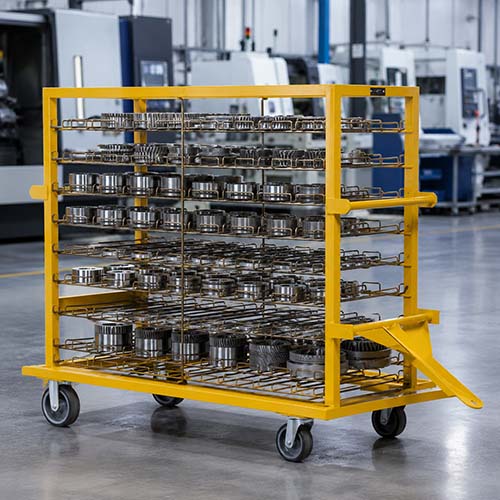
Industrial metal rolling carts provide a practical solution for moving heavy parts across the shop floor. Built with durable steel construction, heavy-duty casters, and application-specific features, these carts help employees transport materials more safely and efficiently. Instead of relying on manual carrying, improvised equipment, or unnecessary forklift movement, facilities can use custom rolling carts designed around the size, weight, and handling requirements of the parts being moved. For companies that need a dependable industrial warehouse cart, custom metal rolling cart design can improve product flow, reduce handling strain, and support more organized material movement throughout the facility.
Why Industrial Metal Rolling Carts Matter
Manufacturing environments are demanding. Parts may be heavy, sharp, oily, hot, awkwardly shaped, or sensitive to damage. Equipment must hold up to repeated use, rough floors, tight spaces, and daily loading and unloading. A lightweight cart may work for occasional use, but it often cannot handle the weight, durability, or stability required in industrial applications.
Industrial metal rolling carts are designed to support those conditions. They can be used to move machined parts, welded assemblies, castings, stampings, tooling, fixtures, bins, baskets, raw materials, and finished goods. The goal is to create a safer and more efficient way to move heavy items without slowing production.
A well-designed cart can help reduce unnecessary lifting, improve access to parts, prevent product damage, and keep work areas more organized. When carts are built around the workflow, they become an important part of the facility’s material handling system.
Built for Heavy Parts and Daily Use
Heavy parts require carts that are engineered for load capacity, not simply general movement. The frame, shelves, casters, handles, and support points all need to work together to carry the intended load safely.
Key design factors include:
- Frame strength
- Load distribution
- Caster capacity
- Wheel material
- Shelf reinforcement
- Center of gravity
- Turning radius
- Handle placement
- Floor conditions
- Braking or locking requirements
A cart carrying heavy machined components may need a reinforced steel frame and low center of gravity. A cart used for tall assemblies may need side containment or custom supports. A cart used near a production line may need a narrow footprint to fit between workstations. Each application is different, which is why custom design is often the best option for heavy-duty material handling.
Improving Shop Floor Transport
Shop floor transport includes the movement of parts, tools, and materials between work areas. In many facilities, this movement happens constantly throughout the day. Parts may move from machining to washing, from welding to inspection, from storage to assembly, or from production to shipping.
Industrial metal rolling carts can help streamline this movement by giving employees a dedicated way to transport materials. Instead of waiting for a forklift or making multiple trips by hand, workers can move the right number of parts in a controlled and organized way.
This can be especially valuable in facilities with:
- High-volume production
- Multiple workstations
- Frequent part transfers
- Heavy or awkward components
- Limited forklift access
- Tight aisles or production cells
- Work-in-process staging needs
When carts are positioned near the point of use, employees can access parts more quickly and keep production moving.
Reducing Forklift Dependence
Forklifts are useful for moving pallets, heavy loads, and long-distance materials, but they are not always the most efficient option for every movement inside a facility. In crowded production areas, frequent forklift use can create congestion, safety concerns, and delays.
Industrial metal rolling carts can reduce forklift dependence for short-distance transport and smaller load movements. A cart may be used to move parts from a machine to an inspection station, from a staging area to a production cell, or from storage to a workstation. This helps keep forklifts available for larger tasks while giving employees more flexibility for everyday material movement.
In many operations, this can improve traffic flow and reduce waiting time between production steps.
Supporting Better Organization
A rolling cart should do more than carry weight. It should also help keep parts organized. Custom carts can be designed with shelves, dividers, baskets, trays, compartments, or part-specific supports that keep materials separated and easy to identify.
For example, a cart may be designed to hold parts by job number, production stage, assembly sequence, or part type. This can help reduce confusion and make it easier for employees to find what they need. In inspection or assembly areas, organized carts can also help prevent parts from being mixed, misplaced, or damaged.
For heavy parts, organization is especially important because repeated handling can increase the risk of damage or injury. A cart that holds each part securely can reduce unnecessary lifting and repositioning.
Protecting Parts During Movement
Heavy parts are not always rugged parts. Many industrial components have machined surfaces, painted finishes, threaded areas, precision edges, or critical dimensions that need protection during handling. If parts shift, collide, or rub together during transport, damage can occur.
Custom industrial metal rolling carts can include part protection features such as:
- Dedicated pockets
- Wire dividers
- Dunnage inserts
- Rubber or urethane contact points
- Formed supports
- Side rails
- Retaining bars
- Custom baskets or trays
These features help keep parts in place while the cart moves across the shop floor. For automotive, aerospace, medical, food production, and precision manufacturing applications, this added protection can reduce scrap, rework, and quality issues.
Improving Safety and Ergonomics
Manual handling is one of the biggest challenges in industrial environments. Heavy lifting, awkward reaching, repeated bending, and pushing poorly designed equipment can increase employee fatigue and injury risk.
Industrial metal rolling carts can improve ergonomics by positioning parts at better working heights and reducing the need for manual carrying. Proper handle height, cart width, caster selection, and shelf spacing can all make a cart easier to use.
Safety-focused features may include:
- Heavy-duty brakes
- Directional locking casters
- Floor locks
- Ergonomic push handles
- Stable wide-base frames
- Low-profile loading heights
- Rounded or protected contact areas
- Secure part containment
When employees can move materials with less strain and greater control, the shop floor becomes safer and more efficient.
Custom Features for Industrial Rolling Carts
Every shop floor has different requirements. A cart used in a welding area may need a rugged steel frame and open surfaces. A cart used near a CNC machine may need trays for machined parts and room for coolant drainage. A cart used in assembly may need shelves, bins, or pull-out trays. A cart used in a warehouse may need a taller structure for better storage density.
Custom rolling cart features may include:
- Fixed or adjustable shelves
- Solid or wire mesh surfaces
- Custom baskets
- Pull-out drawers or trays
- Tow bars
- Push handles
- Forklift pockets
- Stacking features
- Tool holders
- Part-specific dunnage
- Powder-coated or plated finishes
- Stainless steel construction
The right configuration depends on how the cart will be loaded, moved, accessed, cleaned, and stored.
Applications for Industrial Metal Rolling Carts
Industrial metal rolling carts are used across many types of facilities and production environments. Common applications include:
- Machined part transport
- Automotive component handling
- Aerospace part movement
- Metal fabrication support
- Assembly line staging
- Tooling and fixture transport
- Work-in-process movement
- Warehouse order staging
- Parts washing support
- Inspection and quality control
- Shipping and receiving
- Maintenance department transport
Because these applications vary widely, custom cart manufacturing allows the cart to be designed around the actual job instead of relying on a standard product that may not fit.
Choosing the Right Cart Design
Selecting the right industrial metal rolling cart starts with understanding the load and workflow. Facilities should consider the size and weight of the parts, how far the cart will travel, what floor conditions it will face, how employees will load and unload it, and whether the cart needs to fit with existing equipment.
Important questions include:
- What is the maximum load weight?
- Will the cart be pushed manually or towed?
- Does the load need containment or separation?
- Will the cart move through narrow aisles?
- Does the cart need brakes or floor locks?
- Will parts require protection from scratches or impact?
- Does the cart need shelves, baskets, trays, or dividers?
- Will the cart be exposed to moisture, chemicals, heat, or debris?
Answering these questions helps ensure the cart is built for real-world use.
Custom Industrial Rolling Carts from Salco Engineering
Industrial metal rolling carts can improve shop floor transport by making heavy parts easier to move, organize, and protect. When designed properly, they reduce unnecessary handling, support safer workflows, and help materials move more efficiently between production steps.
Salco Engineering designs and manufactures custom industrial carts for manufacturing plants, warehouses, distribution centers, automotive facilities, fabrication shops, and other demanding environments. Whether your operation needs a heavy-duty rolling cart for parts transport, a custom cart with shelves, a cart for work-in-process staging, or a specialized material handling solution, Salco can build equipment around your application.
To discuss a custom rolling cart for your facility, contact Salco Engineering today.