


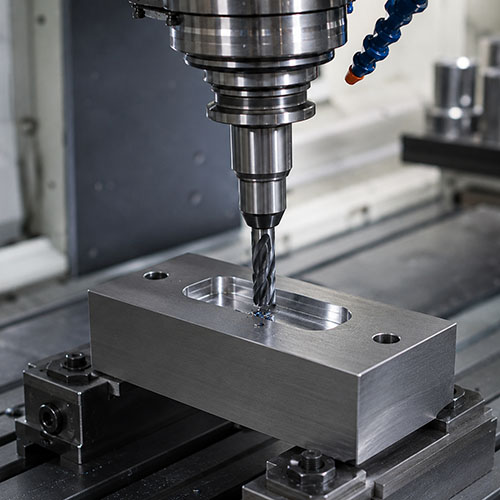
CNC steel milling services are an important part of modern manufacturing when companies need durable components with controlled dimensions, repeatable features, and dependable fit. From mounting plates and brackets to tooling, fixtures, machine parts, material handling components, and fabricated assemblies, CNC milling allows manufacturers to create steel parts that meet precise application requirements.
Steel remains one of the most widely used materials in industrial manufacturing because of its strength, durability, and versatility. However, producing accurate steel components requires more than simply cutting material to size. Many parts need machined holes, slots, pockets, surfaces, or other features so they can align correctly with equipment, support loads, or fit within a larger assembly.
Salco Engineering & Manufacturing provides CNC steel milling services for customers that need custom components manufactured around specific dimensions, materials, production requirements, and industrial applications. Whether the project involves a one-off prototype, a replacement part, a short production run, or a component that will become part of a larger fabricated assembly, CNC milling can help turn raw steel into a finished part ready for use.
What Are CNC Steel Milling Services?
CNC steel milling is a subtractive machining process that uses computer-controlled equipment and rotating cutting tools to remove material from a steel workpiece. Instead of relying entirely on manual machine movement, CNC programming controls tool paths, positioning, cutting depth, and other machining operations according to the geometry of the part.
This digital control allows manufacturers to produce repeatable features and maintain dimensional consistency from one component to the next. It also makes it possible to machine shapes and details that would be more difficult or time-consuming to create manually.
CNC steel milling can be used to produce or modify:
- Steel plates and mounting components
- Custom brackets and structural supports
- Machine parts and replacement components
- Slots, pockets, holes, and grooves
- Flat and precision mating surfaces
- Parts used in carts, racks, fixtures, and industrial equipment
- Tooling, jigs, and production aids
- Custom fabricated assemblies requiring machined features
Because steel combines strength with broad manufacturing versatility, CNC milling is a valuable process for components expected to perform reliably in demanding industrial environments.
Why CNC Milling Matters in Custom Steel Fabrication
Custom steel fabrication often requires more than cutting, forming, and welding. Many components need machined features before they can function correctly within the final assembly. A fabricated frame may require precisely located holes, a bracket may need adjustment slots, a machine plate may require a flat mounting surface, and a fixture may need pockets or locating features that hold another component in a defined position.
CNC milling helps bridge the gap between structural fabrication and precision machining by allowing steel components to be both durable and dimensionally controlled. This becomes especially important when parts must align with existing machinery, fit within a larger assembly, support mechanical movement, or maintain consistent geometry from one production run to another.
Machined steel components may need to:
- Align with existing equipment
- Fit accurately into a larger assembly
- Support moving or rotating components
- Hold parts in a repeatable position
- Mount to machinery, carts, racks, or frames
- Provide flat or controlled contact surfaces
- Be reproduced consistently for future orders
Adding CNC milling to the fabrication process can reduce the amount of adjustment required during assembly and help improve the overall quality of the finished product.
Benefits of CNC Steel Milling
Precision and Repeatability
One of the most important benefits of CNC milling is the ability to reproduce the same machined features across multiple parts. Once the machining process has been programmed and established, the same dimensions, hole locations, slots, pockets, and surfaces can be produced repeatedly with greater consistency than would typically be possible through manual methods alone.
This is particularly valuable when a component must fit into equipment, tooling, carts, racks, or assemblies where variation can create alignment or installation problems. Repeatable machining can help reduce rework, fitting issues, and unnecessary adjustments during final assembly.
Durable Components for Demanding Applications
Steel is commonly selected for industrial applications because it can withstand weight, impact, wear, and repeated use. CNC milling allows manufacturers to add precision features to this durable material without sacrificing the overall strength that makes steel valuable in the first place.
Machined steel components can be used in manufacturing plants, warehouses, automotive facilities, fabrication shops, aerospace operations, food production environments, and many other industrial settings where long-term reliability is important.
Design Flexibility
CNC milling provides substantial flexibility for custom component design because parts can be machined with a wide range of features based on the intended application. These may include holes, slots, pockets, channels, cutouts, flat surfaces, recessed areas, angled features, and custom profiles.
This flexibility is especially useful when a component must fit around existing equipment, hold another part in a defined location, support a specific load, or integrate with a larger fabricated structure. The machining process can be planned around the function of the part rather than forcing the application to adapt to a standard component.
Improved Fit and Function
Fabricated components often need to connect with other parts, equipment, or assemblies. When holes are misaligned, surfaces are uneven, or dimensions vary from part to part, additional labor may be required to make everything fit correctly.
CNC milling helps improve fit and function by creating controlled dimensions and consistent features. This is particularly useful for mounting plates, machine brackets, rails, supports, tooling components, and fabricated assemblies that depend on reliable alignment.
Support for Prototype and Production Requirements
CNC steel milling can support both one-off custom work and repeat production. A prototype can be machined and evaluated before additional parts are produced, allowing designers or engineers to confirm fit, geometry, and function before committing to a larger quantity.
Once the design is finalized, established machining programs can be used again for future production runs. This makes CNC milling useful for prototype development, replacement parts, short-run production, and recurring industrial components.
Common CNC Steel Milling Operations
Many steel components require more than one machining operation before they are complete. Depending on the design, a single part may require several different features produced during the milling process.
Common operations include:
- Face milling
- Pocket milling
- Slotting
- Drilling
- Boring
- Counterboring
- Tapping
- Contour milling
- Machining flat mounting surfaces
- Creating locating or alignment features
The combination of operations used depends on the geometry, tolerance requirements, material thickness, and intended function of the component.
CNC Milling for Custom Mounting Plates
Mounting plates are common throughout industrial equipment and machinery, and they often require more precision than their relatively simple appearance suggests. Hole patterns may need to match an existing machine, mounting surfaces may need to remain flat, and slots or recesses may be required for adjustment or component clearance.
CNC milling can help produce these features accurately while maintaining consistent spacing and alignment. Custom mounting plates may be used for motors, bearings, automation equipment, material handling systems, fixtures, production machinery, and other industrial equipment.
Custom Brackets and Structural Components
Steel brackets and structural supports are another common application for CNC milling. A fabricated bracket may require accurately located holes, slots, recessed areas, or machined surfaces before it can be incorporated into the final assembly.
When these components are produced in repeat quantities, CNC machining helps maintain consistent geometry so each part installs in the same way. This can be useful for machine frames, production equipment, conveyor systems, material handling structures, and other fabricated products.
CNC Milling for Material Handling Components
Material handling equipment often combines welded fabrication with machined steel parts. Industrial carts, racks, fixtures, baskets, transport systems, and custom handling equipment may all require components with accurately positioned mounting points or supports.
A custom cart, for example, may require steel plates with specific hole patterns for caster mounting. A fixture may need machined pockets or slots to locate products consistently, while a rack may require custom supports that position components at specific angles or heights.
Integrating CNC milling into these types of projects can help ensure the fabricated equipment works as intended and interfaces correctly with other components.
Machined Components for Tooling and Fixtures
Tooling and fixtures often depend on precision because they are designed to position parts consistently during manufacturing, welding, assembly, or inspection. Small dimensional variations in the fixture can affect every component produced or held by that fixture.
CNC steel milling can be used to create:
- Welding fixtures
- Assembly fixtures
- Locating plates
- Inspection fixtures
- Tooling blocks
- Jigs
- Production supports
- Custom machine fixtures
The ability to create accurately positioned features helps manufacturers maintain more consistent processes from one production cycle to the next.
Replacement Parts for Industrial Equipment
Industrial equipment may remain in service for years or even decades, and replacement components are not always readily available. In some situations, the original manufacturer may no longer support the equipment, or the required part may have been custom from the beginning.
CNC milling can provide a practical way to produce certain replacement components when the necessary dimensions, material requirements, drawings, or sample parts are available. Replacement parts may include brackets, plates, spacers, fixture components, machine supports, or other custom steel pieces.
Low-volume machining is especially valuable in these situations because the customer may only need one or several replacement parts rather than a large production run.
Prototype CNC Steel Milling
Prototype machining allows manufacturers to evaluate a component before moving into production. A machined prototype can be used to check fit, clearance, mounting locations, geometry, and interaction with surrounding equipment.
If changes are required, the design can be adjusted before additional components are produced. This can help identify issues such as incorrect hole locations, insufficient clearances, difficult assembly conditions, or unnecessary machining complexity.
By resolving these issues during the prototype stage, manufacturers can reduce the likelihood of repeating the same problem across a larger production quantity.
Low-Volume and Repeat Production
CNC steel milling works well for both low-volume custom manufacturing and repeat production because many industrial customers do not need thousands of identical parts. A project may involve one prototype, a small batch of tooling components, several replacement parts, or recurring quantities manufactured as needed.
Once the machining process has been established, repeat parts can be produced using the same programming and setup strategy. This can help maintain consistency on future orders while providing flexibility for changing production quantities.
Integrating CNC Milling with Larger Fabricated Assemblies
Some machined components are standalone parts, but many become part of larger welded or fabricated products. A project may involve cutting, forming, welding, machining, finishing, and final assembly before it is complete.
Integrating CNC milling with these other manufacturing processes allows the production sequence to be planned around the finished component. In some cases, a part may be machined before welding. In others, a fabricated structure may need certain surfaces or features machined after welding.
The correct sequence depends on factors such as dimensional requirements, welding distortion, accessibility, part geometry, and how the final assembly will be used.
From CAD Design to Finished CNC Components
Modern CNC milling often begins with digital design information. CAD models and engineering drawings can define part geometry, dimensions, hole locations, tolerances, and other critical requirements.
This information can be used to plan the machining process and determine how the part should be held, what tools will be required, and what sequence of operations will produce the finished component most efficiently.
Evaluating manufacturability before machining begins can help reduce unnecessary setups and identify features that may be difficult or inefficient to produce.
Choosing the Right CNC Steel Milling Partner
Selecting a manufacturing partner involves more than finding a shop capable of operating a milling machine. The finished component also needs to function within the customer’s equipment, assembly, or broader manufacturing process.
An experienced manufacturing partner should consider the relationship between material selection, machining, fabrication, welding, finishing, and assembly.
Before a CNC milling project begins, important information may include:
- Part dimensions and tolerances
- Material or steel grade
- Production quantity
- Hole locations and machined features
- Surface requirements
- Expected load or wear conditions
- How the part will be installed
- How the part interacts with surrounding equipment
- Whether additional fabrication is required
- Whether repeat production may be needed in the future
Drawings, models, samples, sketches, and application information can all help define the appropriate manufacturing approach.
Advantages of In-House CNC Steel Milling
When machining and fabrication are handled by separate suppliers, projects may require additional transportation, communication, scheduling, and coordination. This can become especially challenging when a component needs to move back and forth between fabrication and machining operations.
In-house CNC milling can help simplify the process by allowing machining to remain closely coordinated with other manufacturing steps. Depending on the project, this can support shorter handoffs, improved communication, better control over production sequencing, and quicker response when design changes are required.
Industries That Use CNC Steel Milling Services
CNC steel milling supports a broad range of industries because precision steel components are used throughout modern industrial equipment and manufacturing systems.
Common industries include:
- Automotive manufacturing
- EV manufacturing
- Aerospace
- Warehousing and distribution
- Material handling
- Metal fabrication
- Industrial machinery
- Food processing equipment
- Automation and robotics
- Packaging equipment
- General manufacturing
Although the specific applications differ, these industries often share the same basic requirements: durable materials, dimensional accuracy, consistent part quality, and dependable performance.
Quality and Consistency in CNC Steel Milling
The quality of a machined steel component depends on more than the CNC equipment itself. Programming, tooling, workholding, material condition, setup, operator experience, and inspection all influence the finished result.
Critical dimensions should be verified before components move into assembly or shipment. For repeat production, consistent inspection can also help confirm that the machining process continues to produce parts within the required specifications.
CNC Steel Milling Services from Salco Engineering & Manufacturing
CNC steel milling services help manufacturers produce strong, accurate, and repeatable components for demanding industrial applications. Whether the project requires a mounting plate, bracket, fixture component, replacement part, tooling component, or a precision-machined part incorporated into a larger fabricated assembly, CNC milling can provide the dimensional control needed for dependable performance.
Salco Engineering & Manufacturing works with customers across material handling, manufacturing, warehousing, automotive, aerospace, food production, and other industrial markets. By combining CNC milling with broader fabrication capabilities, Salco can help develop components that fit the customer’s equipment, workflow, and production requirements.
Request a Quote for CNC Steel Milling Services
If your project requires custom steel components with precision-machined features, Salco Engineering & Manufacturing can help evaluate the application and develop a manufacturing approach based on your material, dimensions, tolerances, production quantity, and end-use requirements.
Contact Salco Engineering & Manufacturing to discuss your CNC steel milling project and request a quote.