


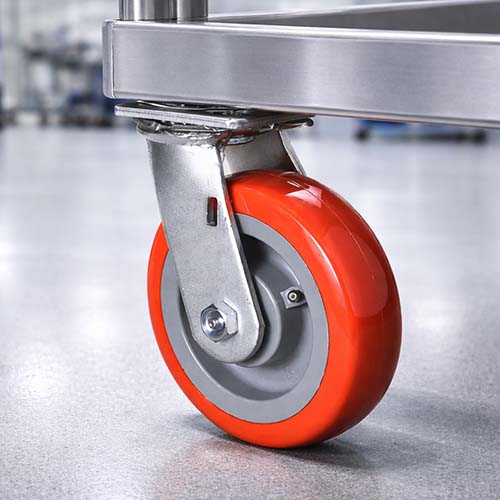
Industrial carts play a critical role in manufacturing, warehousing, and distribution environments. From moving heavy components across the shop floor to supporting work-in-process materials, industrial carts help improve efficiency, reduce manual handling, and keep operations running smoothly. However, even the most well-designed cart can fall short without the right casters.
Choosing the correct casters for industrial carts directly affects load capacity, maneuverability, safety, and long-term durability. The best casters are not one-size-fits-all. They must be matched to the cart design, the weight being transported, and the environment in which the cart will operate. Understanding these variables helps ensure your industrial carts perform reliably day after day.
Why Casters Matter on Industrial Carts
Casters are the interface between the cart and the floor, making them one of the most important components of any industrial cart. Poor caster selection can lead to difficult steering, excessive operator effort, premature wear, and even safety hazards such as tipping or uncontrolled movement.
Well-matched casters improve workflow by allowing carts to move smoothly, track predictably, and stop securely when needed. In facilities where carts are used continuously, selecting the best casters can also reduce maintenance costs and downtime.
Load Capacity Requirements
Load capacity is the first and most critical factor when selecting casters for industrial carts. Each caster must be rated to support not only the cart’s empty weight but also its maximum loaded capacity. This includes parts, tools, fixtures, or baskets being transported.
A common mistake is selecting casters based only on average loads rather than worst-case scenarios. For heavy-duty industrial carts, it is best practice to build in a safety margin so casters are never operating at their maximum rating. Proper load distribution across all casters is equally important to avoid uneven wear or failure.
Caster Type and Maneuverability
The type of caster affects how easily industrial carts move and how precisely they can be positioned.
Swivel casters allow carts to turn freely and navigate tight spaces, making them ideal for assembly areas and crowded production floors. Rigid casters track straight and provide stability for longer, linear moves. Many industrial carts use a combination of swivel and rigid casters to balance control and maneuverability.
For specialized applications, carts may use all-swivel casters with brakes or directional lock features to switch between free movement and straight tracking.
Caster Wheel Materials
Wheel material plays a major role in durability, floor protection, and rolling resistance. Selecting the right material depends on load weight, floor conditions, and environmental exposure.
Common options include rubber, polyurethane, nylon, and steel. Rubber provides quiet operation and floor protection but may not be ideal for heavy loads. Polyurethane offers a strong balance of load capacity, durability, and smooth rolling. Nylon and steel wheels handle heavier loads but can transmit more vibration and may mark floors.
This guide to caster materials offers a helpful overview of how different wheel types perform in industrial settings.
Caster Size and Rolling Efficiency
Caster size directly affects how easily an industrial cart moves under load. Larger diameter wheels roll more easily over debris, floor joints, and uneven surfaces, reducing the force required to push the cart. Smaller wheels may be sufficient for lighter carts operating on smooth floors but can struggle under heavy loads.
Matching caster size to load weight and floor conditions improves ergonomics and reduces operator fatigue.
Bearing Types and Performance
Caster bearings influence how smoothly a cart rolls and how well it handles continuous use. Options include plain bearings, roller bearings, and precision ball bearings.
For heavy-duty industrial carts, higher-quality bearings reduce friction, improve load handling, and extend service life. Bearings are especially important in applications involving frequent starts, stops, or long travel distances.
Brakes and Cart Stability
Brakes are essential for safety and positioning. Industrial carts often require brakes to hold the cart in place during loading, unloading, or assembly tasks.
Brake options include wheel brakes, swivel locks, and total lock systems that secure both the wheel and swivel mechanism. Selecting the right brake type ensures carts remain stable when stationary without sacrificing ease of movement when released.
Environmental and Floor Conditions
The environment in which industrial carts operate should always influence caster selection. Wet areas, washdown environments, temperature extremes, and exposure to chemicals all require specific caster materials and coatings.
Carts used in food processing, automotive manufacturing, or chemical handling environments often require corrosion-resistant casters that maintain performance under harsh conditions.
Custom Casters for Custom Industrial Carts
The best casters are most effective when paired with carts designed around their intended use. Custom industrial carts allow casters to be selected based on real-world operating conditions rather than compromises made for standard designs.
Salco Engineering & Manufacturing designs and fabricates industrial carts with caster selection integrated into the overall cart design. This ensures proper load distribution, smooth movement, and long-term durability across a wide range of manufacturing and warehouse applications.
Choosing the Best Casters for Industrial Carts
Selecting casters for industrial carts requires careful consideration of load capacity, caster type, wheel material, size, bearings, braking systems, and environmental factors. The best casters are those that align precisely with how the cart will be used, not just how it looks on paper.
If you are designing new industrial carts or upgrading existing equipment, contact Salco Engineering & Manufacturing to discuss custom cart solutions built with the right casters for your operation. Proper caster selection can improve safety, efficiency, and reliability across your facility.