


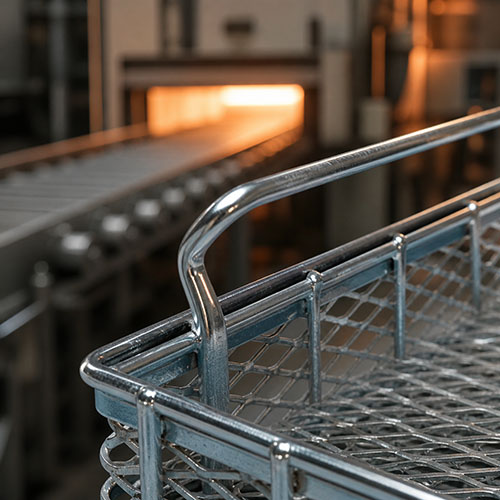
Heat treating is a critical step in the production of many automotive and aerospace components. Whether a manufacturer is hardening gears, strengthening shafts, treating fasteners, processing brackets, or preparing precision-machined parts for final assembly, the parts must be handled in a way that supports consistency, safety, and dimensional stability.
That is where custom heat treat baskets play an important role. In demanding manufacturing environments, baskets are not simply containers. They are engineered material handling tools designed to support heavy loads, allow proper heat transfer, protect parts from damage, and withstand repeated exposure to high temperatures.
Automotive and aerospace applications place especially high demands on heat treating baskets because part quality, traceability, and process repeatability are essential. A poorly designed basket can warp, sag, crack, restrict airflow, or allow parts to shift during processing. Over time, these issues can contribute to inconsistent heat treatment results, part damage, downtime, and unnecessary replacement costs.
Why Automotive and Aerospace Heat Treating Requires Custom Basket Design
Automotive and aerospace manufacturers often work with complex parts that must meet strict performance requirements. Components may need to hold tight tolerances, resist fatigue, withstand repeated stress, or perform reliably in safety-critical applications.
Heat treating baskets used in these environments must be designed around several key factors, including:
- Part size and geometry
- Load weight
- Furnace temperature
- Thermal cycling frequency
- Quench or cooling requirements
- Automation compatibility
- Operator handling requirements
- Downstream washing, inspection, or staging processes
A standard basket may fit the general dimensions of a furnace or production line, but it may not provide the right support for the specific parts being processed. Custom heat treat baskets allow manufacturers to design around the actual part, the actual process, and the actual production workflow.
Heat Treat Baskets for Automotive Manufacturing
Automotive manufacturing relies heavily on heat treating for parts that require strength, wear resistance, and long-term durability. Gears, shafts, bearings, fasteners, brackets, transmission components, steering components, and drivetrain parts may all move through some type of heat treatment process.
Because automotive production is often high-volume, basket design must support both durability and efficiency. A basket that fails prematurely, causes part damage, or slows down loading and unloading can create problems throughout the production line.
Custom automotive heat treat baskets can be designed to:
- Hold parts in consistent orientations
- Prevent contact damage between components
- Support heavy or dense loads
- Improve loading and unloading efficiency
- Integrate with conveyors, carts, or robotic handling systems
- Maintain airflow and heat circulation around parts
- Withstand repeated furnace cycles
For example, automotive shafts or machined components may require spacing features that prevent parts from rolling, nesting, or colliding during transport and processing. Gears or fasteners may require basket designs that balance high load capacity with open mesh construction for effective heat exposure. In each case, the goal is to maintain part quality while improving handling efficiency.
Heat Treat Baskets for Aerospace Applications
Aerospace applications often involve even more demanding requirements. Parts may be made from specialized alloys, machined to precise tolerances, and subject to extensive quality control standards. During heat treatment, improper support or uneven exposure can create risks related to distortion, surface defects, or inconsistent results.
Custom heat treat baskets for aerospace parts may need to account for:
- Delicate or high-value components
- Tight dimensional tolerances
- Specialty materials and alloys
- Controlled spacing between parts
- Careful weight distribution
- Traceability and repeatable loading patterns
- Compatibility with inspection or cleaning processes
In aerospace manufacturing, the cost of part damage or rework can be significant. A custom basket can help reduce unnecessary handling and create a more controlled path through heat treating, cooling, washing, and staging. When parts remain properly supported throughout the process, manufacturers can reduce the risk of deformation, surface contact damage, and inconsistent exposure.
Material Selection for High-Temperature Performance
Material selection is one of the most important decisions in heat treat basket design. Automotive and aerospace heat treating environments may expose baskets to extreme temperatures, repeated thermal cycling, quenching, oxidation, and heavy loading.
The right material depends on the application. In high-temperature furnace environments, heat-resistant alloys are often needed because they retain strength better under elevated temperatures. For post-heat processes such as cooling, washing, or staging, stainless steel may be appropriate depending on the temperature range and environmental conditions.
Custom basket design also involves selecting the right wire diameter, frame material, reinforcement layout, and weld construction. Heavier wire and reinforced frames can improve strength, but the design must still allow proper airflow and heat circulation. If the basket is overbuilt in the wrong areas, it may restrict heat transfer or add unnecessary weight. If it is underbuilt, it may sag, crack, or fail prematurely.
Preventing Warping, Sagging, and Basket Failure
Heat treat baskets are exposed to punishing conditions. Over many cycles, baskets expand, contract, and carry heavy part loads through extreme temperature changes. If the design does not account for this movement, stress can build up at weld joints, corners, and support points.
Common causes of basket failure include:
- Insufficient reinforcement
- Poor weight distribution
- Improper material selection
- Weak weld joints
- Restricted thermal expansion
- Overloading
- Repeated quenching stress
- Inadequate support for dense parts
Custom basket engineering helps address these risks before the basket enters production. Reinforced frames, cross-bracing, controlled expansion geometry, and strategic weld placement can all help improve long-term performance.
For automotive and aerospace manufacturers, this is especially important because basket failure can affect more than the basket itself. A failing basket can damage parts, interrupt production, create safety concerns, or lead to inconsistent heat treatment results.
Part Protection and Process Consistency
One of the biggest benefits of custom heat treat baskets is improved part protection. During high-volume production, parts may be loaded, transported, heated, quenched, cooled, washed, inspected, and staged before final assembly or shipment. Every transfer creates an opportunity for damage if the handling system is not designed correctly.
Custom baskets can include features that separate, position, or secure parts throughout the process. This can help prevent metal-to-metal contact, reduce shifting, and support repeatable loading patterns.
Repeatability is especially valuable in automotive and aerospace work. When parts are loaded the same way each time, manufacturers can achieve more consistent exposure to heat and quench media. Consistent loading also supports inspection, traceability, and workflow standardization.
Integrating Heat Treat Baskets with the Full Production Workflow
Heat treating is rarely an isolated process. In many facilities, baskets must move between furnaces, quench tanks, cooling stations, washers, conveyors, carts, and inspection areas. A basket that works well inside the furnace but does not integrate with the rest of the line may create bottlenecks.
Custom heat treat baskets can be designed to match the broader material handling system. This may include specific dimensions for conveyor compatibility, lift points for ergonomic handling, reinforced edges for cart transport, or nesting features for storage.
For automotive and aerospace manufacturers, this type of integration can improve throughput and reduce unnecessary handling. Instead of forcing operators to transfer parts between multiple containers, a custom basket can support a smoother process from heat treatment through downstream operations.
Why Work with Salco Engineering
Salco Engineering designs and fabricates custom material handling solutions for demanding industrial applications, including heat treating baskets, wire baskets, carts, trolleys, dunnage inserts, and custom steel fabrication. For automotive and aerospace manufacturers, Salco can design baskets around the specific part geometry, load requirements, process conditions, and handling needs of the application.
Instead of relying on a generic basket, manufacturers can work with Salco to develop a custom solution built for strength, thermal stability, part protection, and long-term use.
Request a Custom Heat Treat Basket Quote
If your automotive or aerospace heat treating process requires stronger, longer-lasting, or more application-specific baskets, Salco Engineering can help design a custom solution for your parts and production workflow.
Contact Salco to discuss your application, share part requirements, and request a custom basket design built for demanding heat treating environments.