


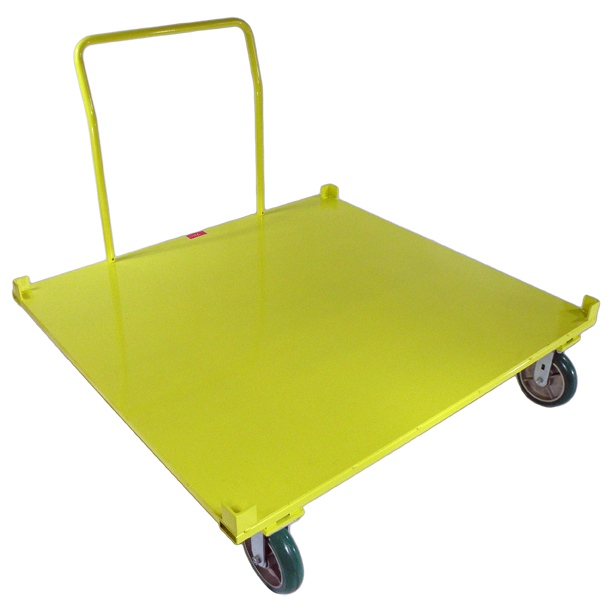
Warehouses and distribution centers depend on efficient material movement to keep receiving, storage, picking, packing, staging, and shipping operations running smoothly. While forklifts and other powered equipment handle many large-scale material handling tasks, custom pallet carts provide a flexible solution for moving heavy loads throughout a facility without relying on powered equipment for every transfer.
Custom pallet carts can be designed around specific pallet dimensions, load capacities, aisle widths, floor conditions, workflow requirements, and handling processes. Instead of adapting operations to a standard cart, warehouses can use purpose-built equipment designed around how materials actually move through the facility.
For high-volume distribution centers, manufacturing warehouses, fulfillment operations, and other demanding industrial environments, heavy-duty pallet carts can improve material flow, reduce unnecessary handling, and provide years of dependable service.
What Are Industrial Pallet Carts?
Industrial pallet carts are mobile platforms or frames designed to support pallets, containers, bulk materials, components, and other heavy loads as they move through a facility. Depending on the application, a pallet cart may feature a flat deck, open-frame construction, recessed pallet supports, guide rails, retaining stops, or a completely custom configuration.
Unlike pallet jacks, pallet carts generally do not need to lift a load from the floor. Instead, the pallet or container is positioned on the cart so it can be transported between different areas of the facility.
This relatively simple concept can be adapted to a wide range of industrial material handling applications. Pallet carts can move incoming products from receiving areas, transport inventory between storage and production, deliver materials to picking or packing stations, or stage finished orders near shipping docks.
Why Use Custom Pallet Carts in Warehousing and Distribution?
Off-the-shelf material handling carts are designed to serve a broad range of applications. While this makes them suitable for general-purpose use, it can also create limitations in facilities with specialized requirements.
A cart may be too large for existing aisles, too small for the intended pallet, difficult for employees to maneuver, or unable to withstand the weight and frequency of use required by the operation.
Custom pallet carts address these challenges by allowing the equipment to be designed specifically for the facility, load, and workflow.
Heavy-Duty Load Capacity
Warehouse pallet carts may be expected to transport hundreds or thousands of pounds at a time. A heavy-duty steel frame can be engineered around the anticipated load, including appropriate structural reinforcement, welds, axles, wheels, and casters.
Designing the complete cart around its intended capacity helps distribute weight effectively and provides the durability necessary for repeated industrial use.
Dimensions Designed Around the Application
Not every warehouse uses identical pallets, containers, or material handling systems. Custom dimensions allow a cart to accommodate standard pallets as well as proprietary containers, oversized loads, bins, totes, racks, fixtures, and other equipment.
Overall cart dimensions can also be selected according to aisle widths, door openings, elevators, storage locations, loading areas, and other facility constraints.
Salco’s pallet carts for industrial material handling can be designed around these application-specific requirements.
Improved Maneuverability
A heavy-duty cart is only useful if employees can move and position it effectively. Wheel diameter, caster material, caster arrangement, handles, and overall cart geometry all influence maneuverability.
Some applications benefit from four swivel casters for movement in multiple directions, while others may require a combination of rigid and swivel casters for more predictable tracking over longer distances.
Facilities can also specify brakes or locking mechanisms to keep carts securely positioned during loading, unloading, staging, or other operations.
Better Organization and Load Control
Palletized materials are not always uniform. Boxes, containers, components, and other products can shift during movement if they are not adequately supported.
Custom carts can incorporate rails, guides, stops, dividers, side frames, or other load-retention features. Designing these components as part of the cart can help maintain load organization and reduce the potential for product damage during transportation.
How Pallet Carts Improve Warehouse Material Flow
Material handling involves much more than moving a load from one end of a building to another. Every unnecessary transfer, delay, or handling step adds time to the process.
A well-designed pallet cart can remain with a load through multiple stages of an operation. Instead of transferring products between several different carts or temporary staging surfaces, the same pallet cart may move from receiving to storage, picking, inspection, packing, or shipping.
Reducing these intermediate transfers can simplify workflows while helping employees keep materials organized.
Custom pallet carts can contribute to:
- Faster movement of materials between warehouse areas
- Reduced unnecessary loading and unloading
- More organized staging and work-in-process inventory
- Improved use of warehouse floor space
- Less dependence on forklifts for short-distance transportation
- More consistent material handling procedures
- Reduced risk of damage caused by repeated transfers
- Improved coordination between warehouse departments
These benefits can become particularly important in high-volume operations where even small material handling improvements are repeated hundreds of times throughout each shift.
Reducing Forklift Traffic in Busy Warehouses
Forklifts are essential for pallet racking, truck loading, unloading, and transporting loads throughout many warehouse environments. However, using a forklift for every short-distance material movement is not always the most efficient approach.
Heavy-duty pallet carts can provide an alternative for certain repetitive routes between receiving, storage, production, picking, packing, and shipping areas.
Reducing unnecessary forklift trips can help decrease congestion in busy portions of a facility while keeping powered equipment available for tasks that actually require lifting capabilities.
Pallet carts may also be incorporated into tugger or cart-train systems when facilities need to move several loads along established routes. The appropriate method depends on load weight, travel distance, facility layout, and the overall material handling process.
Custom Pallet Carts for Receiving Operations
Receiving docks are often one of the busiest areas of a warehouse. Products must be unloaded, inspected, sorted, and transported to storage or processing areas as efficiently as possible.
Custom pallet carts can be positioned near receiving areas so incoming loads can quickly be transferred to the appropriate destination. Dedicated carts may also be created for specific materials, containers, departments, or production areas.
This can help prevent inbound materials from accumulating around docks while providing a more predictable process for moving products deeper into the facility.
Pallet Carts for Picking and Order Fulfillment
Distribution and fulfillment operations depend on getting the correct products to the correct location quickly. Custom pallet carts can support picking operations by transporting bulk quantities of inventory to picking areas or moving completed orders toward packing and shipping.
The cart can be designed around the size and weight of the products being handled. Additional structural features can be incorporated when the application requires separation, organization, or containment of different materials.
For high-volume facilities, designing carts around the picking process can also help standardize the amount of inventory moved during each trip.
Staging and Shipping Applications
Outbound shipping frequently requires completed orders to be staged until the appropriate truck, route, or loading time is available. Pallet carts can provide mobile staging positions that make it easier to reorganize outbound loads as shipping requirements change.
Instead of placing every pallet directly on the floor, mobile carts allow loads to be repositioned without repeatedly retrieving a pallet jack or forklift.
Custom identification features, designated cart styles, or application-specific configurations can also help facilities organize materials according to route, customer, product type, or destination.
Important Design Features for Heavy-Duty Pallet Carts
The performance of a custom pallet cart depends on more than its overall size. Each component should be selected according to the operating environment and intended use.
Frame and Deck Construction
Heavy-duty steel provides a strong foundation for industrial pallet carts. The frame can be reinforced according to load requirements, while deck construction can vary considerably depending on what the cart will carry.
Some applications require a solid platform, while others can use an open steel frame that supports the pallet at specific points. A recessed or bordered deck can also help locate the pallet and limit unwanted movement.
Caster and Wheel Selection
Caster selection can have a major effect on both load capacity and ease of movement.
Factors such as floor condition, debris, thresholds, travel distance, operating temperature, load weight, and frequency of use should be considered. Larger-diameter wheels may make it easier to move heavy loads over certain surfaces, while specific wheel materials can be selected according to the operating environment.
The configuration of rigid and swivel casters should also match how the cart is expected to travel through the facility.
Handles and Operator Control
Push and pull handles can be designed around cart height, load dimensions, and the intended direction of travel. Proper placement can improve operator control and help employees maintain a more comfortable position while maneuvering the cart.
For particularly heavy loads, the design should also consider whether manual movement is appropriate or whether the cart will be moved using powered assistance.
Brakes and Locking Features
Pallet carts frequently need to remain stationary while employees load, unload, inspect, or work with materials. Caster brakes, floor locks, or other locking systems can provide additional stability during these operations.
The appropriate locking method depends on the cart configuration, load, floor conditions, and how frequently the equipment needs to be repositioned.
Protective Finishes
Industrial carts can be exposed to impacts, abrasion, moisture, oils, cleaning chemicals, and other demanding conditions. The appropriate material and finish should be selected according to the environment.
Painted or powder-coated carbon steel can provide a durable solution for many warehouse applications. Stainless steel may be preferable when corrosion resistance, washdown requirements, sanitation, or moisture exposure are significant considerations.
Custom Pallet Carts for Cold Storage and Specialized Environments
Not every distribution center operates under standard warehouse conditions. Cold storage facilities, food distribution operations, clean manufacturing environments, and other specialized facilities may require materials and components selected for those conditions.
Cold temperatures can affect certain wheel materials, lubricants, and components. Moisture and frequent cleaning can also increase corrosion concerns.
Custom manufacturing allows these operating conditions to be considered during the design process instead of attempting to modify general-purpose equipment after it has already been placed into service.
Supporting Lean Warehousing and Continuous Improvement
Lean warehousing focuses on eliminating unnecessary movement, waiting, excess handling, and other activities that do not add value to the process.
Custom pallet carts can support these efforts by creating predictable methods for moving materials through a facility. Carts can be sized around appropriate quantities, assigned to specific routes, or designed for particular departments and processes.
A purpose-built cart can also help eliminate improvised material handling practices that develop when employees do not have equipment suited to the task.
Over time, these relatively simple changes can contribute to a more standardized and organized material flow system.
Designing Pallet Carts Around Existing Warehouse Equipment
Custom carts can be particularly valuable when they need to interact with existing equipment.
Cart dimensions and deck heights can be developed around storage systems, production workstations, loading areas, conveyor interfaces, inspection stations, or other material handling equipment. Pallet locating features can help maintain consistent positioning, while specialized frame configurations can provide access for other equipment when necessary.
Considering these requirements during the initial design process can help create a cart that functions as an integrated part of the operation rather than simply another piece of equipment on the warehouse floor.
Durability and Long-Term Value of Custom Steel Pallet Carts
Warehouse equipment may be moved, loaded, unloaded, bumped, stopped, and repositioned hundreds of times during a normal workweek. Equipment that performs adequately during occasional use may not withstand this level of activity over the long term.
Heavy-duty welded steel construction provides the durability needed for demanding industrial applications. When the frame, wheels, casters, and other components are selected according to the actual operating conditions, a custom cart can provide dependable service over an extended period.
Longer equipment life can mean fewer replacements, fewer repairs, and less downtime caused by damaged material handling equipment.
There is also value in having a cart that works correctly for the application. Improving maneuverability, load organization, and compatibility with existing processes can provide operational benefits every time the cart is used.
Custom Pallet Carts from Salco Engineering & Manufacturing
Salco Engineering & Manufacturing designs and manufactures custom material handling equipment for warehouses, distribution centers, manufacturing plants, and other industrial facilities.
Pallet carts can be developed around specific load capacities, dimensions, containers, pallet sizes, facility layouts, and handling processes. Custom options may include specialized frame configurations, caster arrangements, handles, brakes, guides, stops, load-retention features, protective finishes, and other application-specific components.
By considering how the cart will actually be loaded, moved, positioned, and unloaded, Salco can develop equipment that fits into the customer’s existing workflow and provides the durability required for daily industrial use.
Improve Warehouse Material Handling with Custom Pallet Carts
Efficient warehousing and distribution depend on having the right equipment available for each stage of material movement. While pallet jacks, forklifts, conveyors, and automated systems all have important roles, heavy-duty pallet carts provide a flexible option for moving and staging loads throughout a facility.
A custom design can address the limitations of general-purpose carts by matching the equipment to the load, facility, employees, and workflow. The result is a pallet cart designed not simply to carry materials, but to support a more organized and efficient material handling process.
Contact Salco Engineering & Manufacturing to discuss your warehouse or distribution application and request a quote for custom pallet carts built around your material handling requirements.