


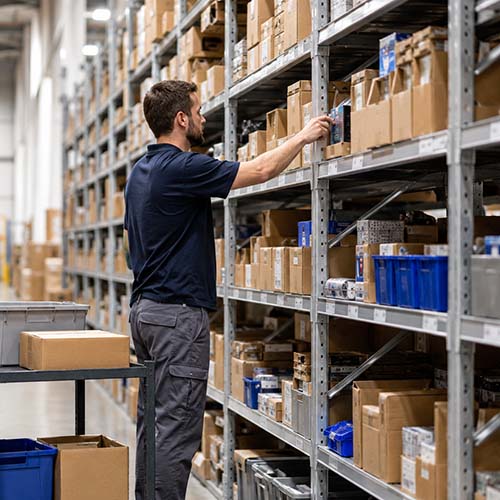
Stock picking is one of the most important daily activities in a warehouse, distribution center, fulfillment operation, or manufacturing stockroom. When employees can find, collect, organize, and move inventory efficiently, orders move faster and operations run more smoothly. When the stock picking process is slow or disorganized, the entire workflow can suffer.
Poor stock picking workflows often lead to unnecessary walking, repeated handling, misplaced products, picking errors, product damage, and employee fatigue. These problems may seem small at first, but they can add up quickly across hundreds or thousands of picks per day. For facilities that need to improve productivity and accuracy, custom material handling carts can make a measurable difference.
Unlike generic utility carts, custom stock picking carts are designed around the products, aisles, storage systems, employees, and movement patterns inside the facility. The right cart can help workers pick more efficiently, keep products organized, reduce manual carrying, and move inventory safely from storage areas to packing, staging, production, or shipping.
Why Stock Picking Workflow Matters
Stock picking is more than simply pulling items from shelves. It is a coordinated process that affects inventory control, order accuracy, labor efficiency, shipping speed, and customer satisfaction. In many facilities, stock picking is one of the most labor-intensive steps in the operation.
A strong stock picking workflow helps employees move through the facility with a clear path and an organized system. Products are easy to identify, carts are properly configured, and picked items are separated by order, batch, department, or destination.
An inefficient workflow creates delays. Employees may need to backtrack through aisles, carry items by hand, sort products after picking, or correct mistakes before orders can move forward. Custom material handling carts help reduce these inefficiencies by giving each item a designated place during movement.
The Role of Custom Material Handling Carts
Custom material handling carts are designed to support the specific way products move through a facility. In a stock picking environment, carts may be used to collect items from storage racks, move components to production areas, stage products for packing, replenish inventory, or transport picked orders to shipping.
The design of the cart should reflect the way employees work. For example, a cart used for small parts picking may need divided compartments, bins, or tote positions. A cart used for large products may need reinforced shelves or open platforms. A cart used in narrow aisles may need a compact footprint and easy-turning casters.
Facilities that rely on frequent picking and fulfillment activity often benefit from custom order picking carts designed around order flow, product separation, cart capacity, and employee handling needs.
Reducing Walking Time During Stock Picking
Walking time is one of the biggest sources of inefficiency in stock picking. If employees need to make multiple trips through the warehouse to complete one order or collect one batch of parts, productivity drops.
Custom carts can help workers collect more items in a single trip while keeping everything organized. Multi-level shelving, tote positions, baskets, dividers, and flat platforms can be designed around common product sizes and picking methods.
For batch picking, a cart can include multiple order locations so employees can collect items for several orders during one route. For zone picking, carts can be configured to move cleanly between storage areas, transfer points, and packing zones. By reducing unnecessary travel, facilities can improve throughput without changing the entire warehouse layout.
Improving Picking Accuracy
Speed is important, but accuracy is just as critical. A fast stock picking process still creates problems if products are placed in the wrong order, mixed with other items, damaged, or sent to the wrong location.
Custom material handling carts can improve accuracy by making organization easier. Dedicated compartments, labeled sections, color-coded areas, removable totes, and part-specific dividers help employees keep picked items separated and easier to identify.
This is especially valuable in fulfillment operations where one cart may hold products for multiple orders. When each item has a defined location, there is less chance of confusion during picking, packing, and staging.
Supporting Different Picking Methods
Different facilities use different stock picking methods depending on order volume, product variety, warehouse layout, and labor needs. Custom carts can be designed to support each method.
Single-order picking may require a straightforward cart with shelves or a platform for one order at a time.
Batch picking may require multiple compartments or tote positions to separate several orders during one trip.
Zone picking may require carts that can move between departments or transfer points while keeping products clearly organized.
Parts picking for manufacturing may require carts with custom dunnage, wire baskets, or part supports to protect components as they move to workstations.
Because each workflow is different, custom cart design allows facilities to match the equipment to the process instead of forcing employees to work around a standard cart.
Protecting Products During Movement
Stock picking often involves frequent handling. Products may be pulled from shelves, placed on carts, moved through aisles, staged near packing, and transferred again before shipping or production. Every touchpoint creates an opportunity for damage.
Custom material handling carts can help protect products by keeping them secure and properly supported during movement. Wire baskets can contain loose items. Dividers can prevent parts from shifting. Flat shelves can support boxes and totes. Protective dunnage or coated contact points can reduce scratching, scuffing, or impact damage.
For industrial facilities handling machined parts, automotive components, aerospace parts, medical products, or finished goods, product protection can be just as important as speed.
Improving Ergonomics and Employee Safety
Stock picking can be physically demanding. Employees may push carts over long distances, reach for products, bend to load lower shelves, lift heavy items, or maneuver carts through tight spaces. Poorly designed carts can increase fatigue and make the job harder than it needs to be.
Custom carts can be designed with ergonomics in mind. Proper handle height, shelf spacing, loading height, cart width, and caster selection can improve comfort and control. Smooth-rolling casters can reduce pushing effort, while brakes or directional locks can improve stability during loading and unloading.
By reducing manual carrying and awkward movement, custom stock picking carts can support a safer and more efficient workplace.
Choosing the Right Cart Features
The best cart design depends on the products being picked and the environment where the cart will be used. Important design considerations include:
- Cart size and aisle clearance
- Load capacity
- Shelf spacing
- Number of picking levels
- Tote, bin, or basket layout
- Product separation needs
- Caster type and wheel material
- Brake or floor lock requirements
- Handle placement
- Material and finish
- Compatibility with packing stations, conveyors, or workstations
A custom manufacturer can evaluate these factors and develop a cart that fits the facility’s workflow instead of relying on a one-size-fits-all solution.
Applications for Stock Picking Carts
Custom material handling carts can support stock picking in many environments, including distribution centers, e-commerce fulfillment centers, manufacturing plants, automotive parts warehouses, aerospace facilities, medical supply operations, industrial stockrooms, retail distribution centers, and food production facilities.
In each setting, the basic goal is the same: help employees collect and move products more efficiently while keeping inventory organized and protected. The exact cart design may vary, but the value comes from matching the equipment to the process.
Improve Stock Picking with Custom Cart Solutions
A better stock picking workflow can improve productivity, reduce errors, protect products, and support safer movement throughout the facility. Custom material handling carts make this possible by giving employees equipment designed around the way they actually work.
Salco Engineering designs and manufactures custom carts, baskets, racks, and material handling solutions for warehouses, distribution centers, fulfillment operations, and manufacturing facilities. Whether your operation needs picking carts, transport carts, stockroom carts, or custom product handling equipment, Salco can build a solution around your products, process, and facility layout.
To start planning a custom cart solution for your operation, request a quote from Salco Engineering today.