


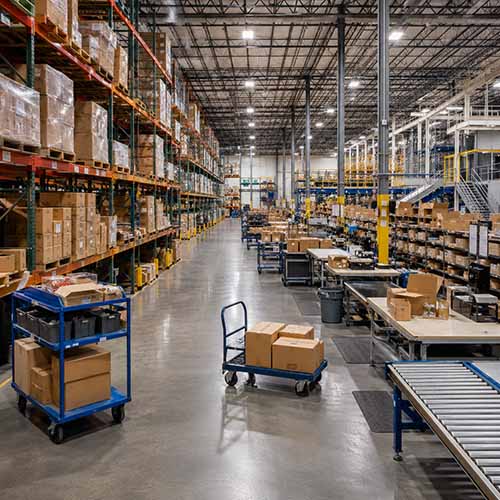
Warehouse flow depends on how efficiently products, parts, materials, and orders move through a facility. From receiving and storage to picking, packing, production support, and shipping, every step requires dependable material handling. When employees spend too much time walking, carrying items by hand, searching for the right products, or moving inefficient equipment, productivity slows down and the risk of errors increases.
Custom picking carts, transport carts, and warehouse carts help solve these challenges by giving teams a more organized and efficient way to move materials through the building. Instead of relying on generic carts that may not match the workflow, custom cart designs can be built around the products being handled, the aisle widths, the storage systems, the order fulfillment process, and the needs of the employees using them.
For warehouses, distribution centers, manufacturing facilities, and fulfillment operations, the right carts can improve speed, organization, ergonomics, and product protection.
Why Warehouse Flow Matters
Warehouse flow refers to how smoothly products and materials move from one area to another. In a well-designed facility, products can be received, stored, picked, staged, packed, and shipped with minimal wasted movement. Employees know where items belong, carts move easily through aisles, and products reach the next step without unnecessary handling.
Poor warehouse flow creates delays. Employees may need to make extra trips, carry products manually, wait for equipment, sort mixed items, or work around carts that are too large, too small, or poorly configured. Over time, these small inefficiencies can lead to missed shipping windows, higher labor costs, product damage, and employee fatigue.
Custom warehouse carts help create a more controlled movement process. By matching cart design to the facility layout and the items being handled, businesses can reduce bottlenecks and support faster, safer product movement.
The Role of Picking Carts in Order Fulfillment
Picking carts are designed to help workers collect items from shelves, racks, bins, or storage locations. They are commonly used in distribution centers, e-commerce warehouses, parts departments, retail fulfillment operations, and manufacturing stockrooms.
A picking cart may be used for single-order picking, batch picking, zone picking, or replenishment tasks. Depending on the workflow, the cart may need shelves, dividers, tote positions, label holders, bins, trays, or product-specific compartments. These features help employees stay organized as they move through the facility.
In operations where order accuracy is critical, the design of the picking cart can make a major difference. Separate compartments can keep orders from mixing together. Label holders can make products easier to identify. Shelving can be spaced around common product sizes. Handles and casters can be positioned for better control in narrow aisles.
Facilities that need to improve order movement often rely on stock picker carts to support faster product retrieval, better organization, and smoother movement from storage areas to packing or staging zones.
How Transport Carts Improve Material Movement
Transport carts are used to move products, materials, components, tools, or finished goods from one area of a facility to another. While picking carts are often focused on collecting items from inventory, transport carts are typically used for movement between departments, workstations, storage areas, assembly lines, packing stations, and shipping areas.
In a manufacturing environment, transport carts may carry work-in-process parts from one production step to the next. In a warehouse, they may move picked goods to a packing area. In a food production or medical supply environment, transport carts may need to support sanitation, cleanability, or controlled handling.
Custom transport carts can be designed for:
- Heavy-duty product movement
- Small parts handling
- Bulk material transport
- Finished goods staging
- Work-in-process movement
- Tool and equipment handling
- Return product processing
- Shipping and receiving support
The right transport cart can reduce manual lifting, limit unnecessary forklift use, improve organization, and help products move more predictably throughout the facility.
Why Custom Warehouse Carts Outperform Generic Options
Standard warehouse carts can be useful for basic tasks, but they often require employees to adapt the workflow to the cart. Custom warehouse carts reverse that approach by designing the cart around the workflow.
A generic cart may not fit narrow aisles, may lack the right shelf spacing, may be difficult to maneuver under load, or may not protect the specific items being moved. A custom cart can account for product size, weight, handling sensitivity, storage methods, travel distance, and employee interaction.
Custom warehouse carts can include:
- Fixed or adjustable shelves
- Wire baskets or containment areas
- Dividers for order separation
- Custom dunnage or part supports
- Heavy-duty casters
- Braking systems
- Push handles or ergonomic grips
- Label holders or identification plates
- Reinforced frames
- Open mesh or solid shelf construction
- Powder-coated, plated, or stainless steel finishes
These features help the cart become part of the larger material handling system rather than a basic piece of equipment.
Improving Efficiency with Better Cart Design
Efficiency in a warehouse is often tied to how many touches a product requires before it reaches its final destination. Every time an item is picked up, set down, transferred, sorted, or repositioned, time is added to the process.
Custom picking carts and transport carts can reduce those touches. For example, a cart with dedicated tote locations can allow workers to pick multiple orders at once without mixing products. A cart with part-specific dividers can reduce the need for repacking or repositioning. A cart designed to move directly from picking to packing can eliminate extra staging steps.
Cart dimensions also affect efficiency. A cart that is too wide may slow movement through aisles. A cart that is too small may require too many trips. A cart that is too tall or poorly balanced may be difficult to control. Custom design allows the cart to match the facility’s layout, product volume, and handling process.
Supporting Safer Warehouse Operations
Warehouse safety is closely connected to material handling. When employees carry heavy items by hand, bend repeatedly, reach awkwardly, or push carts that are difficult to control, the risk of injury increases.
Well-designed warehouse carts help reduce physical strain by allowing employees to move more products with less manual carrying. Proper shelf heights can reduce bending and reaching. Smooth-rolling casters can make carts easier to push or steer. Brakes can improve stability during loading and unloading. Handles can be positioned to support more comfortable movement.
Transport carts can also reduce the need for forklifts in certain areas, especially for smaller loads or short-distance movement. This can help reduce congestion and improve safety in busy warehouse spaces.
Protecting Products During Picking and Transport
Product damage is another common issue in warehouses and distribution centers. Items may be scratched, dented, crushed, contaminated, or misplaced if they are not handled properly. Custom carts can help protect products by keeping them separated, supported, and contained during movement.
For fragile parts, carts may include padded surfaces, coated contact points, or custom dunnage. For small parts, wire baskets or compartments can prevent items from falling or mixing together. For larger components, reinforced frames and stable platforms can help maintain control during transport.
In industries such as automotive, aerospace, medical supply, food production, and e-commerce fulfillment, product protection can directly affect quality, customer satisfaction, and cost control.
Matching Carts to Warehouse Layout and Workflow
Every warehouse has different space constraints and movement patterns. Some facilities have narrow aisles and high-density storage. Others have large open areas, long travel distances, or multiple departments that need to exchange materials throughout the day.
Custom picking carts and transport carts can be designed around these conditions. A narrow cart may be ideal for tight aisles. A longer cart may be useful for bulky items. A multi-level cart may increase capacity without taking up more floor space. A heavy-duty cart may be required for dense parts or industrial components.
The best cart design considers where the cart starts, where it travels, how it is loaded, how it is unloaded, who uses it, and what happens to the product next.
Applications for Custom Picking and Transport Carts
Custom warehouse carts can support a wide range of applications, including:
- Distribution center order picking
- E-commerce fulfillment
- Manufacturing work-in-process movement
- Inventory replenishment
- Parts storage and transport
- Retail distribution
- Food production material handling
- Medical and healthcare product distribution
- Automotive component handling
- Aerospace part movement
- Returns processing
- Shipping and receiving
Because these applications vary widely, custom carts provide the flexibility needed to build around each operation’s specific requirements.
Choosing the Right Cart Manufacturer
When selecting a cart manufacturer, it is important to look for experience with custom material handling applications. The right partner should be able to evaluate product size, load capacity, facility layout, durability needs, caster selection, ergonomics, finish requirements, and handling goals.
A custom manufacturer can also help identify design improvements that may not be obvious with off-the-shelf equipment. Small changes to shelf spacing, handle placement, cart width, or wheel configuration can make a significant difference in everyday use.
Improve Warehouse Flow with Custom Cart Solutions
Picking carts, transport carts, and warehouse carts all play an important role in product movement. When designed around the needs of the facility, they can improve order picking, reduce manual handling, protect products, support safer movement, and create a more efficient workflow from storage to shipping.
For operations that rely on speed, accuracy, and repeatable movement, custom carts can provide a stronger solution than standard equipment. By matching cart design to the product, process, and facility layout, warehouses and manufacturers can improve flow across the entire operation.