

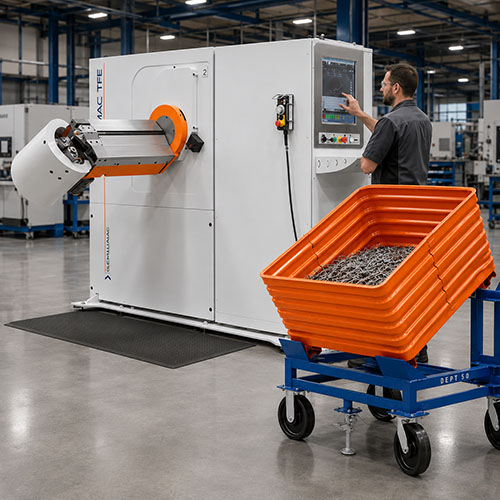
Corrugated steel containers and industrial hoppers are commonly used in manufacturing plants, warehouses, distribution facilities, and material handling environments where bulk parts, scrap, components, raw materials, or work-in-process items need to be collected and moved. These containers are built for strength and capacity, but their size and weight can make them difficult to move safely and efficiently without the right support equipment.
That is where a custom mobile cart base can make a significant difference. Salco can design and fabricate a custom cart frame around an existing container, helping facilities improve mobility, handling, ergonomics, and material flow. For large steel bins, bulk containers, and hoppers, a custom cart base can turn a stationary or forklift-dependent container into a more flexible mobile handling solution.
Why Corrugated Steel Containers Need Custom Cart Bases
Large corrugated steel containers are often used because they can hold heavy loads and withstand demanding industrial environments. Their ribbed or corrugated sidewalls provide strength, making them useful for bulk material storage, scrap collection, part handling, and transport between production areas.
However, these containers are not always easy to move manually. A full steel hopper or bulk bin can be heavy, awkward, and difficult to reposition without forklifts or other equipment. In busy facilities, relying on forklifts for every move can create bottlenecks, increase congestion, and limit flexibility.
A custom mobile cart base provides a dedicated rolling platform that supports the container and allows it to be moved more easily through the facility. Depending on the application, the cart can be designed for manual pushing, tugger movement, forklift access, tilt or dump functionality, or integration with a larger material handling system.
Custom Cart Design Around Existing Containers
One of the main advantages of a custom cart base is that it can be designed around the specific container already being used in the facility. Corrugated steel containers and hoppers may vary in size, shape, load capacity, dump angle, bottom geometry, and handling requirements. A standard cart may not provide the right fit or support.
Salco can fabricate custom carts and trolleys that are built around the customer’s container dimensions, floor conditions, movement path, and production workflow. This allows the cart base to support the container securely while improving how it moves through the facility.
Design considerations may include:
- Container size and weight
- Maximum loaded capacity
- Center of gravity
- Floor conditions and travel distance
- Caster type and wheel material
- Manual push or tugger movement
- Forklift access requirements
- Tilt, dump, or lift functionality
- Operator safety and ergonomics
- Storage and staging requirements
By designing the cart base around the real-world application, manufacturers can improve movement while reducing the risks that come from using improvised or poorly matched handling equipment.
Improving Mobility for Heavy-Duty Material Handling
Large steel containers are often used for heavy parts, dense materials, scrap metal, castings, stampings, machined components, or bulk production items. Without a properly designed mobile base, moving these loads can be difficult and unsafe.
A custom cart base can be engineered with the appropriate frame strength, caster capacity, wheel configuration, and reinforcement needed to support the load. Heavy-duty casters can be selected based on floor surface, load weight, turning requirements, and environmental conditions.
For example, a cart used in a smooth warehouse aisle may require a different caster setup than a cart used in a production area with uneven floors, metal chips, debris, or frequent turns. The right caster configuration helps improve maneuverability and reduce the effort required to move the container.
Reducing Forklift Dependence
Forklifts are essential in many industrial facilities, but they are not always the most efficient option for short-distance material movement. When a container only needs to be moved between nearby workstations, across a production cell, or from a machine area to a staging zone, a mobile cart base may be a more practical solution.
By placing corrugated steel containers or hoppers on custom cart bases, facilities can reduce unnecessary forklift trips and make certain material handling tasks easier for employees. This can help improve traffic flow, reduce waiting time, and free forklifts for heavier or longer-distance movement.
In areas where forklift access is limited or congestion is a concern, mobile cart bases can also create a safer and more flexible handling process.
Supporting Bulk Parts, Scrap, and Work-in-Process Movement
Mobile cart bases for corrugated steel containers and hoppers can support a wide range of applications. In manufacturing environments, they may be used to collect scrap or move parts between production steps. In warehouse settings, they may support bulk storage or staging. In assembly areas, they may help keep components close to the point of use.
Common applications include:
- Bulk parts transport
- Scrap collection and movement
- Work-in-process handling
- Machine-side material collection
- Parts staging near assembly lines
- Heavy component movement
- Returnable container handling
- Warehouse and production floor transport
The cart can be designed around how the container is loaded, moved, emptied, and returned to service. This helps create a more repeatable process and reduces unnecessary manual handling.
Tilt and Dump Cart Base Options
Some corrugated steel hoppers are designed to tilt or dump materials into another container, processing area, or disposal system. In these applications, the cart base must do more than support the weight of the container. It must also account for balance, safety, operator control, and dumping motion.
A custom tilt cart base can include features that help control the container during unloading. Depending on the application, the design may include locking mechanisms, tilt supports, reinforced pivot points, stabilizing geometry, or controlled release features.
Because large steel hoppers can shift significantly when loaded, it is important to consider the center of gravity and weight distribution throughout the dumping process. A properly engineered cart base helps improve stability and reduces the risk of tipping or uncontrolled movement.
Ergonomics and Operator Safety
Material handling equipment should help employees work more safely and efficiently. If a cart is difficult to push, hard to steer, too tall, unstable, or poorly balanced, it can create strain and safety risks.
Custom cart bases can be designed with operator use in mind. This may include proper handle height, caster placement, braking systems, tow bars, push bars, floor locks, or ergonomic access points. The goal is to make the loaded container easier to control during movement, staging, and unloading.
Safety features may also be important when carts are used in shared aisles, around equipment, near workstations, or in areas with forklift traffic. Brakes, directional locks, guard features, or controlled movement options can help improve safe use.
Frame Strength and Structural Support
A mobile cart base must be strong enough to support the container and its loaded contents over repeated use. This requires more than simply placing wheels under a bin. The frame must distribute weight properly, resist twisting, and maintain stability during movement.
Salco can fabricate cart frames with reinforced steel construction, welded supports, crossmembers, and application-specific geometry. The frame can be designed to cradle or support the container securely, reducing unwanted movement and helping extend the life of both the cart and the container.
For larger containers, structural support is especially important because the load may be unevenly distributed. A hopper filled with scrap or bulk parts may not load evenly every time, so the cart base must be designed to handle real-world use.
Finish Options for Industrial Environments
The right finish can help protect the cart base and improve long-term performance. Depending on the environment, a custom cart frame may be powder coated, plated, painted, or finished to match facility needs. Finish selection may depend on exposure to moisture, chemicals, abrasives, oils, indoor or outdoor use, and customer preferences.
Color can also be used for organization. Different cart colors may identify departments, materials, process stages, or safety zones. This can be helpful in busy manufacturing plants where multiple containers and carts move throughout the facility.
Designed for the Facility Workflow
Every facility has its own material flow. Some containers move only a few feet between a machine and a staging area. Others travel through long aisles, across departments, or between production and shipping areas. Some need to be moved manually, while others may be pulled by a tugger or lifted occasionally by forklift.
Custom mobile cart bases can be designed around these requirements. This may include specific overall height, wheel placement, turning radius, tow connections, fork pockets, braking options, or storage footprint. When the cart matches the facility workflow, employees can move materials more efficiently and with fewer interruptions.
Contact Salco for Custom Mobile Cart Bases
Mobile cart bases can make corrugated steel containers and industrial hoppers easier to move, stage, tilt, dump, and integrate into daily production. By fabricating the cart frame around the customer’s existing container and material handling requirements, Salco Engineering can help improve mobility, safety, and workflow efficiency.
Whether your facility needs a cart base for a steel bulk container, hopper, parts bin, scrap container, or custom material handling application, Salco can design and fabricate a solution around your process.
To discuss a custom mobile cart base for your facility, contact Salco Engineering today.