


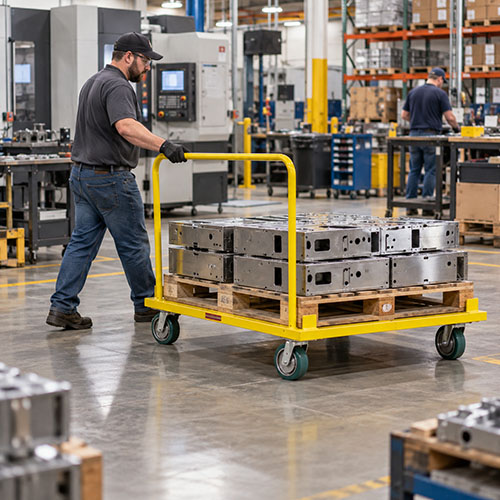
A pallet cart with wheels can make heavy material movement faster, safer, and more flexible throughout a manufacturing plant, warehouse, or distribution facility. Unlike a stationary pallet or fixed storage platform, a wheeled pallet cart allows materials, containers, assemblies, and work-in-process components to move between production areas without requiring a forklift for every transfer.
However, not every pallet cart is designed for demanding industrial use. Heavy loads, uneven floors, repeated movement, tight aisles, loading methods, and the type of material being transported can place significant stress on the cart frame, deck, casters, and steering system. Choosing the right design requires more than simply placing wheels beneath a steel platform.
For operations moving substantial or high-value loads, the cart should be engineered around the actual application. Load capacity, cart dimensions, wheel selection, frame construction, maneuverability, braking, and material containment all play an important role in long-term performance.
What Is a Pallet Cart With Wheels?
A pallet cart with wheels is a mobile material handling platform designed to support pallets, containers, bins, equipment, or loose industrial components. The basic concept combines the load-supporting function of a pallet with a caster or wheel system that allows the entire load to be moved across the facility.
Depending on the application, pallet carts may have a flat steel deck, open framework, raised perimeter edges, handles, containment structures, or customized fixtures. Some are intended to move standard pallets, while others are designed around a specific container, product, or manufacturing process.
Industrial facilities often use pallet carts to move materials between receiving, storage, machining, assembly, inspection, packaging, and shipping areas. Because they can remain underneath the load throughout multiple stages of production, they can also reduce unnecessary handling and the need to repeatedly transfer materials between different pieces of equipment.
Salco Engineering manufactures custom pallet carts and trolleys for industrial material handling applications where durability, mobility, and application-specific design are important.
Start With the Maximum Load Capacity
Load capacity is one of the first considerations when designing a pallet cart with wheels. The cart must safely support not only the typical working load but also the conditions created when that load is moved.
A cart carrying several hundred or several thousand pounds experiences different forces when it starts moving, changes direction, passes over floor joints, or comes to a stop. A design based only on the static weight of the load may not adequately account for these real-world conditions.
The distribution of the load is equally important. A large container that spreads its weight across the entire cart deck affects the structure differently than a machine component that concentrates substantial weight in a relatively small area. Concentrated loads may require additional frame reinforcement directly beneath the part or container.
When specifying a custom pallet cart, manufacturers should provide realistic maximum load information rather than an average or ideal load. Designing around the actual heaviest expected condition can help avoid premature frame deformation, caster failure, and difficult handling.
Frame Construction for Heavy Industrial Loads
The frame is the foundation of a heavy-duty pallet cart. Industrial designs commonly use welded steel construction because the frame may need to withstand repeated loading, unloading, impacts, and daily movement over many years of service.
Steel tubing, angle iron, formed steel, plate, and other structural components can be combined depending on the cart geometry and load requirements. Crossmembers and reinforcement can be placed beneath high-load areas to distribute weight throughout the structure rather than allowing stress to concentrate at a few points.
The frame also needs sufficient rigidity. Excessive flexing can affect caster alignment, make the cart more difficult to push, and allow the load to shift during movement. At the same time, unnecessarily heavy construction can increase cart weight and make manual movement more difficult.
A well-designed industrial pallet cart balances strength with practical mobility. The objective is not simply to use as much steel as possible, but to place structural support where it is actually needed.
Selecting the Right Wheels and Casters
The wheels underneath the cart are among the most important components in the entire design. They affect load capacity, steering effort, floor protection, noise, vibration, and how easily the cart can travel through the facility.
Wheel Diameter
Larger-diameter wheels generally roll more easily over floor joints, small debris, thresholds, and surface irregularities. This can become particularly important as cart weight increases. A wheel that performs adequately on a lightly loaded shop cart may be much more difficult to move when used beneath a heavily loaded industrial pallet cart.
The correct wheel diameter should therefore be selected according to both the load and the facility environment. Floor conditions, ramps, transitions, and other obstacles along the cart’s normal route should be evaluated during the design process.
Wheel Material
Wheel material affects rolling resistance, durability, noise, floor protection, and resistance to environmental conditions. Different materials may be better suited to smooth warehouse floors, manufacturing environments, outdoor transitions, or facilities where oils and other contaminants may be present.
The heaviest-duty wheel is not automatically the best option. A very hard wheel may provide low rolling resistance but transmit more vibration into the load and potentially be harder on certain flooring surfaces. Softer wheel materials may reduce noise and absorb some vibration but behave differently under very heavy loads.
Caster Capacity
Each caster must be appropriately rated for the expected load. Designers should also consider that a cart’s weight is not always distributed evenly across every caster. Uneven floors, frame movement, loading position, and changes in direction can temporarily place more weight on some casters than others.
For this reason, caster selection should be based on realistic operating conditions instead of simply dividing the total load by the number of wheels.
Swivel Casters vs. Rigid Casters
Caster configuration has a major influence on how a pallet cart handles. Swivel casters allow the wheel assembly to rotate, making it possible to maneuver the cart in multiple directions. Rigid casters keep the wheels aligned in a fixed direction and help the cart track predictably during longer movements.
A common industrial configuration combines rigid and swivel casters so that the cart can be steered while still maintaining directional stability. Other configurations may be more appropriate when the cart needs exceptional maneuverability in confined areas or when it follows a consistent path through the facility.
Four-swivel designs can provide excellent movement in tight spaces, but heavy carts may be more difficult to control over longer distances. A cart designed primarily for transportation down straight warehouse aisles may benefit from greater directional stability.
The correct arrangement depends on how the cart will actually move—not simply how well it maneuvers when empty.
Maneuverability Becomes More Important as Loads Increase
Heavy material handling carts need to be evaluated as complete moving systems. A cart can technically support a heavy load while still being impractical for workers to move.
As load weight increases, rolling resistance, wheel alignment, handle position, caster configuration, and floor conditions become increasingly important. A poorly configured cart may require excessive force to start moving or can become difficult to control once it is in motion.
Designers should consider whether the pallet cart will normally be moved manually, pulled with material handling equipment, transferred by forklift, or incorporated into another transportation system. The distance traveled and number of turns should also be considered.
A cart moved a few feet between adjacent workstations has different maneuverability requirements than one that routinely travels hundreds of feet through a distribution center.
Cart Dimensions Should Match the Load
Standard pallet dimensions can provide a useful starting point, but many industrial applications require carts designed around nonstandard containers or components.
The cart deck should provide adequate support without creating unnecessary overhang or excessive unused space. If a container extends significantly beyond the cart frame, it may be vulnerable to impact. If the cart is substantially larger than the load, it consumes additional aisle and storage space and can become harder to maneuver.
Custom dimensions can be particularly valuable for manufacturers moving steel containers, reusable packaging, automotive components, large assemblies, dies, fixtures, or specialized production equipment.
Height also matters. Adding a wheeled base raises the load above the floor. That additional height should be evaluated in relation to ergonomic loading, workstation height, conveyors, machinery, shelving, and other equipment.
Consider How the Pallet or Container Will Be Retained
Keeping a heavy load on the cart is just as important as supporting its weight. A flat deck may be sufficient for stable loads that move slowly across smooth surfaces, while other applications may require additional containment.
Potential design features can include:
- Raised deck edges
- Corner stops or positioning guides
- Steel side rails
- Wire mesh containment
- Custom brackets or locating features
- Dividers for individual components
- Handles or push bars
- Forklift access points
- Wheel brakes or locking casters
- Custom fixtures designed around a specific container or part
Containment features should match the way materials are loaded and unloaded. An edge that prevents a container from sliding during transport should not interfere with forklift access or make it unnecessarily difficult to remove the load at its destination.
Braking and Parking Heavy Pallet Carts
Once a heavy cart reaches a workstation, staging area, or loading location, it may need to remain securely in position. Wheel brakes or other locking mechanisms can help prevent unintended movement while the cart is being loaded, unloaded, or used as temporary work-in-process storage.
The importance of braking increases on sloped floors and in areas where workers interact directly with the load. Cart weight should also be considered when selecting a braking method because stopping a lightly loaded cart is very different from restraining one carrying a substantial industrial load.
Brakes should also be placed where workers can realistically access them when the cart is loaded. A locking mechanism that becomes hidden behind a pallet or difficult to reach during normal use may not provide the intended benefit.
Floor Conditions Can Affect Cart Design
Industrial floors are rarely perfect. Expansion joints, damaged concrete, drainage areas, dock plates, thresholds, metal plates, debris, and changes in elevation can all affect a pallet cart with wheels.
These conditions become more significant as the load gets heavier. Small obstacles that are barely noticeable with a lightweight cart can require substantial pushing force when thousands of pounds are involved.
Understanding the cart’s normal travel path can help determine suitable wheel diameter, caster configuration, frame clearance, and overall design. If the cart regularly moves between indoor and outdoor areas or crosses loading dock transitions, those conditions should be identified during the design stage.
Manual Movement vs. Powered Material Handling
Another critical design question is how the cart will be moved. Some pallet carts are intended primarily for manual handling, while others may be transported using tuggers, forklifts, or other powered equipment.
For manually moved carts, rolling resistance and ergonomics become particularly important. Handle location should allow workers to apply force from a practical position while maintaining visibility around the load.
For carts that will be pulled or transported mechanically, appropriate towing or connection points may need to be incorporated into the frame. The design must account for the additional forces generated when a loaded cart is accelerated, stopped, and turned by powered equipment.
The intended movement method should be established before the cart is fabricated rather than added as an afterthought.
Custom Pallet Carts for Work-in-Process Material Handling
Pallet carts are especially useful for work-in-process material handling because the load can remain on the same mobile platform as it moves through several production stages. This can reduce unnecessary transfers and help create a more organized material flow between departments.
For example, components may be loaded onto a cart after machining, moved to inspection, staged before assembly, and then transported to packaging without being transferred to a different pallet at every stage.
Custom carts can also be designed to interface with workstations or existing material handling equipment. The deck height, overall dimensions, wheel arrangement, containment features, and orientation of the load can all be adapted around the production process.
Pallet Carts for Warehouses and Distribution Centers
Warehouse operations can also benefit from wheeled pallet platforms when materials need to move frequently between receiving, storage, picking, packing, and shipping areas.
Using a mobile base beneath a pallet or container can reduce the number of times a forklift is required for short-distance movement. This can be particularly useful in staging areas or production environments where loads are moved repeatedly throughout the day.
Facilities should still evaluate aisle width, pedestrian traffic, turning radius, storage locations, and the interaction between carts and forklifts. A successful material handling system considers how the cart fits into the entire facility rather than viewing it as an isolated piece of equipment.
When a Custom Pallet Cart Makes Sense
Off-the-shelf carts can work well when load size, weight, and operating conditions are relatively standard. Custom fabrication becomes more valuable when the application involves heavy loads, unusual dimensions, dedicated containers, specialized handling requirements, or integration with an existing production process.
A custom pallet cart can be designed around the actual load instead of forcing the operation to adapt to a generic platform. Frame reinforcement can be placed where it is needed, wheel configurations can be selected around the travel path, and retaining features can match the container or components being transported.
This approach can be especially valuable for automotive manufacturing, industrial production, warehousing, logistics, aerospace, and other environments where material handling equipment is used repeatedly under demanding conditions.
Designing a Pallet Cart With Wheels for Long-Term Industrial Use
The best pallet cart with wheels is not simply the one with the highest published load rating. Successful industrial cart design considers how the entire system functions under real operating conditions.
Load weight and distribution determine structural requirements. Wheel diameter and material influence rolling performance. Caster configuration affects maneuverability. Frame dimensions determine how well the load fits. Brakes, guides, handles, and containment features influence how easily employees can use the cart throughout the day.
Evaluating these factors together can produce a pallet cart that does more than carry a heavy load. It can help improve material flow, reduce unnecessary handling, integrate more effectively with production equipment, and provide dependable service in a demanding industrial environment.
Salco Engineering designs and manufactures industrial pallet carts and trolleys for manufacturing, warehousing, and material handling applications. Cart dimensions, frame construction, caster selection, containment features, and other details can be customized around the load and the way materials move through your facility.
If you need a pallet cart designed for heavy parts, containers, equipment, or other industrial loads, contact Salco Engineering to discuss your dimensions, load requirements, operating environment, and material handling needs.