Heavy Duty Pallet Carts Built for Industrial Environments
Industrial equipment must withstand substantially different conditions than a general-purpose warehouse cart. Repeated loading, heavy components, impacts, uneven weight distribution, frequent movement, and continuous production schedules can quickly expose weaknesses in equipment that was not designed for the application.
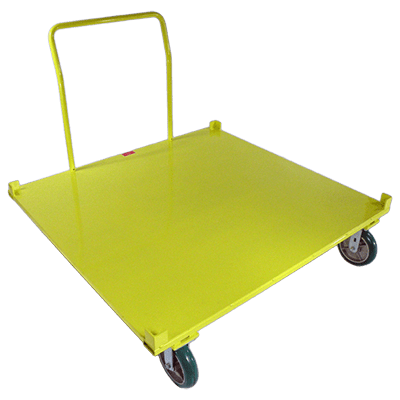
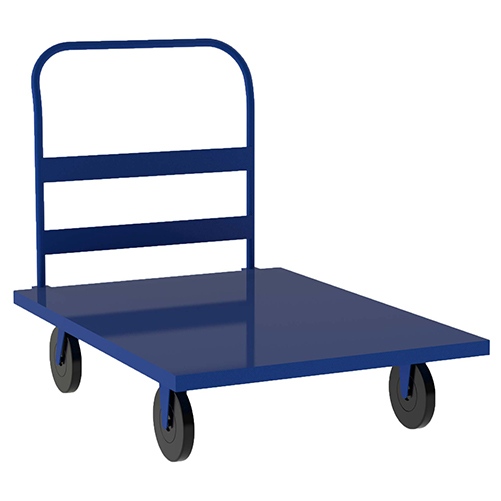
Salco can manufacture heavy duty pallet carts using welded steel construction engineered around the intended load and operating environment. Structural members, platform design, supports, reinforcements, and other components can be selected according to the demands of the application.
A properly engineered cart provides more than load capacity. The entire structure must work together to remain stable and manageable as the cart is loaded, moved, positioned, and unloaded.
Durable construction can also provide long-term value. A pallet trolley designed specifically for an industrial process can reduce premature equipment replacement while supporting more consistent material flow throughout the facility.
Custom Pallet Carts Designed Around Your Load
One of the biggest advantages of custom pallet carts is the ability to design the equipment around the material rather than selecting the closest available standard size.
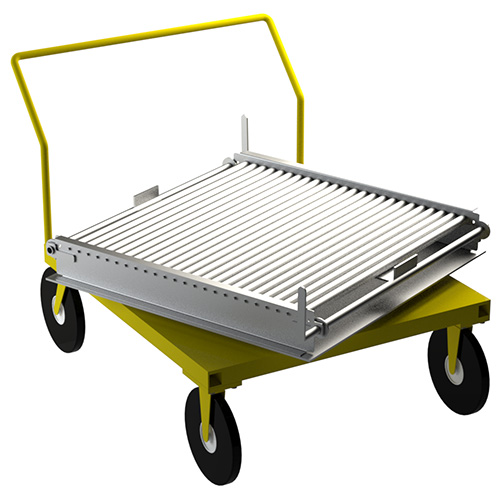
A manufacturer may need to transport a conventional pallet, but another application could involve a steel container, automotive assembly, production fixture, oversized component, or specialized material rack. Differences in dimensions, weight distribution, handling methods, and required access can significantly affect the ideal cart design.
Salco’s custom steel fabrication capabilities allow pallet carts and trolleys to be manufactured to application-specific requirements.
Depending on the project, customization may include:
- Custom platform lengths and widths
- Application-specific load capacities
- Low-profile or elevated deck heights
- Open or solid deck configurations
- Fixed, removable, or folding handles
- Push or pull configurations
- Side rails, stops, guides, or containment features
- Multiple levels or shelves
- Specialized caster arrangements
- Brakes or floor-locking systems
- Protective finishes
- Features designed around a particular pallet, container, or component
This flexibility is particularly valuable when an existing cart is creating problems such as poor maneuverability, wasted floor space, difficult loading, unstable loads, or excessive manual handling.
Pallet Trolleys for Manufacturing Material Flow
Within manufacturing facilities, materials rarely remain in one location for long. Components may travel from receiving to storage, machining, cleaning, assembly, inspection, packaging, and shipping before the manufacturing cycle is complete.
Industrial pallet trolleys can help create a more organized flow between these processes.
For example, a cart can be loaded with components in a staging area and moved directly to the appropriate production cell. Once a process is complete, the same trolley may transport the components to the next operation. Reducing unnecessary transfers can simplify handling and help keep work-in-process inventory organized.
Mobile pallet carts can also support facilities that regularly reconfigure production cells or manufacturing lines. Unlike permanent material handling structures, carts can be relocated as workflows, equipment, or production requirements change.
Warehouse Pallet Carts for Picking, Staging, and Distribution
Pallet carts are equally useful in warehousing and distribution environments. They can provide a straightforward way to move inventory without relying on powered equipment for every material transfer.
Warehouse pallet carts can be used for order staging, replenishment, picking operations, receiving, packing, and outbound shipping. A properly sized cart can allow workers to consolidate materials and reduce the number of trips required between different areas of a facility.
For operations handling a variety of products, custom configurations can also improve organization. Stops, dividers, containment features, or specialized deck designs can help keep materials positioned during movement and simplify loading and unloading.
Choosing the Right Casters and Wheels for Pallet Carts
A strong frame alone does not make an effective industrial pallet cart. Casters have a major influence on how the equipment performs once it is loaded.
Wheel diameter, material, load rating, caster placement, and swivel configuration should be evaluated according to the intended use. A cart carrying a substantial load may technically support the required weight but still be difficult to maneuver if its caster configuration is poorly matched to the application.
Factors to consider include:
- Total loaded weight
- Floor surface and condition
- Required turning radius
- Aisle width
- Travel distance
- Frequency of movement
- Manual versus assisted movement
- Need for directional control
- Requirements for brakes or stationary positioning
Some applications benefit from swivel casters for maneuverability, while others require a combination of rigid and swivel casters for greater directional stability. Locking casters or floor locks can also help keep a cart securely positioned during loading, unloading, or production tasks.
Ergonomic Pallet Cart Design
Moving a heavy load manually can place considerable demands on an operator. Cart design should therefore consider not only what the equipment carries but also how workers interact with it.
Handle height and location, caster selection, deck height, visibility, loading access, and overall cart dimensions can all influence ergonomics.
For example, designing the cart at an appropriate working height may reduce unnecessary bending during repeated loading operations. Properly positioned handles can provide better leverage, while an appropriate caster configuration can reduce the force required to start, stop, and steer the cart.
These same principles are important throughout Salco’s ergonomic cart solutions, where equipment is developed to complement the material handling task instead of adding unnecessary movement to it.
Improving Safety During Pallet Transport
Industrial pallet carts can also be designed with features intended to improve load control and stability. The appropriate solution depends heavily on the materials being transported.
A flat platform may be sufficient for some palletized loads. Other components may require locating features, side restraints, raised edges, stops, or custom supports to reduce movement during transport.
Manufacturers should consider the center of gravity, load distribution, cart height, floor conditions, and how the load is placed onto and removed from the trolley. These factors become increasingly important when handling heavy, tall, or irregularly shaped materials.
Designing these considerations into the cart from the beginning can create a more practical solution than modifying generic equipment after it has been placed into service.
Pallet Carts for Automotive and Heavy Manufacturing
Automotive and heavy manufacturing operations frequently require movement of large components, assemblies, containers, tooling, and work-in-process materials. Standard warehouse equipment may not provide the dimensions, strength, or part protection these applications require.
Custom pallet carts can be engineered around a specific automotive component or production process. Depending on the application, a trolley might include locating points, protective contact surfaces, dividers, or other features that keep components properly positioned.
This approach can help reduce part-to-part or part-to-cart contact while creating a repeatable material handling process from one production stage to another.
Pallet Handling Solutions for Food Production
Food manufacturing and processing facilities present a different set of requirements. Equipment may encounter moisture, frequent cleaning, temperature changes, or other demanding operating conditions.
Material selection, cart geometry, accessibility, and finish can therefore become important considerations when designing equipment for these environments. Salco develops food industry material handling solutions for applications where durability, mobility, and cleanability must be considered together.
Integrating Pallet Carts into Lean Manufacturing
Custom pallet carts can also support lean manufacturing initiatives by helping facilities position the correct materials where they are needed while reducing unnecessary movement.
Instead of maintaining large quantities of inventory beside a production line, carts can support controlled replenishment of parts and materials. Mobile equipment can also make it easier to modify production layouts without rebuilding permanent storage infrastructure.
Potential workflow advantages include:
- Reducing unnecessary material transfers
- Improving point-of-use material availability
- Organizing work-in-process inventory
- Supporting line-side replenishment
- Reducing congestion around production areas
- Adapting to changing manufacturing layouts
When pallet carts are designed as part of the overall workflow rather than simply as transportation equipment, they can become an integral part of the material handling system.
Custom Pallet Carts vs. Standard Pallet Carts
Standard carts can be appropriate when the application is straightforward and the load fits common dimensions. However, manufacturers often discover that adapting their process to generic equipment introduces compromises.
A cart may be wider than necessary, too tall for convenient loading, difficult to steer when loaded, or unable to properly secure the product. Those small inefficiencies can become significant when the same material handling task is repeated hundreds of times.
Custom pallet carts address these issues at the design stage. The goal is not customization simply for the sake of having specialized equipment. It is to develop a trolley whose dimensions, construction, mobility, and handling features match the actual job it needs to perform.
Industries That Use Industrial Pallet Carts and Trolleys
Salco’s material handling equipment can be developed for applications across a variety of industries, including:
- Automotive manufacturing
- Warehousing and fulfillment
- Logistics and transportation
- Aerospace manufacturing
- Food processing and production
- Industrial manufacturing
- Heavy equipment production
- Assembly and fabrication operations
Different industries—and even different departments within the same facility—can have substantially different requirements. Custom engineering allows the pallet cart to be matched to those requirements rather than relying on a one-size-fits-all approach.
Why Choose Salco for Industrial Pallet Carts?
With decades of experience developing industrial material handling equipment, Salco Engineering & Manufacturing can support projects from initial concept through fabrication and production.
Customers can work with Salco to develop pallet carts based on the load, operating environment, facility layout, and desired workflow. Existing designs can be evaluated, or a new cart can be developed around specific operational challenges.
Salco’s broader industrial carts and trolleys capabilities also make it possible to develop related material handling equipment for different areas of the same facility, creating solutions that better support the overall manufacturing or warehouse workflow.
Request a Quote for Custom Pallet Carts and Trolleys
The right industrial pallet cart can do much more than move a load. A properly engineered solution can simplify material flow, improve maneuverability, organize work-in-process inventory, support safer handling, and better utilize valuable production space.
Whether you need a heavy duty pallet cart for manufacturing, a mobile pallet trolley for warehouse operations, or a completely custom solution designed around a unique component or container, Salco can help develop equipment for the application.
Request a quote from Salco Engineering & Manufacturing to discuss your pallet cart requirements, load specifications, dimensions, operating environment, and material handling goals.