


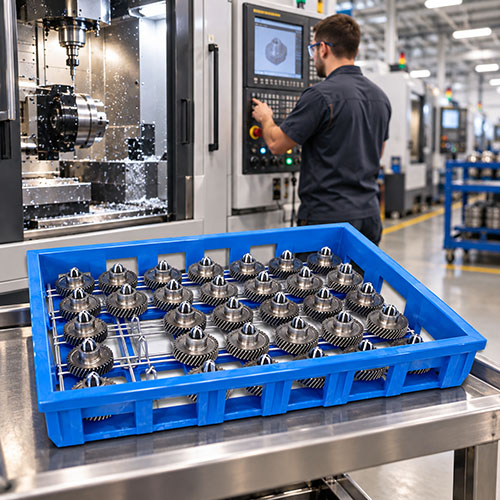
Automotive and aerospace manufacturers depend on reliable material handling systems to move valuable components between production facilities, suppliers, assembly lines, and distribution centers. Throughout these operations, parts must remain organized, protected, and accessible while minimizing unnecessary handling and packaging waste. Returnable dunnage systems provide a practical solution by combining reusable containers with custom-designed inserts that support and separate individual components.
Unlike disposable packaging that is discarded after a single shipment, returnable dunnage is designed to circulate repeatedly through manufacturing and logistics operations. Durable containers, steel wire inserts, and specialized part-holding features can be engineered around specific components, helping manufacturers maintain consistent handling methods throughout the supply chain.
For automotive and aerospace applications, these systems can offer advantages beyond basic part protection. Properly designed returnable dunnage can improve loading efficiency, support organized inventory management, reduce recurring packaging purchases, and create a more standardized process for moving parts between facilities.
What Are Returnable Dunnage Systems?
Returnable dunnage systems are reusable packaging and material handling solutions designed to protect, separate, and organize components during transportation, storage, and production. They typically combine a durable outer container with inserts or fixtures that hold parts in designated positions.
The outer container may be a reusable plastic tote, steel rack, or other industrial container. Inside, custom dunnage inserts are designed around the dimensions, weight, surface characteristics, and handling requirements of the parts being transported.
One particularly effective approach combines standard returnable plastic totes with custom steel wire inserts. The plastic container provides a lightweight, stackable structure, while the wire insert creates individual positions that keep components separated and properly oriented.
Salco Engineering manufactures custom dunnage inserts for returnable containers, including formed-wire dividers and supporting structures designed for specific industrial components. These systems can be adapted to existing containers or incorporated into new material handling configurations.
Why Automotive Manufacturers Use Returnable Dunnage
Automotive manufacturing involves high volumes of components moving through complex supplier networks. Parts may travel from machining or fabrication facilities to finishing operations, assembly plants, warehouses, and distribution centers. In many cases, these movements occur repeatedly between the same locations.
Returnable dunnage systems are particularly useful in these closed-loop supply chains because the same containers can be unloaded, returned to the supplier, and used again for subsequent shipments.
Protecting Precision Automotive Components
Automotive components often include machined surfaces, mounting features, finished edges, and other characteristics that can be damaged through improper handling. Transmission components, steering assemblies, brackets, housings, and other precision parts may require specific positioning during transport.
Custom dunnage inserts can hold individual parts in defined locations rather than allowing them to contact one another inside a bulk container. This helps reduce movement, scratching, and impact while also making it easier for operators to load and unload components consistently.
Supporting High-Volume Production
Production facilities need predictable material flow to maintain assembly schedules. When each container holds a defined number of parts in a consistent arrangement, receiving and production personnel can identify quantities more easily and prepare components for downstream operations.
A standardized container layout also helps simplify work instructions. Instead of handling loosely packed components, operators can work with an organized arrangement designed around the production process.
Reducing Disposable Packaging
High-volume automotive supply chains can generate substantial quantities of cardboard, plastic film, foam, and other single-use packaging materials. Where transportation routes and container-return procedures are well established, returnable dunnage can reduce dependence on these disposable products.
Although reusable systems require an initial investment and ongoing maintenance, their ability to support repeated shipping cycles can make them an attractive option for long-term manufacturing programs.
Returnable Dunnage for Aerospace Components
Aerospace manufacturing presents different material handling challenges. Production quantities may be smaller, component values may be higher, and parts can have complex geometries that require careful support during transportation and storage.
Custom returnable dunnage systems can be particularly useful for aerospace parts that travel repeatedly between machining, finishing, inspection, assembly, and testing operations.
Protecting Complex Part Geometry
Aerospace components may contain thin walls, precision-machined features, delicate surfaces, or irregular shapes that do not fit securely in conventional packaging. Generic dividers may leave important areas unsupported or allow the part to shift during handling.
Custom wire inserts can be designed to support components at appropriate contact points while maintaining clearance around critical surfaces. Additional protective materials may be incorporated where direct metal contact is undesirable.
Maintaining Part Organization
Consistent part positioning is especially valuable when components move between multiple workstations or facilities. A dedicated dunnage layout can provide an assigned location for each part, making quantities and missing components easier to identify.
Identification plates, labels, or compatible tracking methods can also be incorporated into the container system when required by the customer’s inventory and traceability procedures.
Accommodating Specialized Handling Requirements
Aerospace components may require particular considerations related to cleanliness, corrosion protection, surface finish, and environmental exposure. Dunnage materials and contact surfaces should be selected according to those requirements rather than assuming one construction method will work for every application.
For example, stainless steel inserts may be appropriate where corrosion resistance and cleanability are priorities, while coated steel or additional protective contact materials may be considered for components with sensitive finished surfaces.
Benefits of Custom Wire Inserts for Returnable Containers
Custom wire inserts provide an effective way to combine structural strength with flexible part positioning. Formed and welded steel wire can create lightweight support structures that fit inside standard plastic containers while maintaining open space around individual components.
Unlike a fully molded plastic insert, a fabricated wire design can often be modified to accommodate specific dimensions, support points, and part arrangements without requiring an entirely new molded container.
Part Separation and Positioning
Wire dividers, frames, and locating features can be designed to establish dedicated positions for each component. This organization helps minimize part-to-part contact and can make loading procedures more repeatable.
Reduced Container Weight
Open wire construction provides support without requiring a completely solid interior structure. Depending on the design and load requirements, this can help control the overall weight of the container system while maintaining the strength needed for repeated industrial handling.
Flexible Design and Modification
Manufacturers frequently introduce revised components, adjust production quantities, or change packaging requirements. Fabricated wire inserts may provide useful flexibility when changes are needed, particularly when the existing outer container dimensions can remain the same.
Compatibility With Existing Containers
Many facilities already use standardized reusable plastic totes. Designing custom inserts to fit those containers can allow manufacturers to improve part protection without completely replacing their established packaging system.
For larger components or applications requiring more substantial support, custom steel wire baskets can also provide durable, application-specific material handling solutions.
Important Design Considerations for Returnable Dunnage
Designing a successful returnable dunnage system requires evaluating the complete handling process. A container that protects parts during storage may not necessarily perform well during transportation, automated handling, or repeated loading and unloading.
Part Weight and Load Distribution
The insert must support the weight of its contents without excessive deflection or deformation. Heavy components may require reinforced wire frames, additional support points, or a more substantial container structure.
Load distribution is particularly important when multiple parts are stored within the same tote. The system should prevent concentrated loads from damaging the container or causing instability during stacking and transportation.
Part Orientation and Contact Points
Proper part orientation can help protect important surfaces while simplifying loading and unloading. Custom locating features may be designed around noncritical areas of the component so that machined, coated, or finished surfaces receive appropriate clearance.
For some parts, vertical positioning may improve accessibility. Others may need to rest horizontally or be supported at multiple points to avoid unnecessary stress.
Stackability and Storage Efficiency
Returnable containers are often stacked in warehouses, trucks, and staging areas. Inserts must not interfere with the container’s stacking features or create loads that exceed the strength of the overall system.
Designers should also consider how empty containers will be stored and returned. Nestable or collapsible packaging can reduce return-shipping volume in appropriate applications, although these features must remain compatible with the insert design.
Loading and Unloading Requirements
A well-designed dunnage system should make it straightforward for operators to place and remove components. Adequate hand clearance, consistent positioning, and accessible part locations can improve usability.
Where robotic loading or unloading is planned, the system may require tighter control of part orientation and placement. Consistent positioning can help automated equipment identify and access components reliably.
Material and Finish Selection
Carbon steel, stainless steel, protective coatings, and supplemental contact materials may all be considered depending on the application. Selection should reflect environmental conditions, corrosion resistance, part sensitivity, cleaning procedures, and expected wear.
For sensitive components, the design may combine the strength of steel wire with protective materials at specific contact points rather than coating every surface unnecessarily.
Integrating Returnable Dunnage With Industrial Carts and Racks
Returnable dunnage works best when it fits naturally into the existing material handling process. Containers may need to move between receiving docks, warehouses, machining centers, inspection stations, and assembly operations without repeatedly transferring parts into different packaging.
Custom industrial carts and trolleys can be designed to transport containers in organized configurations. Depending on the application, these carts may include dedicated shelves, guides, containment features, and caster arrangements that support efficient movement through the facility.
Integrating the dunnage system with carts and racks can also improve how materials are staged beside production equipment. Instead of placing containers directly on the floor or repeatedly lifting them between surfaces, facilities can use mobile or stationary support equipment designed around the container dimensions.
Evaluating the Long-Term Cost of Returnable Dunnage
The initial purchase price of a returnable system is only one part of its total cost. Manufacturers should also consider how frequently the containers will be used, the number of trips expected, handling labor, return transportation, cleaning, storage, maintenance, and replacement requirements.
Reusable containers may cost more initially than disposable packaging, but that cost can be distributed across multiple shipping cycles. Savings may also result from reduced packaging purchases, fewer damaged parts, and more efficient handling.
However, returnable packaging is not automatically the most economical option for every supply chain. Systems used for infrequent, one-way shipments may incur substantial return transportation and administration costs. The business case is generally stronger when the containers circulate frequently along predictable routes and can be tracked and recovered reliably.
Evaluating these costs before implementation helps manufacturers determine the number of containers needed and whether the proposed system offers a practical return on investment.
Maintaining a Successful Returnable Packaging Program
A returnable dunnage system should be evaluated throughout its service life rather than only when the containers are first introduced. Repeated use can expose wire inserts, coatings, containers, and supporting features to wear.
Routine inspection can help identify bent dividers, damaged welds, worn protective surfaces, cracked totes, and other issues that could compromise part protection. Cleaning procedures may also be necessary where containers accumulate oils, debris, or other manufacturing contaminants.
Container tracking and return procedures are equally important. Lost containers, inconsistent return schedules, and insufficient packaging inventory can disrupt production even when the dunnage itself is well designed.
For successful long-term operation, manufacturers should establish clear procedures for container identification, return logistics, inspection, and removal of damaged equipment from service.
Custom Design and Prototyping for Returnable Dunnage
Because automotive and aerospace components vary considerably in shape, size, and handling requirements, custom dunnage development should begin with a clear understanding of the part and its movement through the manufacturing process.
Important information may include component drawings, part samples, maximum weight, required quantity per container, container dimensions, handling equipment, contact restrictions, and shipping conditions.
Using CAD modeling and prototyping, manufacturers can evaluate how the insert supports the part, whether operators have sufficient access, and how the system fits into existing material handling equipment. Salco’s design and prototyping services can support the development of custom inserts and fabricated structures before repeat production begins.
For more demanding applications, prototype systems can also be evaluated under representative loading, transportation, and handling conditions. Identifying problems early can reduce the likelihood of costly modifications after a full container fleet has been manufactured.
Building More Efficient Returnable Dunnage Systems
Returnable dunnage systems provide automotive and aerospace manufacturers with a structured approach to protecting components while improving material flow and reducing reliance on disposable packaging. When designed around the actual parts and transportation process, reusable containers and custom inserts can support consistent loading, organized storage, reliable part positioning, and repeated use throughout the supply chain.
Steel wire inserts offer particular advantages because they can be engineered around complex part geometries while integrating with standard plastic totes, industrial baskets, and material handling equipment. The result is a flexible approach to reusable packaging that can be adapted to demanding automotive and aerospace applications.
Salco Engineering & Manufacturing designs and fabricates custom dunnage inserts, wire baskets, and material handling products for manufacturers that need durable, application-specific solutions. From individual formed-wire inserts to complete returnable container configurations, our team can help develop equipment around your parts, handling requirements, and production workflow.
If your facility is evaluating a new returnable packaging program or needs to improve an existing dunnage system, contact Salco Engineering to discuss your component dimensions, container requirements, production quantities, and material handling challenges.