


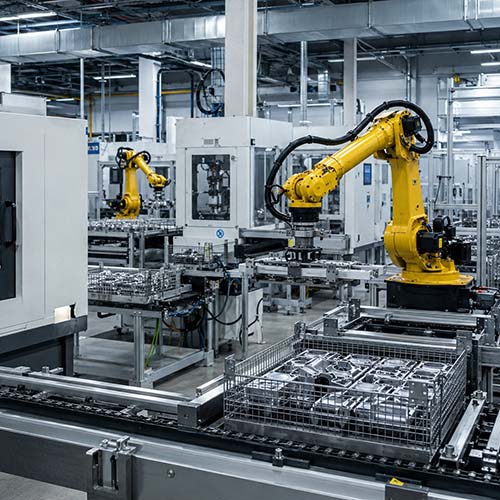
Automated manufacturing environments depend on repeatability, precision, and smooth material flow. As more facilities integrate robotics, CNC machines, automated wash systems, and production cells, the equipment used to hold, move, and present parts becomes just as important as the machinery itself. Robotic material handling baskets are designed to support these automated workflows by keeping parts organized, accessible, properly oriented, and ready for each step in the process.
In manual operations, employees can adjust parts, reposition components, or make small handling changes as needed. Automated systems do not have that same flexibility unless the baskets, trays, racks, or fixtures are designed correctly from the start. A robot loading a CNC machine, transferring parts to a wash line, or moving components through an automated production cell needs consistent part placement. If parts shift, nest, tip, or become difficult to access, the entire process can slow down or fail.
Custom robotic material handling baskets help solve these challenges by creating a reliable interface between the part, the robot, and the equipment. Salco Engineering designs and manufactures custom wire baskets and industrial basket solutions that can be built around part geometry, automation requirements, cleaning needs, and production workflow.
Why Robotic Material Handling Baskets Matter
Automation works best when every part of the process is predictable. Robots, conveyors, CNC machines, wash systems, and automated cells all rely on consistent positioning and repeatable movement. If parts are randomly placed in a bin or stacked without organization, it becomes harder for automation equipment to pick, load, unload, wash, or transfer them efficiently.
Robotic material handling baskets are designed to keep parts in a controlled layout. This may include custom dividers, formed wire supports, compartments, part nests, locating features, or open basket structures that allow robots and operators to interact with parts consistently.
These baskets can help support:
- Consistent part orientation
- Improved robotic pick access
- Reduced part-to-part contact
- Better visibility for operators and vision systems
- Cleaner movement through wash or rinse cycles
- Reduced manual handling
- Improved workflow between automated production steps
When baskets are designed around automation, they become part of the production system rather than a basic storage container.
Robotic Baskets for CNC Loading and Unloading
CNC machining operations often involve repetitive loading and unloading of raw parts, semi-finished components, or completed machined parts. Robotic loading can improve efficiency by reducing manual handling and allowing machines to run more consistently. However, the robot must be able to access each part in a predictable way.
Custom baskets for CNC loading can be designed to hold components in fixed positions so robotic arms can pick them accurately. Depending on the part, a basket may include formed wire pockets, custom spacing, part stops, open sides, or orientation guides. These features help ensure the robot can locate and grip the part without interference.
For CNC unloading, baskets may also need to protect finished surfaces or machined features. Parts coming out of a CNC machine may have critical dimensions, sharp edges, threaded areas, or finished surfaces that must be protected from impact. A custom basket can keep parts separated and reduce the risk of damage as they move to washing, inspection, deburring, or assembly.
Baskets for Automated Wash Lines
Automated wash lines are used to remove machining oils, coolants, chips, debris, residues, and contaminants from industrial parts. For these systems to work properly, the basket must allow cleaning fluids, spray, air, and debris to move freely around the parts.
Wire basket construction is especially useful in wash line applications because it supports drainage, airflow, and visibility. Open wire spacing can allow cleaning solution to reach more surfaces while helping water and debris drain away after the wash cycle.
Custom baskets for wash lines may be designed around:
- Washer dimensions and conveyor clearance
- Spray pattern or immersion requirements
- Part spacing for proper cleaning exposure
- Drainage and drying needs
- Load capacity and basket weight
- Material selection for corrosion resistance
- Robotic or operator loading requirements
When baskets are built for the wash process, they can improve cleaning consistency and reduce the need for secondary cleaning or rework.
Supporting Automated Production Cells
Automated production cells often combine several pieces of equipment into one coordinated workflow. A cell may include a robot, CNC machine, conveyor, inspection station, wash system, assembly fixture, or packaging station. In these environments, baskets need to support movement between steps without creating bottlenecks.
A well-designed robotic material handling basket can help standardize how parts enter, move through, and leave the production cell. This can make it easier to manage part flow, reduce operator intervention, and improve consistency from one cycle to the next.
For automated production cells, basket design may need to account for robot reach, gripper clearance, part spacing, machine access, cycle time, and how full or empty baskets are exchanged. The basket may also need to work with carts, racks, conveyors, turntables, or lift systems.
Improving Part Orientation and Pick Accuracy
Part orientation is one of the most important design considerations for robotic handling. If a robot expects a part to be in one position but the part shifts during transport, the system may mis-pick, pause, or require manual correction. Custom baskets help prevent this by holding each part in a repeatable location.
Part-specific supports can be used to control orientation and spacing. For example, a machined part may sit in a formed wire pocket that prevents rotation. A long component may rest in multiple support points to prevent tipping. A delicate part may be separated from surrounding parts to prevent contact during movement.
Consistent orientation can also support vision systems. If a camera or sensor is used to confirm part location, open basket construction and clear part spacing can improve visibility and reduce confusion.
Reducing Part Damage in Automated Workflows
Automation can move quickly and consistently, but parts still need protection throughout the process. If components shift inside a basket, collide during movement, or stack unevenly, damage can occur before or after the automated step.
Robotic material handling baskets can be designed with part protection features such as:
- Individual compartments
- Wire dividers
- Formed supports
- Retaining features
- Rounded contact areas
- Custom spacing
- Protective coatings or contact points when required
These features can help protect machined surfaces, threads, edges, coatings, and precision features while still allowing efficient movement through the production process.
Material and Finish Considerations
The right material for a robotic material handling basket depends on the application. Stainless steel is often a good choice for wash lines, food processing, medical applications, and environments where corrosion resistance or cleanability is important. Carbon steel may be suitable for general industrial use, especially when paired with a finish such as powder coating or plating.
Important material and finish considerations include:
- Exposure to water, chemicals, oils, or coolants
- Cleaning or washdown requirements
- Part sensitivity and surface finish protection
- Load weight and basket durability
- Temperature exposure
- Frequency of use
- Compatibility with robotic grippers or handling equipment
Choosing the right material helps ensure the basket can withstand daily production demands while supporting the needs of the automated system.
Industries That Use Robotic Material Handling Baskets
Robotic material handling baskets are useful in many industries where automation, repeatability, and part protection are priorities. These baskets can be designed for high-volume production, precision manufacturing, cleaning processes, inspection workflows, and automated machine loading.
Common industries and applications include:
- Automotive manufacturing
- Aerospace component production
- CNC machining operations
- Medical device manufacturing
- Food processing equipment production
- Electronics and technology manufacturing
- Parts washing and finishing lines
- Automated assembly cells
- Industrial robotics applications
- Precision part handling
Each application has different requirements for basket size, wire spacing, part orientation, load capacity, cleaning access, and automation compatibility.
Custom Robotic Material Handling Baskets from Salco Engineering
Robotic material handling baskets help automated production systems operate more smoothly by keeping parts organized, accessible, protected, and properly positioned. Whether used for CNC loading, automated wash lines, inspection processes, robotic pick-and-place systems, or complete production cells, the right basket design can improve consistency and reduce unnecessary handling.
Salco Engineering designs and manufactures custom wire baskets, racks, carts, and material handling solutions for demanding manufacturing environments. Our team can work with your part requirements, automation layout, cleaning process, and production goals to develop baskets that support reliable part flow from one step to the next.
To discuss robotic material handling baskets for CNC loading, wash lines, or automated production cells, contact Salco Engineering today.