


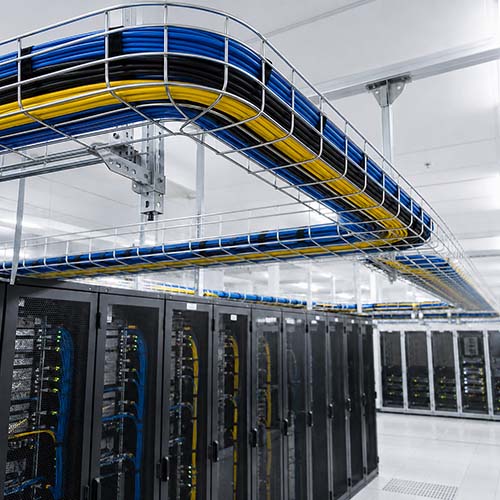
Data centers, server rooms, network closets, telecom facilities, and technology-driven industrial environments depend on clean, accessible, and reliable cable management. As systems grow, the number of power cables, data cables, fiber lines, control wiring, and communication connections can increase quickly. Without the right cable support system, cables can become difficult to trace, harder to maintain, and more vulnerable to damage.
Steel wire mesh cable trays provide a practical solution for organizing and supporting cable runs in demanding IT infrastructure environments. Their open design allows cables to remain visible and accessible while supporting airflow, routing flexibility, and easier maintenance. For facilities that need a custom cable management layout, steel wire mesh trays can be designed to fit specific spaces, equipment configurations, and installation requirements.
Salco Engineering can support custom cable tray projects through advanced wire forming and fabrication capabilities, helping customers create durable wire-based solutions for data centers, IT facilities, industrial control rooms, and equipment areas.
Why Cable Management Matters in Data Centers
Data centers are built around performance, reliability, and uptime. Every cable has a purpose, and poorly organized cabling can create problems for maintenance teams, IT managers, and facility operators. Tangled or unsupported cables can make troubleshooting more difficult, increase the risk of accidental disconnection, restrict airflow, and complicate future upgrades.
Organized cable management helps create a cleaner and more efficient infrastructure. When cables are properly routed and supported, technicians can identify connections more quickly, separate power and data lines where needed, and make changes with less disruption. This is especially important in environments where equipment is frequently upgraded, expanded, repaired, or reconfigured.
What Are Steel Wire Mesh Cable Trays?
Steel wire mesh cable trays are open-grid cable support systems made from formed and welded steel wire. They are commonly used to route and support cables above server racks, along walls, under raised floors, near equipment areas, or throughout industrial and commercial facilities.
Unlike solid-bottom trays or enclosed conduits, wire mesh trays provide an open structure. This makes cables easier to see, access, clean around, and reroute. The open construction can also help support airflow around cable bundles, which is valuable in environments where heat management is a priority.
Depending on the application, wire mesh cable trays can be designed for light-duty, medium-duty, or heavy-duty cable loads. They may be used for data cabling, power distribution, fiber optic routing, control wiring, security systems, communication networks, and other infrastructure needs.
Benefits of Wire Mesh Cable Trays for IT Infrastructure
Improved Cable Visibility
One of the main advantages of wire mesh cable trays is visibility. Because the tray is open, technicians can easily see cable paths, identify routing issues, and access specific cable groups. This can reduce the time needed for troubleshooting, maintenance, and upgrades.
In data centers and network rooms, cable visibility can also help teams maintain cleaner documentation and labeling practices. When cables are easier to trace, the facility becomes easier to manage.
Better Airflow Around Cable Runs
Heat management is a constant concern in data centers and IT environments. While servers and networking equipment generate most of the heat, dense cable bundles can also interfere with airflow if they are poorly placed or improperly managed.
Steel wire mesh cable trays allow air to move around cable runs more freely than enclosed cable management systems. This open design can help reduce airflow restrictions and support cleaner thermal management around server racks, cabinets, and equipment areas.
Flexible Routing and Easy Access
IT infrastructure often changes over time. New equipment is added, systems are upgraded, racks are rearranged, and cable pathways need to be adjusted. Wire mesh cable trays provide the flexibility needed to support these changes.
Because cables remain accessible, technicians can add, remove, or reroute cables more easily than they could with more restrictive systems. Custom tray layouts can also be designed to fit unusual spaces, avoid obstructions, or connect different equipment zones.
Strength and Durability
Steel wire mesh cable trays offer a strong and durable structure for supporting cable loads. When properly designed, they can handle repeated cable additions, maintenance activity, and long-term use in demanding environments.
Steel construction can provide the rigidity needed for overhead installations, long runs, wall-mounted systems, or equipment support areas. Depending on the environment, finish options may also be considered to help improve corrosion resistance, appearance, or long-term durability.
Custom Cable Tray Design for Data Centers
Every data center has different cable routing needs. Some facilities may require overhead pathways above server racks. Others may need tray systems that follow walls, connect network rooms, support fiber routing, or separate power and data cabling. A standard cable tray may not always fit the exact layout or load requirements of the facility.
Custom steel wire mesh cable trays can be designed around:
- Rack layout and equipment spacing
- Cable volume and cable type
- Overhead or wall-mounted installation needs
- Power and data separation requirements
- Fiber optic bend radius considerations
- Maintenance access
- Future expansion plans
- Facility airflow and cooling strategy
- Mounting locations and support points
- Environmental conditions
By designing the tray system around the space, facility teams can improve organization while reducing installation challenges.
Applications Beyond Data Centers
While data centers are a natural fit for steel wire mesh cable trays, these systems can support many other IT and industrial applications. Any facility with complex cable routing needs can benefit from open, durable, and accessible cable support.
Common applications include:
- Server rooms
- Network closets
- Telecom facilities
- Industrial control rooms
- Manufacturing automation systems
- Security and surveillance infrastructure
- Commercial building technology systems
- Audio-visual equipment areas
- Power and data distribution zones
- Equipment testing labs
In manufacturing and industrial facilities, cable trays may need to support power, control, sensor, automation, and communication wiring. In these environments, durability, accessibility, and custom sizing can be especially important.
Material and Finish Considerations
The right material and finish for a cable tray depends on where it will be installed and what environmental conditions it will face. Steel wire mesh trays are strong and dependable, but different applications may require different finishes or coatings.
For indoor IT environments, powder coating or plated finishes may be selected for appearance, organization, or protection. In more demanding environments, corrosion resistance may be a larger priority. Stainless steel may also be considered for applications exposed to moisture, cleaning processes, or harsher conditions.
Color-coded finishes can also support organization. Different tray colors may identify cable type, department, system function, or routing priority. In large facilities, this can help technicians quickly distinguish between systems and reduce confusion during maintenance.
Designing for Cable Protection
Cable trays must do more than hold cables in place. They should also help protect cables from damage. Sharp edges, improper support spacing, overloaded trays, or poorly planned routing can create stress points that affect cable life and performance.
Custom tray design can account for cable bend radius, weight distribution, access points, transition areas, and mounting support. Smooth wire construction, properly finished edges, and appropriate tray depth can help keep cables organized without creating unnecessary pressure or abrasion.
For fiber optic lines and sensitive data cables, thoughtful routing is especially important. The tray design should support clean cable paths while limiting tight bends, excessive strain, and hard-to-access areas.
Supporting Future Growth and Expansion
Data centers and IT infrastructure rarely remain static. As technology changes, facilities often need to add new servers, expand network capacity, increase redundancy, or upgrade systems. Cable management should be designed with that growth in mind.
Wire mesh cable trays can make expansion easier by keeping cable runs accessible and visible. Custom tray systems can also be designed with future capacity in mind, allowing facilities to add cables later without completely reworking the support structure.
This can reduce downtime, simplify maintenance, and make infrastructure planning more efficient.
Why Work with Salco Engineering?
Salco Engineering brings custom wire forming and fabrication experience to projects that require durable, application-specific solutions. For customers that need steel wire mesh cable trays, custom wire components, or fabricated support systems, Salco can help develop a design that fits the facility and the function.
Instead of forcing a standard product into a complex space, Salco can evaluate the application and manufacture a solution around the installation requirements, cable load, dimensions, finish preferences, and long-term use of the system.
Salco’s custom fabrication capabilities can support cable management products as well as related industrial wire products, racks, baskets, guards, carts, and material handling equipment. This makes Salco a strong partner for facilities that need wire-based solutions designed for real-world use.
Custom Steel Wire Mesh Cable Trays for Reliable Cable Management
Steel wire mesh cable trays offer an effective way to organize, support, and protect cables in data centers, server rooms, IT infrastructure spaces, telecom areas, and industrial facilities. Their open construction supports visibility, airflow, accessibility, and flexible routing, making them well suited for environments that need clean and adaptable cable management.
For facilities with unique layouts, specialized equipment, or demanding infrastructure requirements, custom cable tray design can provide a better fit than standard options. Salco Engineering can help create steel wire mesh cable tray solutions that support your cable routing, organization, and maintenance goals.
To speak to our design team about your project, contact Salco Engineering today.