


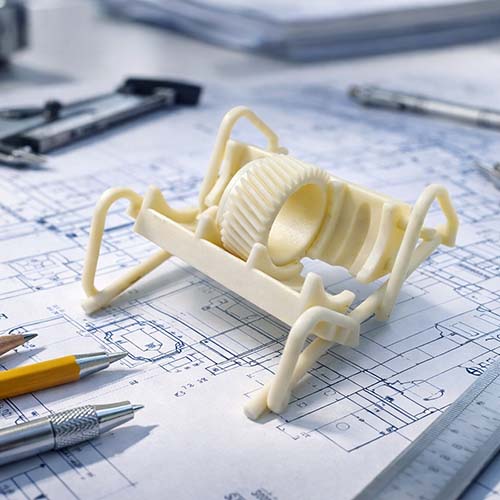
As additive manufacturing continues to mature, manufacturers are increasingly turning to advanced thermoplastics that can handle real-world production demands. Ultem material has emerged as one of the most trusted high-performance plastics used in industrial 3D printing, especially for applications that require strength, heat resistance, and long-term durability.
From functional prototypes to end-use production parts, Ultem offers a unique balance of mechanical performance and design flexibility. Understanding what Ultem material is, how it performs in 3D printing, and where it excels can help manufacturers determine whether it is the right choice for their application.
What Is Ultem Material?
Ultem is a high-performance thermoplastic belonging to the polyetherimide (PEI) family of polymers. When manufacturers ask what is Ultem, the answer typically centers on its ability to perform in demanding environments where many standard plastics fail.
Ultem material is known for its high strength-to-weight ratio, excellent dimensional stability, and resistance to heat, chemicals, and repeated mechanical stress. These properties make it widely used in aerospace, automotive, medical, electronics, and industrial manufacturing applications.
Unlike commodity plastics, Ultem maintains its structural integrity at elevated temperatures and under continuous load. It is also inherently flame resistant and produces low smoke, which makes it suitable for regulated industries and safety-critical components.
Why Ultem Material Performs So Well in 3D Printing
Ultem material is particularly well-suited for industrial 3D printing because its material properties translate directly into functional, reliable printed parts. When processed correctly, Ultem produces components that closely match injection-molded performance without the tooling costs or long lead times.
One of the key advantages of using Ultem in 3D printing is its dimensional stability. Ultem has a low coefficient of thermal expansion, which helps minimize warping, shrinkage, and distortion during the printing and cooling process. This is critical for parts with tight tolerances or complex geometries.
Ultem also offers excellent layer adhesion in fused filament fabrication systems designed for high-temperature materials. This results in strong, isotropic parts that can withstand mechanical loads and repeated use.
Mechanical and Thermal Advantages of Ultem Material
Ultem material delivers a combination of properties that few 3D printing plastics can match.
It maintains strength and rigidity at elevated temperatures, making it ideal for parts exposed to heat, friction, or thermal cycling. Many Ultem grades can withstand continuous service temperatures well above what nylon or ABS can tolerate.
Ultem also offers outstanding chemical resistance, allowing printed parts to hold up against oils, fuels, solvents, and cleaning agents commonly found in industrial environments.
These characteristics make Ultem material a strong candidate for replacing metal components in certain applications where weight reduction, corrosion resistance, or electrical insulation is desired.
Common 3D Printing Applications for Ultem Material
Ultem material is used across a wide range of industrial 3D printing applications where performance matters more than cost alone.
In aerospace and automotive manufacturing, Ultem is frequently used for functional prototypes, brackets, housings, and ducting components that must withstand heat and vibration. These parts are often printed for validation before transitioning to production or used directly in low-volume builds.
In medical and laboratory environments, Ultem material is valued for its stability, sterilization compatibility, and repeatability. It is commonly used for device housings, fixtures, and custom tooling.
Ultem is also widely used for jigs and fixtures on the manufacturing floor. Printed fixtures made from Ultem maintain precise dimensions over time and hold up under mechanical stress, making them ideal for assembly, inspection, and machining operations.
Many manufacturers pair Ultem printed fixtures with custom fabricated components such as wire forms or industrial wire baskets to create complete, application-specific material handling or assembly solutions.
Design Freedom and Rapid Iteration with Ultem and 3D Printing
Another reason Ultem material is so valuable in 3D printing is the design freedom it enables. Complex geometries, internal channels, and lightweight lattice structures can be produced without additional tooling or secondary operations.
Designs can be iterated quickly, allowing engineers to test form, fit, and function in real operating conditions. This is especially useful when Ultem parts are used alongside other custom-fabricated systems such as carts, racks, or automation fixtures.
At Salco, Ultem 3D printing is often integrated into broader design and prototyping workflows that include design and prototyping services to help clients validate ideas faster and move into production with confidence.
Why Work With Salco for Ultem 3D Printing
Salco Engineering & Manufacturing specializes in industrial-grade 3D printing using high-performance materials like Ultem. Our team understands the unique processing requirements of Ultem material and how to design parts that take full advantage of its mechanical and thermal properties.
We support a wide range of applications, from rapid prototypes to production-ready components, jigs, and fixtures. By combining additive manufacturing with in-house fabrication and engineering expertise, we help clients create durable, functional solutions that integrate seamlessly into their operations.
Start Your Ultem 3D Printing Project
Ultem material offers manufacturers a powerful combination of strength, heat resistance, and precision when used in 3D printing. Whether you are developing a functional prototype, replacing a machined component, or building custom manufacturing fixtures, Ultem can deliver performance that standard plastics cannot.
If you are exploring Ultem material for your next 3D printing project, contact Salco Engineering & Manufacturing to discuss your application. Our team can help determine the right material, design approach, and production method to meet your performance and timeline goals.