


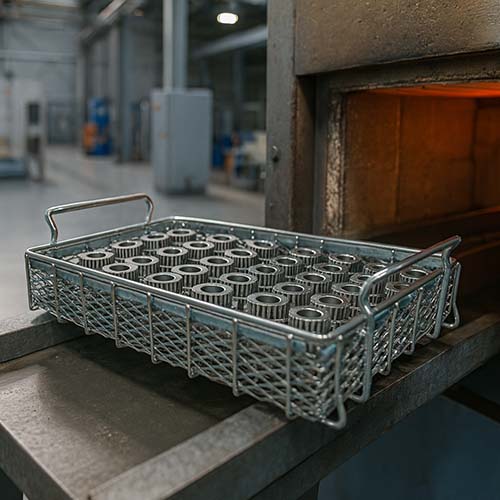
Heat treating is one of the most demanding processes in industrial manufacturing. From carburizing and annealing to quenching and tempering, components are exposed to extreme temperatures, heavy loads, and repeated thermal cycling. To withstand these conditions, manufacturers rely on properly engineered heat treating baskets that can support parts safely while maintaining dimensional stability.
When baskets are poorly designed, they can warp, crack, or contaminate parts, leading to inconsistent results, unplanned downtime, and costly rework. Well-designed heat treating baskets, on the other hand, support efficient furnace loading, uniform heat transfer, and long service life. Understanding how these baskets are engineered for strength and thermal stability is essential for any facility involved in heat treatment operations.
The Role of Heat Treating Baskets in Industrial Manufacturing
Heat treating baskets are used to hold, separate, and transport parts through furnaces and post-treatment cooling or quench systems. They must support heavy loads without sagging, allow consistent airflow around each component, and survive repeated exposure to high temperatures.
In many facilities, heat treating baskets are part of a broader material handling workflow that includes conveyors, carts, and downstream cleaning systems. Baskets designed without considering these interfaces can disrupt automation and slow production. Manufacturers that already use industrial conveyor baskets or automated handling systems often require heat treating baskets built to exact dimensional tolerances to maintain smooth transitions between processes.
Design Challenges in Heat Treating Environments
Heat treating baskets face several challenges that standard wire baskets are not built to handle.
Extreme Furnace Temperatures
Depending on the process, heat treating temperatures can exceed 1,800°F. At these temperatures, standard materials can lose strength, oxidize rapidly, or deform. Basket materials and welds must maintain structural integrity while allowing controlled thermal expansion.
Repeated Thermal Cycling
Baskets move through cycles of heating, soaking, and cooling, sometimes hundreds of times over their lifespan. Thermal cycling places stress on wire intersections and weld joints, which can lead to cracking if the basket is not designed for long-term thermal stability.
Heavy and Dense Part Loads
Many heat-treated components such as gears, shafts, and fasteners are dense and heavy. Without proper reinforcement, baskets can bow or collapse, resulting in uneven heating or part damage.
Material Selection for Heat Treating Baskets
Material selection is one of the most important factors in heat treating basket performance.
Heat-Resistant Alloys
High-temperature alloys are commonly used for heat treating baskets because they retain strength at elevated temperatures and resist scaling. These alloys are designed specifically for furnace environments where carbon steel would fail prematurely.
Stainless Steel in Post-Heat Applications
While not always suitable for the highest furnace temperatures, stainless steel baskets are often used in post-heat processes such as quenching, cooling, or washing. Facilities frequently transition parts from heat treating baskets into stainless steel wire baskets for parts washing or staging without additional handling.
Wire Diameter and Structural Reinforcement
Wire diameter directly impacts both load capacity and heat transfer. Thicker wire improves strength but may reduce airflow, while thinner wire improves circulation but can compromise durability. Reinforced frames, perimeter supports, and cross-bracing are often used to balance these competing needs.
Design Features That Improve Thermal Stability
Beyond material selection, design details play a major role in long-term basket performance.
Open Mesh Construction
Open mesh designs allow heat and quench media to circulate evenly around each part. Proper spacing reduces hot spots and helps ensure consistent metallurgical results.
Controlled Expansion Geometry
Heat treating baskets must expand and contract predictably. Designs that account for thermal movement reduce stress on welds and help prevent permanent deformation.
Precision Welding
Weld quality is often the first failure point in heat treating baskets. Precision welding techniques improve joint strength and reduce cracking caused by repeated thermal cycling. This level of fabrication control is often achieved through custom steel fabrication rather than off-the-shelf basket designs.
Custom Heat Treating Baskets vs Standard Baskets
Standard baskets may work for light-duty applications, but heat treating environments typically demand custom designs. Custom heat treating baskets are engineered around part geometry, load weight, furnace dimensions, and process flow.
Manufacturers that already invest in custom metal fabrication often see longer basket life, better part protection, and improved furnace efficiency when baskets are designed specifically for their operation.
Integration with Downstream Processes
Heat treating baskets are rarely the final step in production. After heat treatment, parts may move directly into quench tanks, cooling stations, or cleaning systems. Designing baskets that integrate smoothly into downstream processes reduces handling time and minimizes damage.
In many facilities, heat-treated parts are transferred directly into parts washing baskets, allowing parts to remain in a controlled container throughout multiple stages of production. This approach supports lean manufacturing principles and improves traceability.
Industries That Depend on Heat Treating Baskets
Heat treating baskets are widely used across industries including automotive manufacturing, aerospace and defense, heavy equipment production, industrial fasteners, and tool and die manufacturing. Each industry presents unique challenges related to temperature, load, and part complexity, reinforcing the importance of custom engineering.
Why Custom Engineering Makes the Difference
Custom-engineered heat treating baskets are designed with your specific process in mind rather than adapted from generic designs. This includes material selection, wire spacing, reinforcement placement, and compatibility with automation.
Facilities that rely on engineered solutions across their material handling systems, such as custom industrial carts, often achieve better consistency and lower total cost of ownership when heat treating baskets are treated with the same level of design attention.
Heat Treating Basket Solutions from Salco Engineering
Salco Engineering designs and fabricates custom wire baskets and material handling solutions for demanding industrial environments. From high-temperature heat treating baskets to downstream washing and transport solutions, Salco works closely with manufacturers to ensure strength, thermal stability, and long-term reliability.
Request a Custom Heat Treating Basket
If your heat treating operation requires baskets that can withstand extreme temperatures, heavy loads, and repeated thermal cycling, a custom solution can significantly improve performance and lifespan.
Contact Salco Engineering to discuss your heat treating application and request a basket design tailored to your process and production goals.