


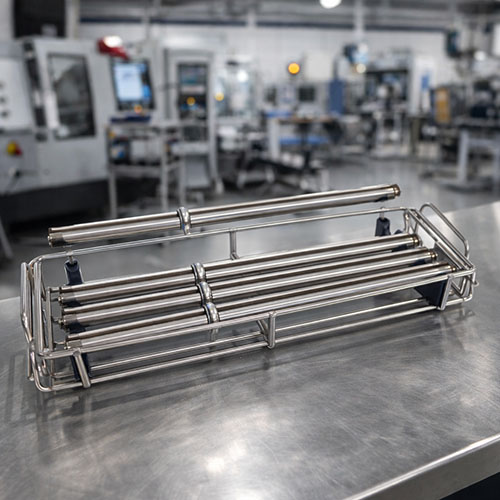
In modern manufacturing, cleanliness is not optional—it’s essential. Whether you’re producing automotive components, aerospace parts, or medical devices, the effectiveness of your industrial parts cleaning system directly impacts product quality, performance, and compliance. While much attention is given to wash equipment and chemistry, one critical element is often overlooked: the basket.
Custom baskets play a vital role at every stage of the cleaning process. From initial wash cycles to ultrasonic cleaning and final drying, properly designed baskets ensure parts are securely held, fully exposed to cleaning media, and protected throughout the workflow.
The Role of Baskets in Industrial Parts Cleaning Systems
Industrial cleaning systems are designed to remove contaminants such as oils, chips, debris, and residues from parts before they move to the next stage of production. These systems may include spray washers, immersion tanks, ultrasonic cleaning systems, and drying stations.
At every stage, baskets serve as the interface between the parts and the cleaning process. A poorly designed basket can block spray patterns, reduce cavitation efficiency, or allow parts to shift and collide. On the other hand, a well-engineered basket improves cleaning consistency, reduces damage, and increases throughput.
Custom parts washing baskets are specifically designed to address these challenges by matching the basket to the part, process, and equipment.
Stage 1: Pre-Wash and Initial Cleaning
The first stage of most industrial cleaning systems involves removing bulk contaminants such as machining oils, metal chips, and debris. This is typically done using spray washers or immersion tanks.
At this stage, basket design should prioritize:
- Open construction for maximum fluid flow
- Durability to handle heavy or abrasive parts
- Secure positioning to prevent part movement
Wire baskets with larger mesh openings are often ideal for pre-wash applications because they allow contaminants to be flushed away quickly. Reinforced frames and heavy-gauge wire ensure the basket can withstand repeated use in demanding environments.
Stage 2: Precision Cleaning and Ultrasonic Processes
Once bulk contaminants are removed, parts often move to a more precise cleaning stage—commonly ultrasonic cleaning. This process uses high-frequency sound waves to create cavitation bubbles that remove microscopic contaminants from part surfaces.
Basket design becomes even more critical during this stage. Improper basket geometry can block ultrasonic waves and reduce cleaning effectiveness.
Custom ultrasonic cleaning baskets are engineered to:
- Maximize cavitation exposure
- Ensure even spacing between parts
- Prevent contact that could damage sensitive components
- Allow full circulation of cleaning solution
Mesh size, wire diameter, and part orientation all play a role in achieving optimal results. In many cases, baskets are designed with custom nests or dividers to hold parts in precise positions, ensuring consistent cleaning across every cycle.
Stage 3: Rinsing and Secondary Cleaning
After ultrasonic cleaning, parts typically move into a rinse stage to remove any remaining cleaning agents or loosened contaminants. This step is critical for preventing residue from drying onto part surfaces.
Baskets used in this stage should support:
- Fast drainage to eliminate standing water
- Minimal obstruction to rinse flow
- Corrosion resistance for prolonged exposure to water
Stainless steel wire baskets are commonly used here due to their durability and resistance to corrosion. Their open design ensures that rinse water flows freely over and through the parts, improving cleaning consistency.
Stage 4: Drying and Post-Processing
The final stage in many industrial cleaning systems involves drying and preparing parts for the next phase of production, such as assembly, coating, or inspection.
Basket design at this stage should focus on:
- Airflow optimization for faster drying
- Part stability to maintain orientation
- Stackability for efficient handling and storage
Custom baskets can be designed to integrate with drying ovens, air blow-off systems, or conveyor lines. Proper airflow through the basket reduces drying time and prevents water spots or residue buildup.
Key Design Considerations Across All Stages
While each stage has unique requirements, several design principles apply across the entire cleaning process.
Part Protection
Preventing part damage is a top priority. Custom baskets can include dividers, formed wire nests, or protective coatings to keep parts separated and secure.
Material Selection
Stainless steel is the preferred material for most cleaning applications due to its resistance to corrosion, chemicals, and high temperatures. It also offers long-term durability in high-use environments.
Compatibility with Equipment
Baskets must be designed to fit seamlessly within existing cleaning systems. This includes matching tank dimensions, conveyor systems, and handling equipment.
Ergonomics and Handling
Handles, lifting points, and stackable designs improve ease of use and reduce operator fatigue. These features also support safer and more efficient workflows.
Customization for Workflow Efficiency
Every manufacturing process is different. Custom baskets can be tailored to match part geometry, batch sizes, and production flow, helping eliminate bottlenecks and improve throughput.
Why Custom Basket Design Matters
Standard baskets may offer a quick solution, but they rarely provide the performance needed for demanding industrial cleaning processes. Custom-designed baskets align with your exact application, ensuring that every stage of the cleaning system operates at peak efficiency.
Benefits of custom basket design include:
- Improved cleaning consistency and quality
- Reduced part damage and scrap
- Faster cycle times and increased throughput
- Better integration with existing equipment
- Long-term cost savings through durability and efficiency
By investing in custom solutions, manufacturers can optimize their entire cleaning workflow rather than just one portion of the process.
Optimizing Your Industrial Cleaning Workflow
Industrial parts cleaning systems are only as effective as the tools used within them. Baskets are not just containers—they are engineered components that influence cleaning performance at every stage.
From pre-wash to ultrasonic cleaning, rinsing, and drying, custom basket design ensures that parts are handled correctly, cleaned thoroughly, and protected throughout the process.
If your current cleaning system is experiencing inefficiencies, inconsistent results, or part damage, it may be time to evaluate your basket design. A custom-engineered solution can significantly improve performance without requiring major equipment changes.
To explore a solution tailored to your application, contact Salco Engineering and start optimizing your industrial parts cleaning system today.