


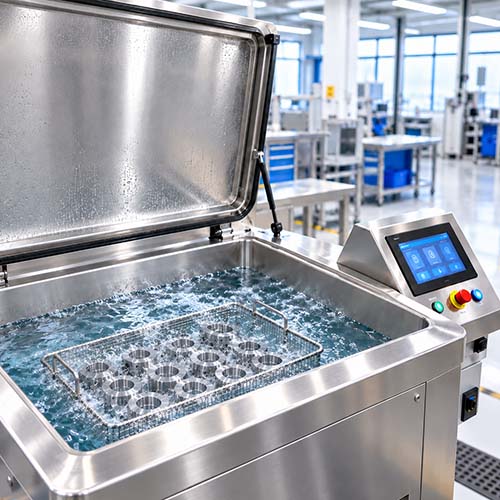
Ultrasonic cleaning is widely used in industrial manufacturing to remove machining oils, metal particles, grease, and other contaminants from precision components. While ultrasonic cleaning equipment receives much of the attention, the baskets used to hold parts during the process play an equally important role in achieving consistent results. A poorly designed basket can interfere with ultrasonic energy, restrict cleaning solution movement, and prevent certain surfaces from receiving adequate cleaning.
For manufacturers handling automotive components, aerospace parts, medical equipment, and precision-machined products, effective ultrasonic cleaning basket design can make a significant difference in overall cleaning quality, part protection, and production efficiency. Factors such as wire diameter, mesh openings, material selection, part spacing, and basket configuration all influence how effectively a cleaning system performs.
Salco Engineering & Manufacturing designs and fabricates custom industrial wire baskets for demanding manufacturing environments, including precision parts washing and ultrasonic cleaning applications. Understanding how basket construction affects ultrasonic cleaning performance can help manufacturers select equipment that supports consistent results while reducing unnecessary rework and handling.
Understanding How Ultrasonic Cleaning Works
Ultrasonic cleaning uses high-frequency sound waves transmitted through a liquid cleaning solution to remove contaminants from submerged components. These sound waves create rapidly forming and collapsing microscopic bubbles through a process known as cavitation.
When the bubbles collapse near a part’s surface, they generate localized forces that help dislodge contaminants. This action makes ultrasonic cleaning particularly useful for components with intricate geometries, recessed features, small openings, and other areas that can be difficult to reach through conventional washing methods.
However, effective cleaning depends on more than the ultrasonic equipment itself. The cleaning solution must reach the contaminated surfaces, and sufficient cavitation activity must occur around those surfaces. Cleaning chemistry, temperature, ultrasonic frequency, power, and exposure time all affect the process.
The basket holding the parts influences several of these conditions. Its structure can alter the distribution of ultrasonic energy, restrict solution access, or create areas where components receive less effective cleaning. Even a powerful ultrasonic cleaning system may produce inconsistent results when parts are improperly positioned or the basket interferes with the cleaning process.
How Basket Design Influences Ultrasonic Cleaning Efficiency
Mesh Size and Open Area Affect Ultrasonic Energy
One of the most important considerations in ultrasonic cleaning basket design is the relationship between mesh size, wire diameter, and the amount of open space within the basket.
Ultrasonic energy must interact with the cleaning liquid surrounding the parts. Dense mesh, heavy structural members, and large solid surfaces can alter the ultrasonic field and reduce cavitation activity in certain areas. Open wire configurations generally provide fewer obstructions, allowing the cleaning solution and ultrasonic energy to interact more effectively with submerged components.
However, larger openings are not always the best choice. Small components may require tighter mesh to prevent them from falling through the basket or becoming trapped in openings. Heavier parts may require stronger structural support, which can introduce additional material into the cleaning environment.
The objective is to balance adequate part containment with an open design that minimizes unnecessary interference with ultrasonic activity.
For example, a basket holding large machined steel components may benefit from a relatively open wire structure with strategically placed supports. A basket designed for small fasteners or precision hardware may require finer mesh or an additional containment insert. Both designs can be effective when engineered for their specific application.
Part Spacing Prevents Cleaning Interference
How components are arranged within a basket can be just as important as the basket’s construction.
When parts are crowded together, stacked too closely, or nested inside one another, cleaning solution may not circulate freely around every surface. Contact between components can also create areas with reduced cavitation exposure, sometimes referred to as acoustic shadowing.
This becomes particularly problematic when processing parts with complex surfaces or tight cleanliness requirements. Components positioned near the outside of an overloaded basket may receive adequate cleaning while those in the center remain contaminated.
Custom basket designs can incorporate dividers, individual compartments, support rods, or formed wire fixtures to maintain consistent spacing between components. These features help prevent parts from shifting into unfavorable positions during cleaning.
For sensitive machined components, separating parts also helps prevent scratching, impact damage, and surface wear caused by contact during vibration and handling.
Part Orientation Improves Cleaning of Complex Geometries
Ultrasonic cleaning is especially effective for complex parts, but only when the cleaning solution can reach the areas requiring treatment.
Components with blind holes, deep cavities, internal passages, or recessed surfaces can trap air when submerged. These trapped air pockets prevent the cleaning solution from contacting certain surfaces, limiting the effectiveness of cavitation in those locations.
Basket design should account for how components enter the cleaning bath and how air escapes from their internal features.
For example, a machined component containing several blind holes may require a specific orientation to allow the cavities to fill completely. A custom wire fixture can hold the component at the appropriate angle while maintaining consistent positioning throughout the cleaning process.
In some applications, controlled rotation, oscillation, or repositioning may be necessary to improve liquid access. Fixed basket positioning alone may not be sufficient for every part geometry.
Correct orientation also becomes important when removing components from the tank. Features that allow cleaning solution to enter must also permit effective drainage during subsequent rinsing and drying operations.
Basket Dimensions and Tank Positioning Matter
An ultrasonic cleaning basket must be compatible with the physical dimensions and operating characteristics of the cleaning equipment.
An oversized basket can interfere with tank walls, lifting equipment, or other system components. An undersized basket may create unnecessary handling inefficiencies or limit production capacity.
More importantly, the basket must hold parts at an appropriate position within the ultrasonic tank. Placing components directly against the tank bottom can interfere with the operation of the transducers and potentially damage equipment or parts.
Properly designed baskets maintain the necessary clearance between the load and the tank’s bottom and side surfaces, following the cleaning equipment manufacturer’s specifications.
The location of ultrasonic transducers, operating frequency, tank geometry, and distribution of acoustic energy should also be considered when determining basket dimensions and positioning.
A custom basket that fits the tank correctly helps provide consistent part placement from one cleaning cycle to the next, reducing variation caused by improper loading.
Wire Diameter and Structural Design Influence Performance
A basket must be strong enough to support its intended load while minimizing unnecessary material that could interfere with ultrasonic cleaning.
Heavy-duty baskets often require reinforced frames, thicker wire, or additional structural supports. However, excessive basket mass and dense construction can reduce the effectiveness of the ultrasonic process by altering or attenuating acoustic energy.
For this reason, basket design involves balancing strength, weight, and open area.
Custom wire forming and CNC wire bending allow manufacturers to create specialized support structures that follow the geometry of individual components. Rather than relying on heavy, continuous panels, strategically positioned wire supports can provide structural strength while preserving access to cleaning solution.
This approach is particularly useful for components that require secure positioning without excessive contact with the basket itself.
Material Selection and Surface Finishing
Stainless steel is commonly used for ultrasonic cleaning baskets because of its strength, durability, corrosion resistance, and compatibility with many industrial cleaning environments.
However, not all stainless steel grades perform identically. Material selection should consider cleaning chemistry, operating temperature, exposure duration, and any applicable cleanliness requirements.
Stainless steel wire construction is especially useful when baskets are repeatedly exposed to heated cleaning solutions, rinsing procedures, and moisture. Properly selected materials can help minimize corrosion-related deterioration and contamination concerns.
Surface finish is another important consideration. Smooth wire surfaces and properly finished welds can reduce areas where contaminants accumulate and make baskets easier to clean between production cycles.
For delicate components, protective coatings or specialized contact surfaces may be considered to reduce scratching. However, some nonmetallic materials can absorb or attenuate ultrasonic energy, so any protective coating or liner should be evaluated for compatibility with the cleaning process.
The Importance of Drainage and Rinsing in Basket Design
Ultrasonic cleaning is frequently one stage of a larger industrial parts cleaning process. Components may pass through pre-washing, ultrasonic cleaning, rinsing, drying, and inspection before continuing to assembly or packaging.
Basket design should support the entire process rather than focusing exclusively on ultrasonic exposure.
An open wire structure allows cleaning solution to drain after components are removed from the tank. Proper drainage helps reduce liquid carryover between process stages and minimizes the possibility of contaminants or detergent residues remaining within the basket.
Poorly designed baskets may contain horizontal surfaces, enclosed corners, or closely spaced structural members that retain liquid. These areas can slow drying, increase chemical carryover, and contribute to residue buildup.
Custom parts washing baskets for industrial cleaning can be engineered to maintain the same part orientation throughout cleaning and rinsing operations. This reduces unnecessary handling while supporting more consistent drainage.
For automated systems, features such as lifting points, reinforced edges, and locating fixtures can also help baskets move between stations efficiently without disturbing the components inside.
Common Ultrasonic Cleaning Problems Caused by Poor Basket Design
When ultrasonic cleaning results become inconsistent, manufacturers often investigate cleaning chemistry, cycle time, or equipment power. Although these factors are important, the basket itself may be contributing to the problem.
Uneven Cleaning Across Components
If parts near the outside of a basket are consistently cleaner than those near its center, overcrowding or excessive basket density may be limiting ultrasonic exposure.
Increasing the cycle time does not always resolve the underlying problem. Adjusting part spacing, reducing the load, or changing the basket structure may provide a more effective solution.
Contaminants Remaining in Recessed Areas
Parts with holes, channels, or complex internal features may retain contamination when their orientation allows air to become trapped during immersion.
Custom supports that hold components at a more suitable angle can improve liquid access and make the cleaning process more consistent.
Surface Scratches and Part Damage
Loose components may collide with one another or contact the basket during cleaning and handling. This is especially concerning for precision-machined surfaces, soft metals, and parts with strict cosmetic requirements.
Individual wire supports, dividers, or compatible protective contact features can help prevent excessive movement while maintaining access to cleaning solution.
Residue After Cleaning and Drying
When a basket retains cleaning solution or prevents complete drainage, detergent residues and loosened contaminants may remain on components after the wash cycle.
Improving drainage paths and part orientation can help reduce this problem, although rinse effectiveness, drying conditions, and solution quality must also be evaluated.
Custom Ultrasonic Cleaning Baskets for Different Manufacturing Applications
Different manufacturing industries present unique cleaning challenges. Custom basket design allows manufacturers to address these requirements rather than relying on standard containers that may not provide the necessary support or positioning.
Automotive Components
Automotive manufacturers frequently clean gears, shafts, valve bodies, machined housings, and other components before assembly or inspection.
Custom baskets can position these parts individually, prevent contact between finished surfaces, and accommodate the dimensions of existing cleaning equipment. Consistent part arrangement can be particularly valuable in high-volume operations where repeatable cleaning results are essential.
Aerospace and Precision Machining
Aerospace and precision manufacturing operations may require the removal of machining oils, fine particles, and other residues from components with complex geometries.
Custom wire fixtures help maintain stable positioning while allowing access to recessed surfaces and critical features. Basket materials and contact points must also be selected to avoid introducing damage or additional contamination during processing.
Medical and Laboratory Equipment
Medical device manufacturers and laboratory equipment producers may use ultrasonic cleaning as part of a validated cleaning process.
Custom stainless steel baskets can provide organized part containment, controlled spacing, and compatibility with specified cleaning procedures. Basket design must be evaluated alongside applicable cleaning requirements, material compatibility, and process validation.
Ultrasonic cleaning removes contaminants but does not, by itself, guarantee sterilization. Where sterilization is required, a separate validated process is necessary.
How Custom Basket Design Can Improve Production Throughput
Efficient ultrasonic cleaning is not simply a matter of processing as many parts as possible in a single cycle. Overloading a basket may increase the number of components placed into the machine, but it can also reduce cleaning consistency and increase the likelihood of additional washing or inspection.
A properly engineered basket balances load capacity with adequate part spacing, access to cleaning solution, and appropriate structural support.
In automated manufacturing environments, standardized basket dimensions and locating features can also improve repeatability. When each load enters the cleaning equipment in the same configuration, operators have greater control over part positioning and handling procedures.
Custom baskets may include removable inserts, dedicated component holders, lifting points, or features that integrate with robotic systems. These options can reduce manual handling while maintaining consistent part arrangements between cycles.
The potential benefits extend beyond cleaning performance. Reduced part damage, fewer rejected components, improved drainage, and more efficient loading and unloading can contribute to lower operating costs over time.
Actual improvements should be confirmed through testing under normal production conditions rather than assumed from basket design alone.
What to Consider When Designing a Custom Ultrasonic Cleaning Basket
Developing an effective ultrasonic cleaning basket requires evaluating the components being processed, the cleaning equipment, and the desired results.
Part dimensions and geometry establish the basic layout, while component weight and expected basket capacity determine structural requirements. The basket must also fit within the cleaning tank while maintaining appropriate clearances and allowing convenient loading and unloading.
Manufacturers should consider ultrasonic frequency, transducer arrangement, cleaning chemistry, operating temperature, and whether the basket will move through additional rinsing or drying equipment. The need for corrosion resistance, surface protection, and automated handling can further influence material and design decisions.
Cleaning requirements are equally important. A process intended to remove heavy machining oils may require different basket characteristics than one designed for fine particulate removal from precision components.
Before finalizing a design, manufacturers can use prototype baskets or sample fixtures to evaluate actual performance. Comparing cleaning results under the same operating conditions helps determine whether adjustments to mesh size, structural members, part spacing, or orientation are necessary.
Salco’s design and prototyping capabilities support the development of custom equipment based on specific part dimensions and manufacturing requirements. Evaluating these factors early can help produce a basket that integrates effectively with existing cleaning operations.
Improve Ultrasonic Cleaning Performance with Better Basket Design
Ultrasonic cleaning equipment depends on proper part positioning, adequate liquid access, and effective cavitation to remove contaminants consistently. The baskets used during cleaning directly influence these conditions, making their design an important part of the overall process.
Open wire construction, appropriate mesh openings, controlled part spacing, proper orientation, and effective drainage can help manufacturers improve cleaning consistency while protecting valuable components. Custom basket designs also allow facilities to address specialized part geometries, automated equipment requirements, and demanding production environments.
At Salco Engineering & Manufacturing, we design and fabricate custom wire baskets for industrial parts washing, component handling, and specialized manufacturing applications. Our team can develop basket configurations based on part dimensions, load requirements, material selection, and compatibility with existing processing equipment.
Whether your operation needs stainless steel ultrasonic cleaning baskets, specialized wire fixtures, or custom containers for a multi-stage industrial cleaning system, Salco can help evaluate your requirements and develop a practical solution.
Request a quote from Salco Engineering & Manufacturing to discuss custom ultrasonic cleaning baskets designed around your parts, equipment, and production needs.