

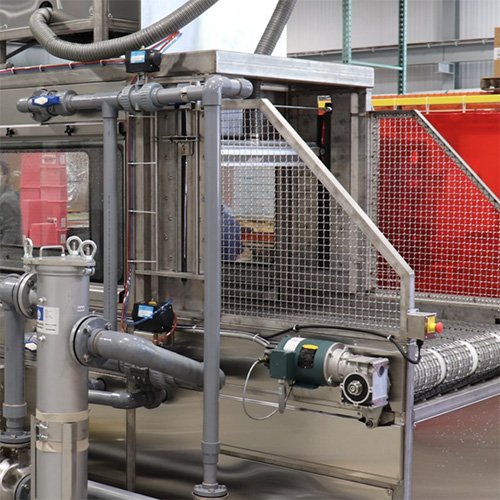
Industrial manufacturers across automotive, aerospace, medical, and general production rely on clean, contamination-free parts to maintain quality and operational efficiency. Oils, grease, machining residues, and fine particulates can interfere with downstream processes, coatings, or assembly. To meet strict cleanliness standards, many facilities use industrial part wash systems designed to remove contaminants and prepare components for the next stage of production.
This guide explores the most common types of part wash systems, their applications, essential components, and the factors to consider when choosing the right equipment for your facility.
Types of Industrial Part Wash Systems
Industrial part washers come in several configurations, each suited for different levels of contamination, part geometries, and production environments.
Immersion Wash Systems
Immersion wash systems submerge parts into a tank filled with a cleaning solution. Agitation, heat, or ultrasonic energy may be added to improve cleaning performance. Because immersion allows the solution to reach complex surfaces, these systems are ideal for parts with tight crevices, blind holes, or intricate geometry.
Spray Wash Systems
Spray wash systems use high-pressure nozzles to deliver a targeted cleaning solution across the surface of each part. They are well suited for removing heavy soils, oils, and residue from flat surfaces or larger components. These systems are commonly used in automotive and general manufacturing where throughput and fast cycle times are priorities.
Ultrasonic Wash Systems
Ultrasonic wash systems rely on high-frequency sound waves to create cavitation bubbles that lift contaminants from part surfaces. They are capable of reaching areas that manual cleaning or spray systems cannot access. For best results, parts are loaded into dedicated ultrasonic wash baskets designed to allow sound waves and cleaning solution to flow freely around each component.
Ultrasonic cleaning is often paired with other equipment such as custom wire baskets for automotive parts washing to ensure stability and part protection during the wash cycle.
Core Components of Industrial Part Wash Systems
Regardless of system type, most industrial part washers share similar foundational elements.
Wash Chambers
The wash chamber is where cleaning takes place. Chambers vary in size depending on part dimensions and production volume. Many systems include adjustable racks, shelves, or baskets to increase loading efficiency and secure parts during washing.
Pumps and Filtration
Pumps circulate the cleaning solution continuously through the system, while filtration units remove particulates and contaminants. Effective filtration is essential for maintaining solution quality and ensuring consistent cleaning performance.
Heating Elements
Heat accelerates chemical reactions and helps loosen oils and residues. Heating elements maintain the solution at the ideal temperature for the chosen cleaning chemistry.
Drying Systems
After washing and rinsing, parts must be dried to prevent corrosion and prepare them for further processing. Drying may involve heated air, blow-off systems, or vacuum drying technologies depending on the application.
How Industrial Part Wash Systems Operate
Most systems use a multi-stage cleaning process to meet strict cleanliness standards:
- Pre-wash: loosens heavy debris and oils
- Main wash: removes contaminants through spray, immersion, or ultrasonic action
- Rinse: eliminates detergent residues
- Drying: prepares parts for assembly, coating, or inspection
This staged approach ensures repeatable and reliable cleaning outcomes across a wide range of part types.
Benefits of Industrial Part Wash Systems
Industrial part washers offer several operational and financial advantages.
Improved Cleaning Consistency
Automated wash systems provide repeatable cleaning performance across every batch. This consistency helps manufacturers maintain high quality standards and reduces the risk of contamination-related defects.
Higher Productivity
By reducing manual labor and accelerating wash times, automated systems increase throughput and free up staff for other tasks. This is especially valuable for high-volume production environments.
Cost Efficiency
Automated part washing reduces labor, minimizes detergent use, and lowers water consumption. Over time, these savings contribute to better operational efficiency and reduced total cost of ownership.
Factors to Consider When Selecting a Part Wash System
Choosing the right system depends on your facility’s specific requirements.
Cleaning Needs and Industry Standards
Consider the part geometry, material, and required cleanliness levels. Industries such as automotive may follow strict technical cleanliness standards that influence system selection.
Cleaning Flexibility
Systems with adjustable wash cycles, configurable baskets, or multi-stage processing offer more flexibility for varied part types.
Durability and Reliability
Industrial wash equipment must withstand long operating hours, heat, chemicals, and heavy loads. Look for systems built with high-quality components and proven performance in demanding environments.
Environmental Considerations
Modern facilities are increasingly focused on lowering environmental impact. Selecting energy-efficient equipment, closed-loop systems, and environmentally friendly detergents supports sustainability efforts.
Supporting Equipment for Part Wash Systems
Proper fixturing and part handling equipment are critical to wash system performance. Many manufacturers use stainless steel cleaning baskets to secure parts, improve solution flow, and maintain part spacing during the wash cycle. Custom fixtures or dividers can further enhance cleaning consistency, especially for delicate or complex components.
Well-designed baskets increase efficiency by improving loading and unloading while protecting parts from damage throughout the cleaning process.
Improve Your Cleaning Process with Custom Engineered Solutions
Industrial part wash systems are essential for achieving reliable, repeatable cleaning results in manufacturing environments. Choosing the right equipment—and pairing it with properly designed baskets and fixtures—can significantly improve productivity, reduce defects, and streamline your operations.
If you are looking to upgrade your cleaning process or need guidance selecting the right wash baskets or part washing equipment, contact Salco Engineering. Our team can design custom solutions that improve efficiency, meet cleanliness standards, and support long-term operational success.