


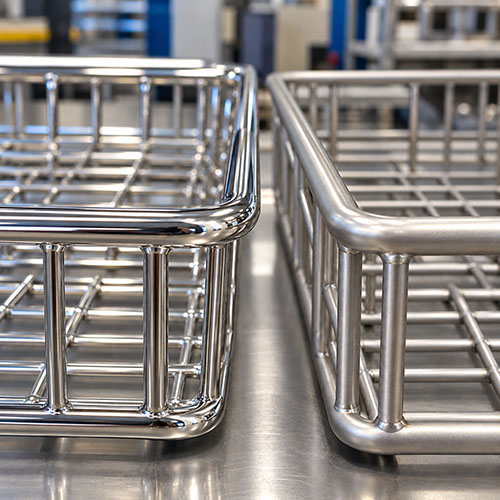
Stainless steel wire baskets are widely used in industrial manufacturing, parts washing, medical equipment handling, food processing, aerospace production, and other environments where durability, corrosion resistance, and cleanliness are important. While stainless steel naturally resists corrosion, fabrication and handling can introduce surface contamination that affects how well the material performs over time.
Two common finishing processes used to improve stainless steel surfaces are electropolishing and passivation. Although both can enhance corrosion resistance, they work differently and produce different results. Understanding the differences between electropolishing vs. passivation is particularly important when selecting the right finish for industrial wire baskets that must withstand repeated cleaning, chemical exposure, moisture, or demanding production conditions.
Choosing the appropriate treatment can help manufacturers improve basket cleanability, protect components from contamination, and avoid unnecessary finishing costs. The decision should be based on how the basket will be used rather than assuming one process is always better than the other.
Why Stainless Steel Surface Finishing Matters
Stainless steel owes much of its corrosion resistance to a thin, protective chromium-rich oxide layer that forms naturally on its surface. This passive layer helps protect the underlying metal from environmental exposure. However, manufacturing processes such as cutting, bending, welding, grinding, and handling can affect surface conditions or introduce contaminants.
For industrial wire baskets, these concerns are especially relevant because the finished assembly may include numerous welded intersections, frames, dividers, handles, and formed-wire supports. These features can create areas where residue, moisture, or contaminants are more difficult to remove.
Salco Engineering manufactures custom stainless steel wire baskets for industrial applications that require durable construction, precise part positioning, and compatibility with demanding handling or cleaning processes. Selecting the right surface finish is one consideration in developing a basket that performs reliably throughout its service life.
What Is Stainless Steel Passivation?
Passivation is a surface treatment used to improve the corrosion resistance of stainless steel by removing free iron and certain other surface contaminants. Traditional chemical passivation typically uses a controlled nitric acid or citric acid solution, followed by thorough rinsing and any required verification procedures.
The treatment helps establish a chemically clean surface that supports the formation and maintenance of stainless steel’s protective passive layer. Unlike electropolishing, conventional chemical passivation is not intended to significantly smooth the metal or change its dimensions.
Passivation is often appropriate when stainless steel components already have an acceptable surface finish but need additional treatment to address contamination introduced during fabrication or handling.
Benefits of Passivation for Wire Baskets
One of the primary advantages of passivation is its ability to improve corrosion resistance without intentionally removing a measurable amount of the underlying material. This can make it a practical finishing method for stainless steel baskets with carefully controlled dimensions or applications where surface smoothing is unnecessary.
Passivation can also be more economical than electropolishing because it generally requires less specialized processing. For baskets used in general manufacturing, storage, material handling, or moderate cleaning environments, chemical passivation may provide the desired surface condition without the added cost of electropolishing.
Limitations of Passivation
Passivation is not a substitute for proper cleaning, weld preparation, or surface finishing. It does not substantially reduce surface roughness, smooth sharp wire ends, remove significant burrs, or eliminate heavy weld scale. Those conditions may require mechanical cleaning, descaling, pickling, or another appropriate preparation process before passivation.
A passivated basket also retains most of its original surface appearance and texture. If the application requires a smoother finish for improved cleanability or reduced residue retention, electropolishing may offer additional benefits.
What Is Electropolishing?
Electropolishing is an electrochemical finishing process that removes a controlled, thin layer of metal from the surface of stainless steel. During the process, the component is immersed in a suitable electrolyte and connected to an electrical current. The treatment preferentially removes microscopic high points from the metal surface, producing a smoother and often brighter finish.
Because electropolishing removes surface material, it can reduce microscopic irregularities, remove certain embedded contaminants, and improve the overall surface condition. When properly performed, electropolishing also passivates stainless steel, making it both a surface-smoothing and corrosion-resistance treatment.
For wire baskets used in demanding industrial processes, electropolishing can be beneficial because it treats complex surfaces that may be difficult to finish consistently through mechanical polishing alone.
Improved Surface Smoothness
One of the main differences between electropolishing and passivation is the effect on surface roughness. Electropolishing can reduce microscopic peaks and irregularities that may otherwise retain residues or contribute to cleaning difficulties.
This can be particularly valuable for stainless steel baskets used in pharmaceutical processing, medical manufacturing, precision parts washing, and food production environments where cleanability is a priority.
Enhanced Corrosion Resistance
Electropolishing can improve corrosion resistance by removing free iron, surface contamination, and a thin layer of metal that may contain defects introduced during manufacturing. The process also supports the formation of a corrosion-resistant passive surface.
However, electropolishing does not make stainless steel completely immune to corrosion. The alloy grade, process chemistry, operating environment, and subsequent maintenance still influence long-term performance.
Improved Cleanability
A smoother metal surface can be easier to clean because it provides fewer microscopic irregularities where residue may collect. For wire baskets repeatedly exposed to cleaning solutions, oils, processing fluids, or other contaminants, this may help support more consistent cleaning and maintenance procedures.
Salco’s existing information about electropolishing manufacturing baskets explores these benefits in greater detail, including applications where enhanced surface quality and corrosion resistance are important.
Electropolishing vs. Passivation: Key Differences
Although both processes improve stainless steel surface conditions, their primary purposes are different. Passivation focuses on removing free iron and supporting the material’s protective surface chemistry. Electropolishing goes further by removing a thin layer of material and improving surface smoothness while also producing a passive surface.
Surface Appearance
Chemical passivation generally preserves the existing appearance of stainless steel. A brushed, matte, or otherwise finished surface will typically retain its basic characteristics after treatment.
Electropolishing commonly produces a brighter, smoother appearance, although the final result depends on the starting material, alloy, and processing conditions. It should not be assumed that every electropolished surface will achieve a mirror finish.
Material Removal
Passivation is intended to alter surface chemistry without significant dimensional change. Electropolishing intentionally removes a controlled amount of material, which can affect wire diameter, sharp edges, and other dimensional features.
For most industrial baskets, this material removal can be accounted for during design. However, it should be evaluated when a basket includes precision locating features, close-fitting components, or other critical dimensions.
Cost and Processing Requirements
Electropolishing generally requires more specialized equipment and process control than conventional chemical passivation. As a result, it often carries a higher finishing cost.
That additional expense may be justified for baskets used in cleanliness-sensitive or corrosive environments, but it may provide little practical benefit for general-purpose storage or transportation applications where passivation already meets the requirements.
Which Finish Is Better for Industrial Parts Washing Baskets?
Stainless steel wire baskets are frequently used to hold components during aqueous washing, spray cleaning, ultrasonic cleaning, rinsing, and drying. Their open construction allows cleaning solutions to circulate around the parts while supporting drainage after processing.
For these applications, both material selection and surface finish deserve careful consideration. A passivated stainless steel basket may perform well when the primary goal is corrosion resistance and the original surface condition is already suitable for the cleaning process.
Electropolishing may be preferable when improved surface smoothness, reduced residue retention, or more demanding cleanliness requirements are priorities. The choice becomes particularly important when baskets move repeatedly through wash cycles or must meet specific cleanliness expectations.
Facilities considering stainless steel ultrasonic wash baskets should also evaluate wire spacing, basket geometry, loading density, part orientation, and drainage. Even an excellent surface finish cannot compensate for a basket design that prevents cleaning solution from reaching important component surfaces.
Finishing Stainless Steel Baskets After Welding
Welding is a common part of manufacturing industrial wire baskets. Welded intersections provide structural strength and allow custom frames, dividers, handles, and part-holding features to be incorporated into a finished assembly.
However, welding can also introduce discoloration, oxide scale, heat tint, and surface irregularities. These conditions should be evaluated before selecting a finishing process because they may affect corrosion resistance and cleaning performance.
Chemical passivation alone is not intended to remove substantial weld discoloration or heavy oxide scale. Depending on the condition of the basket, additional cleaning or surface preparation may be needed before passivation.
Electropolishing can remove certain surface oxides and improve the finish around welded areas, but heavy scale, poor weld quality, and significant defects may still require preparation. Neither finishing process should be viewed as a replacement for proper welding practices and fabrication quality.
Applications in Medical and Pharmaceutical Manufacturing
Medical and pharmaceutical manufacturers frequently use stainless steel baskets and racks for holding, organizing, transporting, and processing equipment or components. These applications can involve repeated cleaning, controlled handling procedures, and specific requirements for surface condition.
Electropolishing may be advantageous when a smoother, more cleanable finish is required. Reduced surface roughness can help limit areas where processing residue may accumulate, making the finish useful for certain equipment handling and cleaning applications.
Passivation may be sufficient when the basket’s existing surface condition is acceptable and the main objective is removing free iron contamination.
Importantly, neither treatment alone establishes that a basket is sterile or suitable for every regulated application. Material grade, validation requirements, cleaning procedures, and applicable specifications must still be considered.
Applications in Food Processing
Food processing facilities frequently select stainless steel for equipment that must tolerate moisture, cleaning agents, and repeated washdowns. Wire baskets can be used to transport products, hold components, organize tools, or support processing and sanitation operations.
Electropolishing may provide additional value when easier cleaning and a smoother surface are important to the application. Passivation can remain a practical choice when corrosion resistance is the primary concern and the original finish is already appropriate.
Neither treatment eliminates the need for proper basket design. Weld quality, accessible surfaces, drainage, material selection, and cleaning procedures all affect the suitability of a stainless steel basket for food-related use.
Applications in Automotive and Aerospace Manufacturing
Automotive and aerospace manufacturers often use stainless steel baskets for handling machined components, precision assemblies, and parts moving between manufacturing processes. These baskets may encounter machining fluids, cleaning solutions, moisture, and repeated handling.
In general material handling applications, passivation may provide sufficient corrosion protection for a properly fabricated stainless steel basket. Where cleaning performance, surface contamination, or the condition of precision components is especially important, electropolishing may offer additional advantages.
For high-value components, basket geometry should also minimize unnecessary contact between parts. Custom dividers, supports, and locating features can help control movement and prevent components from colliding during transportation or processing.
Design Considerations for Electropolished and Passivated Wire Baskets
The finishing process should be considered during the initial basket design rather than after fabrication is complete. This is especially important for custom baskets with closely spaced wire members, multiple welded intersections, deep frames, or intricate part-holding features.
Engineers should evaluate the stainless steel grade, expected operating temperature, chemical exposure, cleaning frequency, part sensitivity, and any dimensional requirements. Basket geometry should allow processing solutions to reach the necessary surfaces and drain effectively during finishing and subsequent use.
If electropolishing is specified, the design should also account for controlled surface material removal. Particular attention may be necessary around thin wire sections, precision locating points, and critical contact surfaces.
For either process, the required finish should be clearly communicated to the basket manufacturer along with any inspection or testing requirements.
Industry Standards for Electropolishing and Passivation
Manufacturers may reference established industry standards when specifying stainless steel surface treatments. ASTM A967/A967M addresses chemical passivation treatments and verification methods for stainless steel parts, while ASTM B912 addresses passivation through electropolishing.
These standards are related but not interchangeable. The appropriate specification depends on the required process, material, surface condition, and verification requirements.
For industrial baskets intended for specialized medical, food, pharmaceutical, or aerospace applications, customers should identify any relevant surface finish and testing requirements during the design and quotation process. This helps ensure the selected treatment and processing documentation are appropriate for the intended use.
Choosing Between Electropolishing and Passivation
The right choice depends on what the basket needs to accomplish. Passivation is often a practical option when the goal is to remove free iron contamination and improve corrosion resistance without significantly changing the metal’s existing surface finish.
Electropolishing is worth considering when the application benefits from a smoother surface, improved cleanability, removal of a controlled surface layer, or enhanced corrosion resistance in demanding conditions.
Neither process should be specified automatically. A general-purpose basket used for clean, dry storage may not require the same finishing treatment as a basket used repeatedly in industrial wash systems or sensitive manufacturing environments.
Evaluating the actual operating conditions helps manufacturers select a finish that meets performance requirements without adding unnecessary processing costs.
Custom Stainless Steel Baskets for Demanding Manufacturing Applications
Electropolishing and passivation both play important roles in preparing stainless steel baskets for industrial use. While passivation focuses primarily on improving surface chemistry and corrosion resistance, electropolishing also modifies surface texture through controlled material removal. Understanding these differences can help manufacturers make more informed decisions about durability, cleanliness, maintenance, and long-term basket performance.
Salco Engineering & Manufacturing designs and fabricates custom stainless steel wire baskets for parts washing, automotive manufacturing, aerospace applications, medical and pharmaceutical handling, food processing, and general industrial production. Our team can work with customers to evaluate basket construction, material selection, part protection, and finishing requirements based on the intended application.
If your company needs custom stainless steel baskets for cleaning, transportation, processing, or storage, contact Salco Engineering to discuss your component dimensions, production environment, surface finish requirements, and material handling needs.