


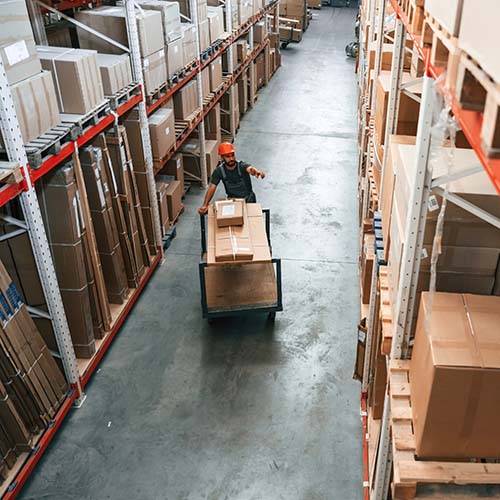
Efficient material handling is one of the foundations of a productive warehouse. Products, components, tools, packaging materials, and finished orders may need to move through dozens of different steps before leaving a facility. When the equipment used to make those moves is poorly matched to the job, employees spend more time walking, lifting, repositioning loads, and searching for materials. The right warehouse cart solutions can simplify these processes and help create a more organized, efficient operation.
Warehouse carts are available in many configurations, from basic utility carts to heavy-duty platforms, shelving carts, stock picking carts, and completely custom material handling systems. Choosing the right cart for your facility requires more than simply comparing dimensions and load capacities. Manufacturers and warehouse managers should also consider how materials move through the building, how frequently carts are used, the types of loads being transported, aisle dimensions, employee ergonomics, caster requirements, and opportunities to improve workflow through customization.
For operations with specialized requirements, a purpose-built warehouse cart can do more than move products from one location to another. It can become an integral part of the picking, staging, production, storage, and shipping process.
Why Warehouse Cart Solutions Matter for Material Handling Efficiency
A warehouse cart may appear to be relatively simple equipment, but its design can have a significant impact on daily productivity. Employees who repeatedly travel between storage locations, production areas, packing stations, and loading docks can lose substantial time when materials cannot be transported efficiently.
A properly designed cart allows more products or components to be moved in a single trip while keeping them organized and accessible. This can reduce unnecessary walking and manual handling while helping maintain a predictable flow of materials throughout the facility.
Warehouse cart solutions can help operations:
- Reduce unnecessary trips between storage and work areas
- Move larger quantities of materials efficiently
- Keep components organized during picking and transport
- Reduce manual carrying and lifting
- Stage products closer to their point of use
- Improve order picking and replenishment processes
- Reduce the risk of product damage during transport
- Make better use of available warehouse floor space
The greatest improvements often come from matching the cart to the actual workflow rather than forcing employees to adapt their processes to a generic cart.
Warehouse Carts Can Help Improve Worker Safety and Ergonomics
Material handling frequently involves repetitive lifting, pushing, pulling, bending, and reaching. A cart that is too low, difficult to maneuver, improperly balanced, or poorly configured for the load can make these tasks more difficult than necessary.
Well-designed ergonomic carts can position materials at more convenient working heights and reduce the amount of manual carrying required throughout a shift. Handles can be positioned for comfortable control, while caster selection can be matched to cart weight, load requirements, floor conditions, and desired maneuverability.
Safety considerations should therefore be part of the initial warehouse cart design rather than an afterthought. A cart that is easier to load, control, position, and unload can support both productivity and employee comfort.
Common Types of Warehouse Carts
Different warehouse processes require different cart configurations. Understanding the primary types of carts can help determine which design is best suited to a particular operation.
Utility Carts
Utility carts are among the most versatile warehouse cart solutions. They can be used to transport boxes, tools, supplies, components, packaging materials, and other general-purpose items throughout a facility.
Depending on the application, custom utility carts can incorporate shelves, bins, dividers, handles, containment features, or other components that make materials easier to organize and transport.
Instead of using a single generic cart throughout the facility, manufacturers can configure utility carts around specific departments or tasks.
Pallet Carts and Heavy-Duty Platform Carts
Warehouses frequently need to transport loads that are too large or heavy for conventional shelving carts. Pallet carts and heavy-duty platform carts provide a strong, open surface for moving containers, bulk products, palletized materials, and other large loads.
These carts can be particularly useful for staging products, moving inventory between departments, supplying production areas, or transferring goods to and from shipping and receiving.
When selecting a heavy-duty cart, the frame, deck, caster configuration, handle placement, and overall load capacity should be evaluated as a complete system.
Shelving Carts
When floor space is limited, vertical organization becomes especially valuable. Warehouse carts with shelves allow multiple levels of products to be moved within a relatively compact footprint.
Shelving carts can be useful for picking smaller items, replenishing inventory, transporting packaged products, staging components, or delivering materials to workstations.
Custom shelf spacing can also make a major difference. Instead of wasting vertical space between shelves, the cart can be configured around the dimensions of the products being transported.
Stock Picker and Order Picking Carts
Picking efficiency is a major concern in fulfillment and distribution operations. Workers may travel significant distances throughout a shift, making cart design an important part of order picking productivity.
Stock picker carts can be designed to keep multiple orders, totes, bins, or product categories separated as employees move through picking routes.
Better organization can make it easier for workers to identify the correct items, reduce unnecessary handling, and move completed orders efficiently to packing or shipping areas.
Custom Warehouse Carts
Standard carts work well when the application itself is standard. Many industrial operations, however, have materials or processes that require something more specialized.
Salco works as one of the custom cart manufacturers capable of developing equipment around specific products and manufacturing requirements. A custom warehouse cart can be engineered around part dimensions, desired capacity, facility layout, handling methods, or integration with other equipment.
Custom features may include:
- Multiple shelves or adjustable storage levels
- Part-specific dividers and compartments
- Wire mesh containment
- Specialized racks or holders
- Protective contact surfaces for sensitive components
- Push or pull handles
- Floor locks and wheel brakes
- Rotating or movable platforms
- Custom caster configurations
- Forklift-accessible bases
- Towable configurations
- Specialized coatings or finishes
These features allow the cart to become part of the process rather than simply a piece of transportation equipment.
Key Factors When Choosing a Warehouse Cart
Load Capacity
The expected load is one of the first considerations when selecting a cart. This should include both the typical load and the maximum load the cart may encounter.
A cart designed too lightly for its application can wear prematurely or create safety concerns. At the same time, unnecessarily overbuilding every cart can add weight and make it more difficult to maneuver. The goal is to design the structure and running gear appropriately for the intended use.
Cart Dimensions and Facility Layout
A cart needs to fit the load, but it also needs to fit the facility.
Warehouse managers should consider aisle widths, door openings, elevators, workstations, storage areas, production equipment, and other physical constraints. Turning radius can be just as important as overall dimensions in facilities with narrow aisles or congested production areas.
Custom sizing can maximize useful cart capacity without creating equipment that is difficult to maneuver through the building.
Material and Construction
Material selection should reflect both the load and the operating environment. Steel is commonly used for industrial warehouse carts because of its strength and ability to withstand demanding daily use.
Certain applications may benefit from stainless steel carts, particularly where corrosion resistance, frequent cleaning, or environmental exposure is an important consideration.
Construction quality is equally important. Welded frames, reinforced load-bearing areas, appropriate structural members, and durable finishes can extend service life in demanding applications.
Casters, Wheels, and Maneuverability
The caster system has an enormous influence on how a warehouse cart performs.
Wheel diameter, wheel material, load rating, bearing type, and caster arrangement can all affect rolling resistance and maneuverability. A configuration that works well for a lightweight picking cart may be unsuitable for a heavily loaded industrial platform cart.
Swivel casters can improve maneuverability in tight areas, while rigid casters can help maintain directional control over longer distances. Some applications benefit from combinations of both.
Floor conditions should also be considered. Smooth warehouse floors, expansion joints, thresholds, debris, and uneven surfaces can place very different demands on wheels.
Brakes and Floor Locks
Mobility is valuable when a cart is moving, but stability becomes the priority when it reaches its destination.
Caster brakes or floor locks can help keep carts stationary while employees load, unload, assemble, or access materials. These features can be particularly useful when a mobile cart doubles as a workstation or line-side storage system.
Product Protection
A warehouse cart should protect the materials it transports, not simply carry them.
Loose components can shift, collide, scratch, or become damaged during movement. Custom dividers, racks, baskets, trays, or part-specific supports can keep products separated and correctly oriented.
This is especially important for machined components, finished surfaces, painted products, automotive parts, and other high-value items where damage can create costly scrap or rework.
Matching Warehouse Carts to Specific Operations
Order Picking and Fulfillment
Picking carts should prioritize organization, maneuverability, and easy access. Multiple shelves, totes, or compartments can allow several orders to be picked during one route through the warehouse.
The right design depends on SKU size, picking method, order volume, and how products transition from picking to packing.
Shipping and Receiving
Shipping and receiving areas often handle some of the largest and most varied loads in a facility. Heavy-duty carts can help move products between trucks, docks, inspection areas, staging zones, and warehouse storage.
Open platforms may work well for large containers, while carts with containment can provide additional security for loose or irregular loads.
Manufacturing and Line-Side Material Handling
Warehouses connected to manufacturing operations often need carts that move parts between storage and production.
Rather than delivering a bulk container of mixed parts, a custom cart can organize components in the sequence or orientation needed by the operator. This can reduce handling at the workstation and support more efficient replenishment.
For automotive applications, specialized automotive parts carts can protect components while supporting movement between machining, cleaning, assembly, inspection, and other production stages.
Food Production and Bakery Operations
Food manufacturing creates a different set of material handling requirements. Equipment may need to withstand repeated cleaning, moisture, temperature changes, or other demanding conditions.
Products such as bakery racks can be designed around specific trays, pans, production processes, and facility layouts to improve movement and storage in high-volume operations.
When Does a Custom Warehouse Cart Make Sense?
A custom cart is worth considering when employees are regularly modifying, working around, or compensating for limitations in standard equipment.
For example, a custom solution may be appropriate when:
- Standard carts waste significant space around the product
- Parts frequently shift or become damaged during transport
- Employees make too many trips because of limited cart capacity
- A cart must interface with machinery, racks, conveyors, or workstations
- Existing carts are difficult to maneuver through the facility
- Materials need to remain separated or oriented during transport
- The cart must perform multiple functions within the workflow
- A specialized material or finish is required
Looking at the complete process can reveal opportunities that are easy to miss when purchasing carts solely by dimensions and capacity.
Using Warehouse Carts to Support Lean Material Flow
Warehouse efficiency is closely tied to how much unnecessary movement occurs between processes. Every extra trip, repeated lift, search for a component, or repositioning step adds time without adding value to the product.
Purpose-built warehouse cart solutions can support leaner operations by delivering the right quantity of material to the right location in an organized format.
For example, a line-side cart can be loaded in a warehouse or staging area and moved directly to production. Once emptied, it can return for replenishment while another loaded cart takes its place. This type of repeatable material flow can simplify replenishment and help keep production areas organized.
Mobile equipment also provides flexibility when warehouse layouts or production requirements change. Instead of rebuilding fixed storage every time a process changes, carts can often be repositioned to support the new workflow.
How Salco Engineering Develops Custom Warehouse Cart Solutions
Salco Engineering & Manufacturing has decades of experience designing and manufacturing custom industrial carts and material handling equipment for demanding applications.
Rather than beginning with a standard cart and attempting to adapt it to the application, a custom project can begin with the product and workflow. Factors such as load dimensions, weight, operator interaction, travel distance, storage requirements, facility constraints, and part protection can all influence the final design.
This approach can produce warehouse cart solutions that integrate more naturally into existing operations and address the specific challenges that created the need for new equipment in the first place.
Build a Warehouse Cart Around Your Facility and Workflow
There is no single warehouse cart that is ideal for every operation. A distribution center picking thousands of small items each day has very different requirements from a manufacturing facility transporting heavy machined components between departments.
Choosing the right solution starts with understanding what is being moved, where it needs to go, how employees interact with it, and what problems exist in the current material handling process.
Salco provides custom material handling equipment for a wide range of industrial applications, with carts engineered around the specific requirements of each facility.
Request a Custom Warehouse Cart Quote
If standard warehouse carts are limiting capacity, creating unnecessary handling, or failing to protect your products, a custom design can provide a better long-term solution. Salco can develop carts around your load, facility layout, workflow, and material handling requirements to create equipment that works as an integrated part of your operation.
Request a quote today to discuss your warehouse cart requirements with Salco Engineering & Manufacturing and start developing a solution built specifically for your facility.